







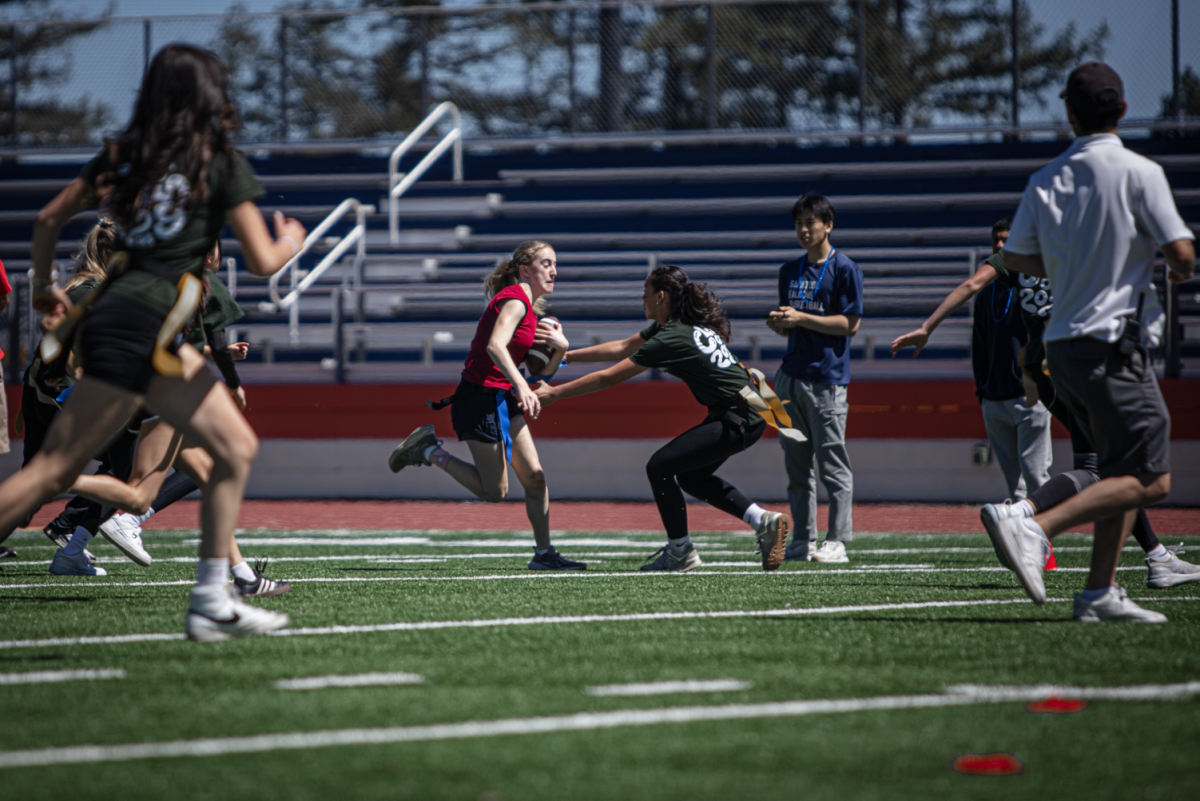

















When athletic trainer Kevin Attard left his position as the school’s athletic trainer early this year for a better opportunity, it marked the second loss of a key athletic department staff member in the past two years.
The same pattern has affected the leadership of the badminton team — two coaches have quit and not returned in the last three years.
Coaching situations in sports like water polo and baseball haven’t been entirely stable either, with some coaches leaving after short tenures. Had it not been for coach Michael Allegretti, who coaches three water polo teams and the swim team, aquatic sports would also be on the recruitment train.
These turnovers highlight a precarious balance of maintaining coaches on a long-term basis, which is a goal of the school’s athletic programs but a hard one to achieve.
Attard, who was hired last spring, resigned after being offered a position as not only the athletic trainer but also a sports medicine teacher at Archbishop Riordan High. Even more enticing was that Riordan was five minutes away from his house — as opposed to SHS, where he was commuting 45 minutes each way.
The athletic trainer before Attard — Caitlin Steiding — who resigned at the end of January last year, was offered a position as a manager at Golden State Orthopedics & Spine. Professionally, it was a promotion and an opportunity she had to take.
“With young coaches or trainers, it’s very unlikely they’re going to retire from Saratoga as a coach,” athletic director Rick Ellis said. “A lot of times they’ll find an opportunity that might be more appealing, and more convenient.”
Challenges for off-campus coaches
Ellis distinguishes between three kinds of coaches: teacher-coaches who teach classes at school, professional coaches who might coach club teams or run academies; and coaches who have other full-time jobs outside of coaching and coach purely out of enjoyment or to give back to the community.
“The school almost always finds itself pulling from these three categories to fill in vacant roles of sports teams,” he said.
Inherently, coaches who come on campus after their day jobs — such as former JV girls and boys tennis coach Neil Jarvis — hold a position where competing responsibilities can easily clash. Jarvis, who works full time as an applications engineer at an electronics company, is also challenged by a long commute time to the school. When work situations become more demanding, being fully present to make practices can be challenging for him.
Jarvis couldn’t return as the coach this year after three years of prior coaching.
“I didn’t feel like I would be able to give the team enough support,” Jarvis said. “I really liked coaching people who were interested in tennis and really wanted to play and be present.”
Additionally, job relocation can become an issue for these off-campus coaches. Last year’s badminton coach Brian Liao moved to Los Angeles when his job relocated there.
Coaches are paid for the work they do each season, but the wages are low and differ by sport and experience; the range runs from $4,000 on the low side to $8,000 on the high side.
Ellis thinks that coaching changes aren’t typically caused by the stipends offered by the district, but rather by life circumstances as well as team dynamics that can discourage them.

Ellis recounted how a particular undisclosed team had significantly subpar participation rates, despite an active and passionate coach trying to help the team reach higher levels. As more and more players skipped practices, the coach, understandably, shifted their effort and time toward another team who was taking the sport seriously rather than the one plainly lacking interest.
This situation sheds light on a broader trend that athletics competes with the school’s academically oriented environment.
Though Los Gatos High athletic director Ken Perotti has seen similar situations when it comes to coaching turnovers, its athletics program faces fewer competing commitments on the part of student athletes.
Comparing SHS to Los Gatos, Ellis said, “One of the things Los Gatos doesn’t deal with that we do is the interesting dynamic of kids not playing junior year because it’s too hard academically, not going in senior year because of college applications.” In general, some coaches at SHS have left the school because of the mixed dedication that some players — whose to-do lists are flooded with the influx of homework and tests — carry to practice. At Los Gatos, coaches have more control over athlete retention rates as players experience less academic emphasis and pressure, paving the way for steady growth and evolution of a team.
Current athletic hiring solutions
Currently, in the absence of a full-time athletic trainer, the athletic department is using Go4, a platform that connects athletic trainers to organizations in search of them. In the middle of the school year when many athletic trainers already have full time jobs, Go4 provides a fitting interim system for SHS.
As Ellis provides schedules of home games in different sports, the organization supplies the school with substitute trainers who are cleared, coming in to help athletes in matches.
In search of new coaches, the first necessity is to receive district permission to post available positions through forms filled by school athletic directors in LGSUHSD. The position first traveled within the district and staff members, before opening up to the broader community through major hiring platforms such as Indeed or Edjoin.
While frequent athletic staff and coaching turnovers may appear concerning on the surface, Ellis said it is often simply a reflection of the realities of high school coaching at most schools — where changing responsibilities and circumstances frequently reshape athletic programs.
The ideal situation, Ellis said, is to find a teacher who holds the role of coach over many years, as has history teacher Mike Davey in his roles as head coach of the boys’ and girls’ basketball teams since the 1990s.
The teacher-coach dynamic is one that not only forges long-term sustainability but also knits tighter chemistry between players and coaches — one that tends to be stronger than what offcampus coaches can provide.
For math teacher Lisa Ginestet-Araki, who is also the assistant coach of girls’ basketball, having students both in the classroom and on the court is beneficial for the team.
“I think having an on-campus coach is the most ideal situation because you get to see your students in a different context and they also get to know you better,” Ginestet-Araki said. “At the same time, logistically, I can check in with them at school, or if there are changes to be made to the gym or setup, I’m already here.”
