











Courtesy of NBC
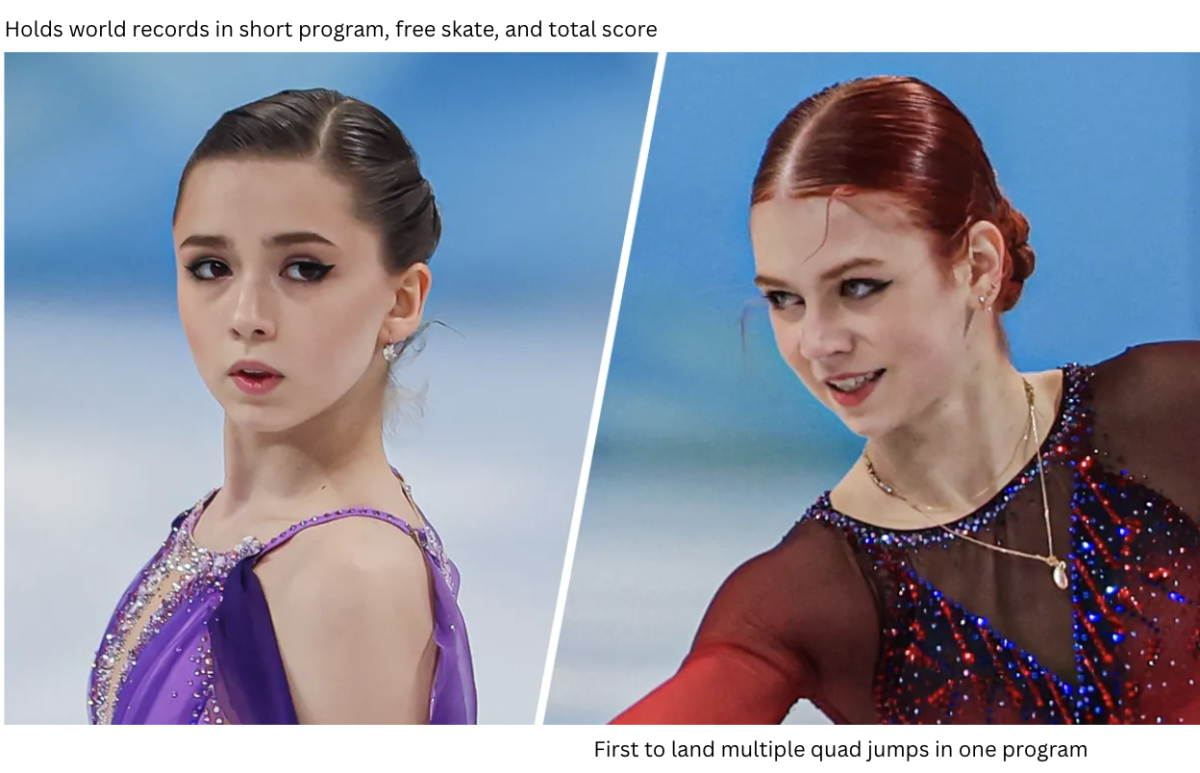
Russian skaters Kamila Valieva (left) and Alexandrea Trusova (right) had high chances of winning gold in the 2026 Olympics, had it not been for the Russian Olympics ban.The Olympic Charter, published in 1908, envisioned sport as a human right, practiced without discrimination and free of the geo-political pressures that so often pit nations against each other.
In reality, though, the Olympic movement has never existed outside of these larger realities. When nations are banned from competition for violating the symbolic “Olympic Truce” — which calls for a ceasefire in global conflicts to ensure the safe passage of athletes and spectators — the ones at the largest loss are not the officials who argue over these decisions, but rather the athletes who have dedicated their lives training for a moment that may last only a few minutes and can vanish through no fault of their own.
In 2023, the International Olympic Committee (IOC) suspended the Russian Olympic Committee (ROC) for incorporating sports organizations in occupied Ukrainian territories, directly violating the Olympic Charter. To quantify the difficulty of having an apolitical Olympic grounding, 590 Ukrainian athletes and coaches have died in the war. Permitting Russian representation in the Olympics while the war continues would have amounted to a profound ethical failure.
But these situations only cover a small history of the games. The Olympics have also long been vulnerable to so-called sportswashing, a process where governments sponsor or host major sporting events to soften their public image and distract from abuses.
Think of the 1936 Games in Berlin. The Nazi regime used the Olympics to portray a peaceful and organized nation to the world, while simultaneously preparing for war and enforcing systemic discrimination against Jews and other minorities at home.
As a whole, to preserve the integrity of sport as a meritocracy — and as the charter’s promised reality of as a human right — individuals should be considered separate from their ties to the country, allowing athletes to compete as independents.
Athletes like figure skaters, with careers peaking in their teen years, see the 4-year Olympic cycle as their only realistic chance at a podium and lifelong success. When a country like Russia is banned, athletes who have had no involvement in military or political decisions see their lifelong dreams extinguished overnight.
There has been some movement in that direction. According to NBC, a total of 13 Russian athletes and seven from Belarus were approved to compete in the 2026 Winter Games despite their home countries being banned. They were not represented by their national identity through team colors, flags or anthems.
They also cannot take part in the opening ceremony athlete parades. Even so, that number is a sharp decrease from the 2022 Beijing Winter Games, where more than 200 Russian athletes competed.
Russia, of course, had already been under Olympic restrictions before the invasion of Ukraine in February 2022. After a state-sponsored doping scandal, Russian athletes were barred from competing under their national flag and anthem, though some were still permitted to participate as neutrals under the label “ROC,” for Russian Olympic Committee, at the 2022 Beijing Games.
At the 2026 Winter Olympics in Milan-Cortina, Italy, 13 Russian athletes competed as “Individual Neutral Athletes” (AIN). The International Olympic Committee (IOC) raised a stricter, individual-only “Neutral” (AIN) status, which restricted Russian athletes from participating in team events such as hockey and team figure skating.
NBC stated that Russian athletes, in order to participate even as neutral candidates, must meet certain criteria. For one, they were allowed only if they have not actively supported the war and have not contracted to the military or state security agencies. Individual neutral athletes also had to be background checked and then approved by each sport’s international federation, and then by a special panel created by the IOC.
This doesn’t take into consideration that a number of Russian athletes train through clubs connected to the army or police. According to the BBC, one of the most famous programs in Russia is the Central Sports Club of the Army, which employs hundreds of coaches while reportedly training more than 10,000 athletes. Even if the athlete personally had nothing to do with politics, those institutional ties could make them ineligible.
And for some Olympic sports, participation is completely gated to those in the wrong country. The international Skating Union banned Russian and Belarusian skaters from its competitions after the invasion of Ukraine. Competitions held by these institutions are often pathways to Olympic qualification; such a strict, non-negotiable blockade is unwarranted against individual athletes who are not involved in the war in any capacity.
Nor do these athletes face pressure from only international organizations — they also have faced condemnation at home. The head of the ROC, Stanislav Pozdnyakov, publicly warned Russian athletes about the consequences of accepting neutral status, saying, “We live in a free state but we strongly recommend that you thoroughly understand the extent and consequences of the personal responsibility assumed” — in regards to taking up neutrality. Some politicians and media figures have gone further, denouncing neutral athletes as “traitors.”
These messages became mainstream through major news agencies such as TASS and RIA Novosti.
With all of the obstacles Russian athletes face in order to compete in the Olympics, the “human right” of sports suddenly becomes a distant dream because they happen to live in a country that has committed international crimes. A better approach is to permit these athletes to claim neutrality without the cumbersome process. That would truly be in the original spirit of the Games.
If the Olympics are meant to honor individual excellence, then they should make room for individuals — even when their governments do not deserve the same grace.
