













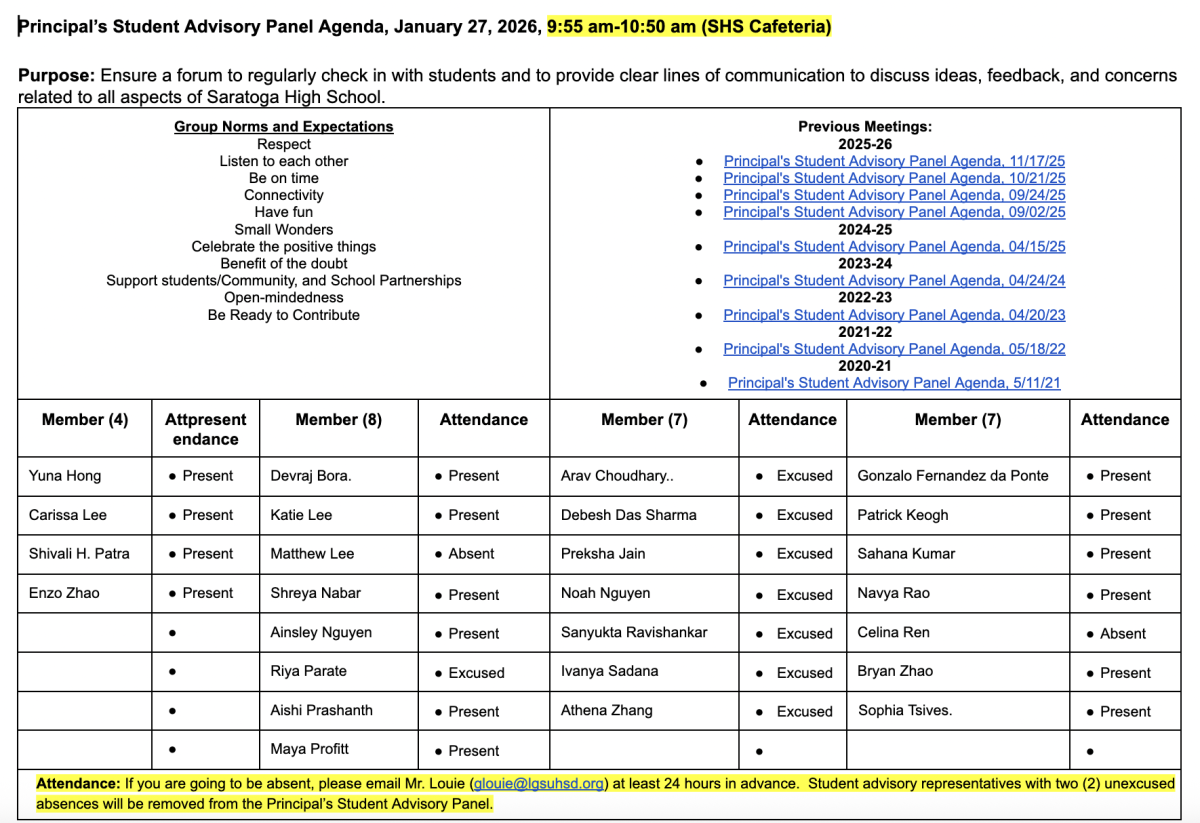
Principal Greg Louie has not been a high school student in decades. That is one of the reasons he relies on a group of 26 students to give him feedback once a month on what it’s like to be a student at the school.
The panel, called the Principal Student Advisory Panel (PSAP), consists of all grade levels, representing a diverse range of clubs and programs. These students, selected by Louie through an application process, aim to improve the quality of life for their peers by lending their thoughts and opinions toward issues in organized discussion.
These students are involved in journalism, robotics, speech and debate and sports, among other activities. They cover topics like the potential standardization of grading processes to the compostable dishware in the cafeteria.
These discussions have also been an important point of reference for SHS’s School Plan for Student Achievement (SPSA), which is a document mandatory for California public schools, outlining their goals for improvement and intended distribution of federal funding.
“The feedback of the students has been very useful when we’re looking at the SPSA and addressing other topics and policies that inevitably should be benefiting our students,” Louie said.
Though the panel may not be well-known on campus, sophomore PSAP member Aishi Prashanth noted that their voice impacts the entire student body.
“The PSAP is making a change in our school community by addressing issues that can be best expressed from a student perspective and finding solutions that will work for the diverse student population,” Prashanth said.
Another area the panel has been focused on this year has been campus maintenance. When students noticed problems in the bathrooms, including broken sinks, toilets and hand dryers, they spoke up during meetings. In fact, panel members have begun to audit bathrooms across campus, testing facilities and documenting any deficiencies or areas of improvement.
So far, bathrooms across campus have undergone maintenance as a direct result of the panel’s feedback, including fixing several broken toilets and sinks in the girls’ locker room.
The panel is in the process of creating a running list of donors to help other school clubs and programs fundraise. From Journalism Donors to restaurants open to collaborating with club fundraisers, the panel aims to make sponsorship for student-run programs more accessible across campus.
Additionally, students are taking action toward pertinent academic concerns. The panel has been pushing for more attention toward SHS-managed tutoring programs in order to support students’ academic pursuits.
“Where there’s more need, things have been adjusted to satisfy those needs. For example, with tutoring services, [we have noted] there needed to be more math tutors” said Riya Parate, a sophomore on the panel.
More improvements toward tutoring service include more advertising for the Falcon Family Peer Tutors, an academic resource they feel more students should be aware of. A new tutoring program, specifically for students taking AP science classes, is also currently in the works. PSAP Vice-Chair Sanyukta Ravishankar is spearheading this initiative, and is in close collaboration with our AP science teachers, aiming to launch the program for the 2026-27 school year.
Through the PSAP, Louie hopes that students learn how to speak up for themselves and causes that are important to them, and to build trust between SHS adult staff and the student body.
“I want to make sure that students understand that it’s not simply my panel. I want students to feel empowered to be able to speak their minds and to be able to push back if necessary,” Louie said. “What makes our school special is our students. And, for that to continue to blossom, we really need the feedback of the students to help inform our staff.”
But the staff and student body are not the only ones who benefit from the panel. Parate noted that joining the panel has given her an open forum to share her thoughts and opinions with her peers, empowering her as a valued member of her school community.
Though sharing opinions aloud with their peers might be intimidating at first, being a PSAP member helps students learn to overcome their fears and build public-speaking skills.
“I think there’s a lot of leadership and independence that comes from it. You sort of have to bring your own ideas to the table and sometimes they’ll get shot down. It builds resistance in that way,” Parate said.
Taking the initiative to speak up, students are growing as young advocates.
The PSAP also allows its students to be more involved with their school community. Prashanth shared that discussions on the PSAP not only brought awareness to campus issues for the rest of her community, but also for her as an individual.
“As a member on the panel, I have gained a lot of skills, like the ability to effectively communicate with my peers. I was able to be more involved in campus issues and learn about our school and its students,” Prashanth said.
