
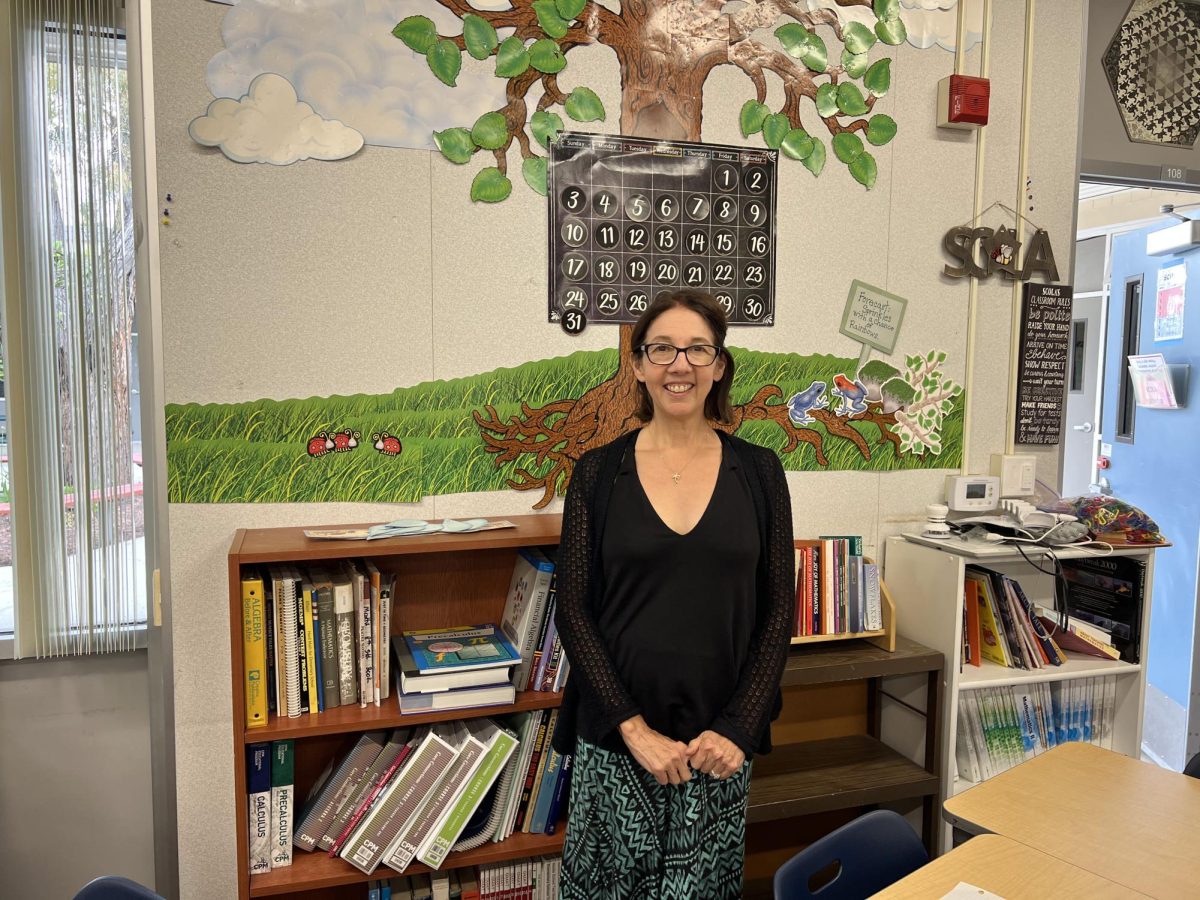









From March 31 to April 1, honors chemistry teacher Kathy Nakamatsu’s room was filled with frantic sophomores and juniors competing to create the perfect, chemistry-fueled “Meal Ready to Eat” or MRE.
In a lab designed to teach real-life applications of thermodynamics, students accurately weighed salts, measured distilled water and stuffed aluminum foil into Ziploc bags to best heat a packet of noodle soup. Typically used in the military, an MRE is a lightweight, portable ration that provides essential nutrition to forces using flameless heating.
The lab was a multi-day engineering challenge in which groups were tasked with designing a chemical meal prep kit capable of raising the temperature of a 30-gram pouch of soup by at least 5 degrees while staying under the 100-gram weight limit.
The project, which took place over four class periods, was implemented for the first time last year as part of the Next Generation Science Standards (NGSS) adopted by the science department in 2024 to foster engineering skills and critical thinking alongside chemistry knowledge.
The 2024 transition to engineering-based labs was also partly because the science department adopted a new textbook, “Zumdahl’s World of Chemistry” by Steven S. Zumdahl. The textbook was specifically selected for its alignment with NGSS standards through its emphasis on modeling, data analysis and immersive labs, teachers said.
According to biology and chemistry teacher Cheryl Lenz, the change was necessary to integrate hands-on engineering projects into honors-level courses to ensure students could apply their knowledge to real-life situations.
Nakamatsu added, “[NGSS] found that students who were graduating from high school could memorize, but when asked to try to really think through a project design, those skills were very weak.”
This year’s iteration of the lab solved significant logistical issues based on student feedback from the previous year. Last spring, students reported that pre-measuring soup and waiting for the lab materials limited their time to conduct multiple trials. In fact, many of last year’s students were only able to finish two trials, even though three were necessary to secure an optimal design.
Not only that, the cold weather in the classrooms caused the starting soup temperatures to fall below 25 degrees Celsius, which was a baseline temperature established by the textbook instructions. To address this issue, the school’s lab technician, Cynthia Cheng, pre-measured 30-gram soup portions for the 2026 lab and stored them in the science building hallway when not in use.
Additionally, instead of Nakamatsu manually weighing salt for each lab group, which took time and forced many lab groups to do only two trials, students were provided with bulk bottles containing 50 grams of salt to manage independently.
The project ultimately functions as a cumulative application of textbook units seven (thermodynamics) and eight (solubility). Students must calculate the enthalpy, the total measurement of energy in a thermodynamic system, of a solution for various salts to determine which chemical reaction will release the most energy — and in turn, heat up the soup the most.

The science faculty plans to meet in the coming weeks to review student feedback and further refine the lab for future years.
“[The MRE lab is] very student-centered and very student-driven,” Nakamatsu said. “It’s really designed to help my students get ready for real life.”
