






Courtesy of Cynthia Cheng
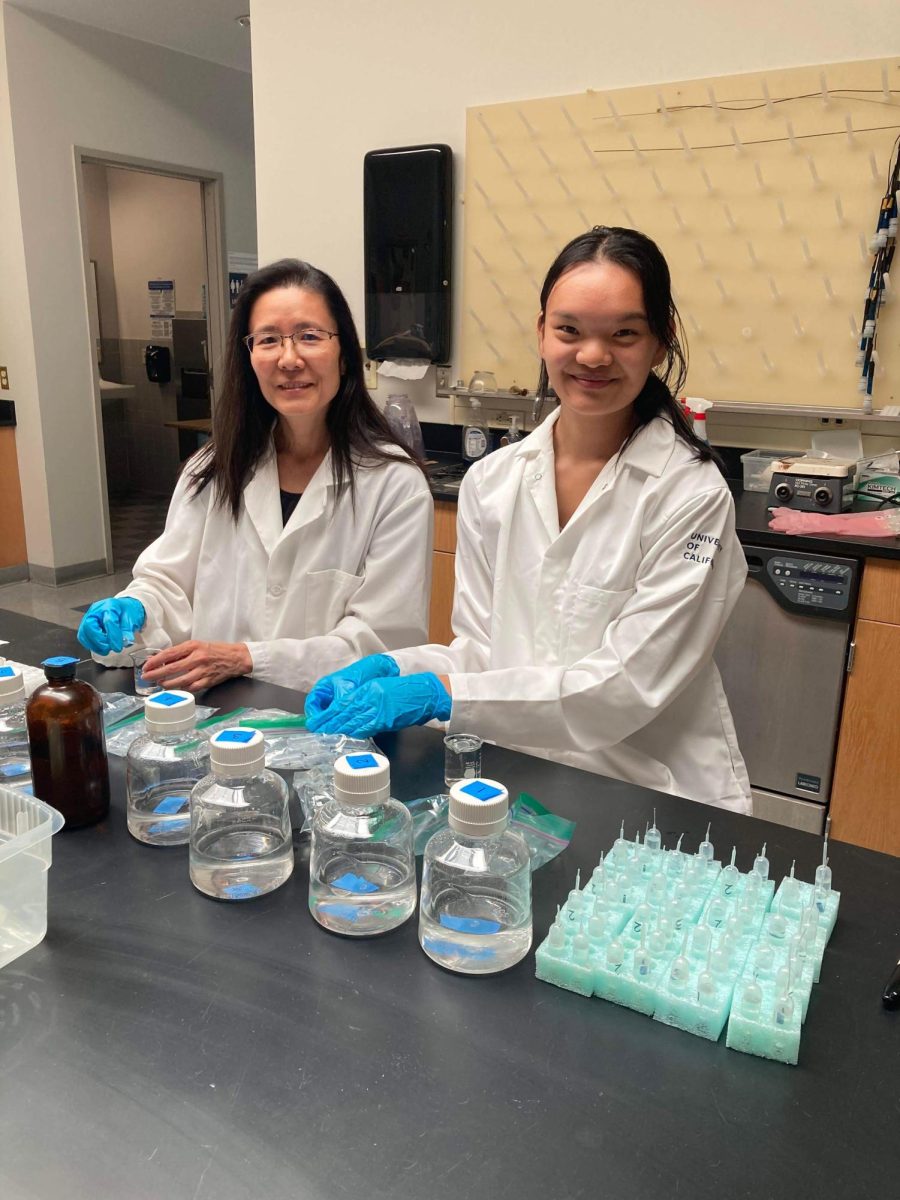
Cheng prepares the Mystery Solution Lab for AP Chemistry with her daughter — class of 24′ alumna Levana Lai in the central storage area of the science wing.When students think about science labs they have done, a few memorable ones come to mind. It could be performing titrations in chemistry, collecting strawberry DNA lab in biology or measuring the speed of sound in physics.
These labs don’t happen on their own and require a large amount of planning and labor to set up. Doing much of this work behind the scenes is lab technician Cynthia Cheng, who holds an instrumental role in the school’s science education.
STEM background and curiosity lead to this role
Some of Cheng’s earliest memories were shaped by the sights and sounds of the lab; both of her parents were scientists working at universities.
“Working in a lab has been a dream for me since childhood,” Cheng said. “The lab has always felt like a home to me.”
In school, Cheng’s favorite subjects were physics and chemistry. The aspects of problem solving and discovery in science was a passion that she developed early on. Her love stems from being able to understand a problem, figure things out and explore new ideas. According to Cheng, she even thinks of making art as part of the problem-solving process — it’s all about creativity and experimentation.
Cheng chose engineering as her first career. She spent 20 years of her professional life as an engineer before stepping away from the profession while two of her daughters — class of ‘24 alumna Levana Lai and class of ‘20 Zerlina Lai — attended local public schools. During this time, Cheng found an opportunity she could not resist: a job posting to be a lab technician for the school’s science classes.
“It felt like everything had come full circle,” Cheng said. “Since then, I’ve been working in my dream job.”
That was 2018. The position — one not fully known by most students — offers a wide range of duties and responsibilities. Her day-to-day tasks almost never look the same, which, she said, keeps the job interesting. On lab days, her morning begins with checking emails or texts for any last-minute changes, as well as checking in with teachers to make sure all materials are set up accurately.
Cheng’s work through the prism of the AP biology pGLO lab
On Friday, Feb. 27, the Falcon had the opportunity to observe Cheng preparing for a lab on pGLO that would occur in AP biology teacher Cheryl Lenz’s classes on March 5. Cheng began her work in 6th period, planning well in advance of the lab’s date.
Before any mixing and crafting, Cheng wiped the tables down with Clorox to prevent any cross contamination with the chemicals she works with. The first step after disinfection involved preparing nutrient agar plates — a “scientific jello” made by boiling nutrient rich Luria Broth medium (LB) with agar powder to create a solid surface for bacteria to grow on.
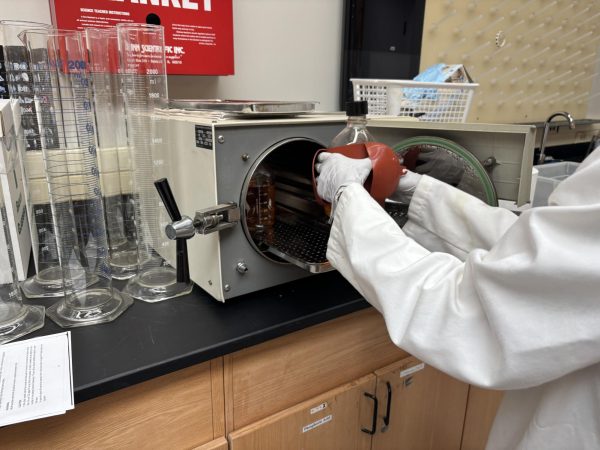
Additionally, another important protocol of genetic work is sterilization through the autoclave machine, which also eliminates all forms of microbial life and chances of contamination. Opening the autoclave door released a hiss of steam, as a wave of heat permeated the nearby atmosphere.
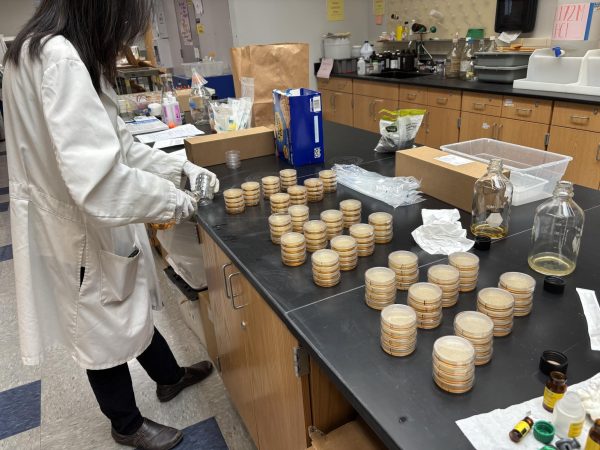
In this lab, there are three different petri dishes: one with LB, one with LB and ampicillin, and LB with both ampicillin and arabinose. Cheng prepared plates for three periods, creating all three groups of plates by mixing substances together with respective labels.
To ensure the substances were perfectly distributed, Cheng used a vortex mixer, which creates rapid vibrations to expedite the dissolution process to achieve a homogeneous mixture.
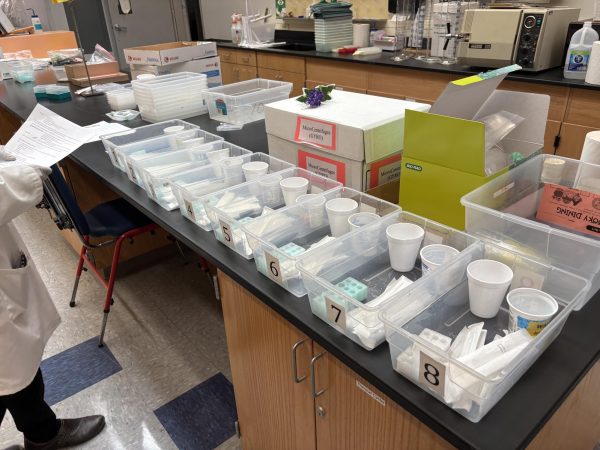
After pouring all the plates, Cheng took the time to clean up: The autoclave machine contains water that needs to be drained and wiped before the next usage. For this lab, she also set up eight bins of materials as each period would be split into eight groups.
Throughout the entire setup, the science hall was thick with an immersive yeasty aroma — the pungent classic scent of LB media.
A couple days before the class, Cheng planned to rehydrate the bacteria used in the lab, prepare aliquot solutions and set up the water bath and incubator. The day following, she prepared the starter plates and student materials, and eventually rehydrated the pGLO plasmid DNA immediately before the lab took place.
“The focused time I spend preparing this lab is about 7–9 hours, but it’s been on my mind for more than a week beforehand,” Cheng said. ”I’m often adjusting the plan as other things come up, while still making sure everything fits within the scheduled time.”
There are three AP Biology classes this year, with eight groups per class and about four students per group. Cheng prepared eight buckets with lab materials and around 120 petri dishes in preparation for the lab.
Cheng’s wide-ranging duties
Throughout the week, Cheng stays on call for anything that may go wrong in science classrooms, with occasional tasks such as refilling reagents, fixing equipment or troubleshooting a lab that isn’t working as intended.
AP chemistry teacher Janny Cahatol said the science department would not run as smoothly without a talented lab tech like Cheng.
“She is so dedicated that she’s often here before class to get ice for me or ensure each detail is in check,” Cahatol said. “Ms. Cheng is an invaluable member to our department — taking care of each of us science teachers almost as if she’s our mom.”
A unique, yet integral aspect of preparation lies in Cheng’s test-runs of upcoming labs, and every cycle of work ends with a thorough clean-up once classes are finished with their activities.
The science hall between classrooms, where she spends her work day, contains a myriad of containers, cabinets and shelves put to good use during this clean-up process; after washing glassware, Cheng puts hundreds of fragile containers and materials back in the exact location where they belong.
For example, Cheng organizes the chemical storage by hazard class — flammables, acids and bases are kept in their own dedicated cabinets to prevent dangerous reactions. After each lab, all of the collected chemical waste is stored until the end of the semester, where it is then disposed of by professional vendors.
Additionally, Cheng orders supplies, tracks inventory and handles reimbursements to make sure science teachers have all the necessary supplies to run the hands-on experiences that cement core concepts for students.
As different science classes vary widely in covered content, Cheng finds it part of her routine to review lab handouts from teachers to fully grasp the essence of the lab. She uses a trusty notebook — which contains notes on how labs went in previous years — to determine what worked well and what needed adjustments for the next time the lab is done. After that, Cheng calculates the total amount of materials needed and organizes all the equipment and supplies for each lab station. The day before the lab, she sets everything up in the classroom.
Despite the immense workload ranging over all grade levels and numerous science classes, Cheng says she usually doesn’t feel much pressure from the job. The only complication results when multiple classes need the same equipment in the same period or on the same day. That’s where planning plays a crucial role: figuring out schedules and setups ahead of time usually solves the problem.
The hardest part of keeping labs running smoothly is when equipment malfunctions or experiments in some groups aren’t working in the middle of a lab, especially when a class is already in progress.
“There’s a lot of satisfaction when the problem is solved. And if it’s not, we all learn a different lesson — sometimes, life just doesn’t go as planned,” Cheng said.
Throughout the school year, she also makes shopping trips to nearby stores to purchase materials. At the end of spring semester, Cheng’s work continues — she disinfects and washes every single pair of safety goggles for the next group of students when the year starts. Even snacks — often used in science experiments like calorimetry — must be carefully chosen, as their size and shape can affect how a lab is conducted.
As yet another aspect of her full circle, fixing broken equipment ties Cheng’s current technician role back to her engineering background, turning the typically tedious process into one of her personal favorites. A final unique task is keeping the Scantron — a machine-readable bubbling form used for multiple-choice tests — in check, and ready for the influx of tests flowing from every corner of the science wing.
If all of this work weren’t enough, Cheng’s duties aren’t just in the science department. She also serves as a textbook technician, opening the textbook room during tutorial, lunch, 7th period and for scheduled English novel pickups by teacher request.
She said these time slots must be factored into her planning for science lab preparation. While sometimes they are not the most convenient for her, Cheng has been able to work around them.
Besides being able to work in a job she loves, another factor pulls Cheng into the environment and keeps her motivated year after year, she said — the tight-knit, hard-working science teachers she serves.
“The incredible community within our science department is what I enjoy the most,” Cheng said. “It is a privilege to work with a team of teachers who care so deeply about one another and their students.”
Cheng also sees within the lab a way to tie back to her core academic principle — one that reminds her of her own days as a student.
“I also love watching the students in all the stages of learning,” Cheng said. “While it’s great when things finally click, I actually enjoy it most when students are confused, puzzled and thinking deeply about a problem. That’s where the real learning happens.”
