








Courtesy of Anya Vora
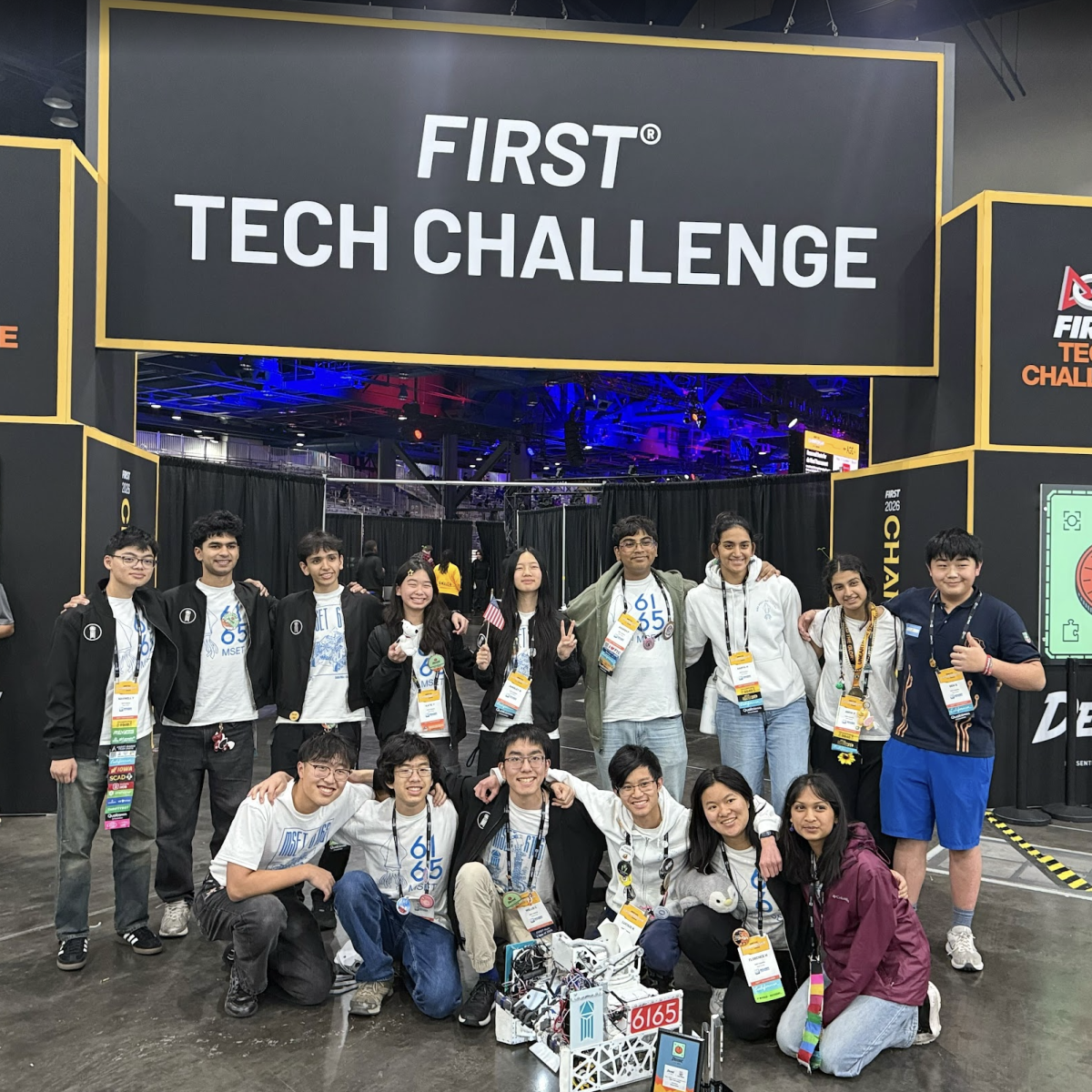
The team poses in front of the entrance to the World Championship arena.At 3 a.m. on April 26, MSET Cuttlefish team members dragged themselves out of bed to drive to San Jose International airport, catching a flight to the FIRST Championship in Houston, Texas. They returned May 2 with the Connect Award. The team was also ranked No. 32 worldwide.
MSET Cuttlefish is the veteran FIRST Tech Challenge (FTC) robotics team and consists of 15 members, including sophomores Ainsley Nguyen and Sehuj Nirman; juniors Ben Guo, Aanya Hotha, Renisha Mandal, Adarsh Peruvemba, Alan Rong, Vedant Sinha, Maxwell Tham, Anya Vora and Katie Yang; and seniors Willis Chung, Florence Hu, Lucius Ko and Eric Woo-Shem. Superintendent Heath Rocha traveled to Houston to watch the team compete along with team mentors and parents who include Anh Quan Nguyen, Payal Vora, Mary Ko, Surya Hotha, Harvinder Mundh, Elliot Shem and Ida Woo.
The team qualified for the FIRST Championships on March 2 for its performance as a Division Semifinalist at the NorCal Regional Tournament.
This year’s game, called “DECODE,” challenged teams to create a robot that can shoot 5-inch plastic balls into a goal 3 feet off the ground. This season was particularly special because FTC had not had a shooter game since the 2020 season game: “ULTIMATE GOAL.” Since “ULTIMATE GOAL” most games have been of the pickand-place variety, where robots pick up an object and deposit it in another location.
Technical issues present difficult hurdles to navigate
During the qualification matches, the team won its first game by over 100 points and narrowly won its second game by 6 points. However, the robot experienced several disconnection issues after its second match — during these periods of time the robot would not be able to move or execute any of the functions it was constructed to do. These issues persisted for the rest of the competition leading the Cuttlefish robot to be nonfunctional on the field during parts of matches.
“When the disconnection issues occurred, it was honestly an interesting problem to try to fix,” said Tham, a software member. “We had never seen anything like it before and in that sense it was fun since we stayed up late to try and fix it.”Because of these disconnect issues, members weren’t able to perform at the level that they had expected to.
The team ended up in No. 32 position in their division due to these difficulties and was selected as a second pick from the 3rd seed alliance for divisional elimination rounds, playing two matches before being eliminated. Team 30030 Exodus who performed in the same division as the Cuttlefish took home the championship.
The Cuttlefish takes home the Connect Award
On top of robot games, teams are awarded for outreach to their community and robot design, with the most prestigious accolade being the Inspire Award. The Cuttlefish have received the Inspire award twice in the last five years. The team received the Judges Choice Award last year.
The awards are given based on a 10-minute presentation and Q&A with judges, essentially an elevator pitch. Teams talk about their hardware, software and outreach. Later they can speak to additional pit judges who can come if they are interested in the team based on the presentation judge’s notes. The team received sets of pit judges who asked them about outreach and ended up winning the Connect Award — awarded for connecting with the team’s community.
“I’m proud of our team for receiving the Connect Award because it recognizes part of the team’s accomplishments at the world level,” Vora said. “I also now feel extremely motivated to aim for a more prestigious award, such as the Inspire Award, next year, which would recognize the full scope of our team’s accomplishments.”
Teams also often prepare more elaborate “pits” or places to put up their posters and tables and produce different types of merch. Compared to a regular qualification, where there is only a table, World championships offer 10-by-10 areas to prop up posters. Many teams use shelves, tables and decorations with LED lights, posters and curtains.
The Cuttlefish brought multiple pins with their team number, keychains and stickers to give to other teams. Since over 60 countries are represented at the World Championships, teams also had the chance to make extensive connections with other cultures. Many teams wear traditional clothing or give out flags representing their native country.
“At Worlds I talked to a team from Argentina in Spanish […] I learned a lot about their culture, like the fact that they’re actually still in winter because they’re south of the equator,” Guo said. “It’s really cool to me how we were able to connect our cultures from such different corners of the world.”
For the first time in FTC history, FIRST — the organization that created FTC — revealed next year’s game element and season theme. The gamemakers announced the release of a small ball called a pollen that robots would need to pick up off the floor. In addition they announced that the new name for the game would be “Bio Buzz.”
Although the Cuttlefish’s efforts at the tournament were plagued with technical issues this year, they left Houston feeling proud of their outreach efforts and hopeful for next season.
“Overall, I feel like this year’s performance was a big learning experience more than anything,” Tham said. “There were a lot of things we could have done better and a lot of bad decisions that were made, but I think that will only just help us become better next year.”

