














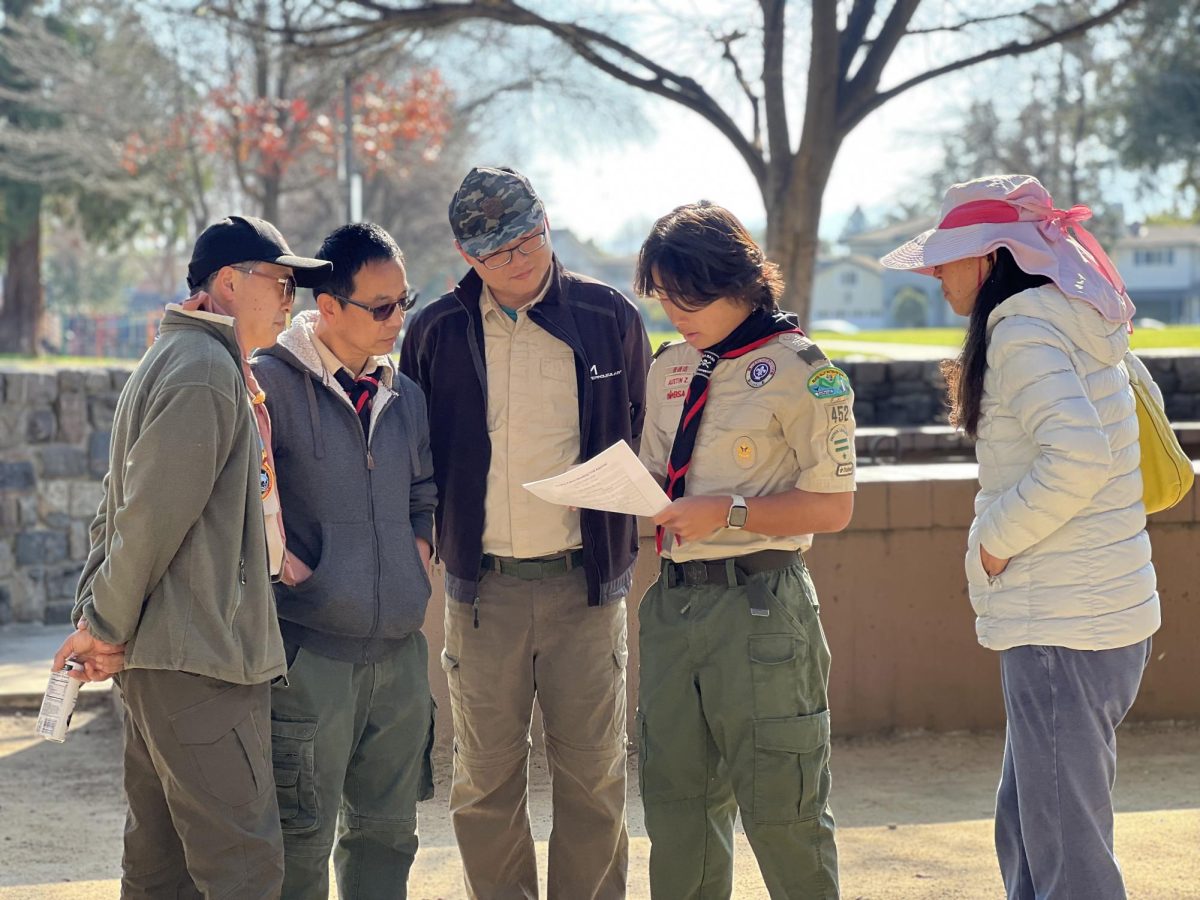
Courtesy of Austin Zhao
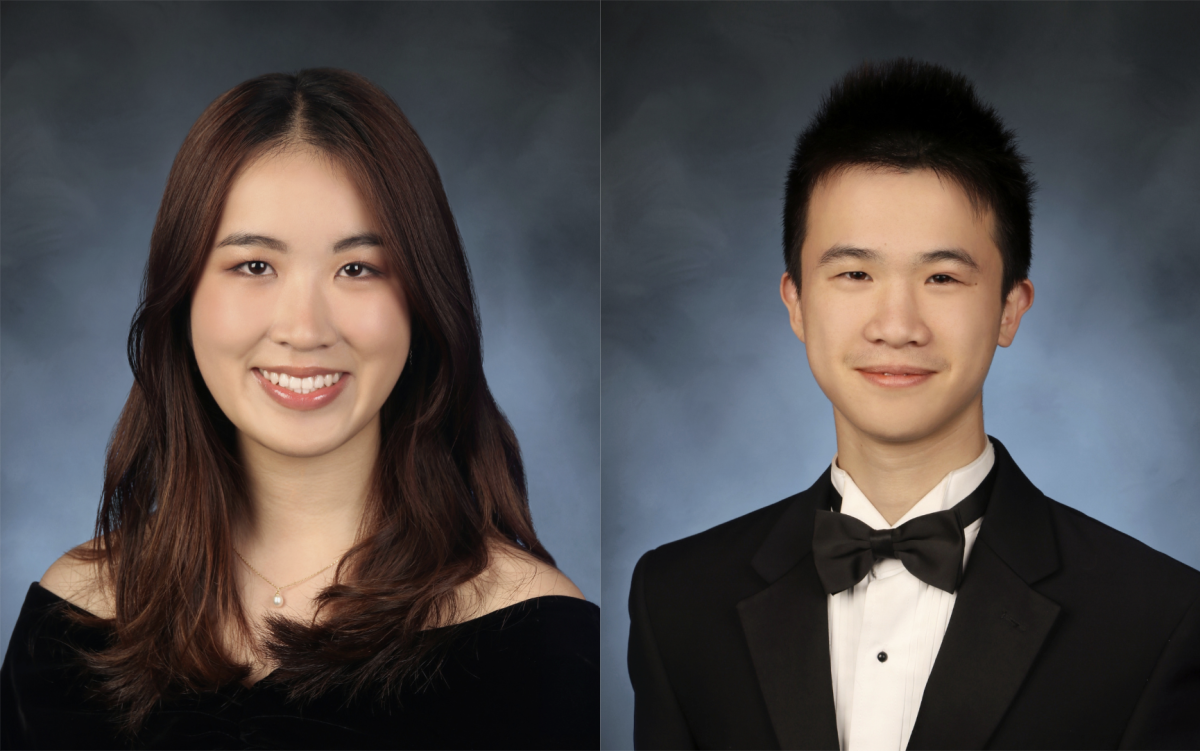
Sophomore Austin Zhao recaps the Boy Scouts introductory patrol meeting to his members’ parents“There was once a / version of me that burned brighter,” sophomore Austin Zhao wrote in his poem “Calibrated to Burn.” His piece is a golden shovel poem, a poetic form where the final word of each line is taken from a preexisting text. Using a line from Ted Kooser’s poem “After years,” Zhao documented the impossible standards he felt while attending The Harker School, a private school in San Jose, as a freshman.
This year, Zhao transferred to SHS.
Zhao moved to the U.S. from Shenzhen, China, in fourth grade and spent his middle school years in Los Angeles before moving to the Bay Area for his parents’ work after graduating from middle school. Zhao said he transferred to SHS this year to seek a more balanced and sustainable environment. The biggest difference is that SHS provides more time for Zhao to invest in activities he cares about instead of just keeping up with an intense school workload.
“Switching helped me realize that what matters isn’t just how rigorous something is, but whether it fits how you want to live and grow,” Zhao said.
Zhao said that even though SHS feels similar in terms of having academically motivated students, it has less of a competitive environment than at Harker.
The process to enroll in Harker is highly tedious and expensive. Parents have to submit a $100 application for their child, make their child take the Harker SSAT (Secondary School Admission Test), a standardized entrance exam for students applying to private schools and finally conduct a final interview with the school administrators. Once accepted, parents finish enrollment by paying a hefty fee of $45,000 to over $66,000 annually.
While Zhao was at Harker, he saw how students often face high competition and pressure because of the school’s main focus on STEM subjects, top-tier academic resources and a Silicon Valley location that drives high ambition.
While Zhao maintains a rigorous academic schedule here as well, his primary motivation for transferring was for its wider variety of non-STEM subjects. Unlike the STEM fields Harker emphasizes, Zhao actually found civic engagement interesting because he had a habit of noticing systematic problems and building practical solutions. To prepare himself for his future, he’s currently self-studying in AP U.S. Government and Politics alongside his current high school courses.
For example, while serving in his Boy Scouts Troop 452, Zhao saw that scattered communication via email and text led to low meeting attendance. To resolve that issue, Zhao built a centralized website to organize event information. This website provides a more organized announcement board for Troop 452, ensuring that members are clearly informed about meetings. Since its installation, Zhao has increased the average number of meeting attendees from five to 10.
“I am drawn to civic government because it allows me to solve similar problems on a larger scale and help more people,” Zhao said.
This problem-solving mindset translates into his leadership in Ignite, a summer program that teaches middle and elementary school students life skills like managing money, leadership and career exploration. Zhao is one of the co-founders of Ignite, along with sophomores Michael Zhao and Elaine Che (the writer of this story).
Originally founded as a Hackclub nonprofit and supported by Hackclub’s fiscal sponsorship, Ignite finally became an independent program after it was not approved by ASB for school club status.
“We want to help students avoid the same roadblocks I had to figure out on my own,” Zhao said. “Through Ignite, we provide a structured way to learn how to communicate and lead effectively before reaching college or the workforce.”
Outside of Ignite and Boy Scouts, Zhao is pursuing multiple hobbies relating to the humanities. Zhao shoots creative photography, using his camera as a “second memory” bank to preserve his precious moments in vivid scenes. He also enjoys caving and diving, immersing himself in a variety of different activities.
In the many activities he chooses to pursue, his favorite is writing. Since middle school, Zhao has been writing poetry. Most of his poems are crafted late at night when his room is quiet, and he has time to think without distraction.
Zhao’s pieces don’t start with an “idea,” but rather a cryptic thought that he had trouble figuring out throughout the day. By writing, he allows himself to slow down and actually understand his feelings.
Most of Zhao’s poems actually stem from physical details, such as the furniture in a room, the characteristics of an object, or the sensory imagery of a moment. After jotting down a personal moment, Zhao expands from here as he tries to unfurl his complex thoughts.
Even with more than 25 pieces, Zhao doesn’t want to write for an audience right now. Since his poems are personal, he wants to keep developing his narrative and eventually share it more seriously through publications and ultimately, the world.
Regardless of the professional path he chooses, the different hobbies he has and the school switch from Harker to SHS, Zhao remains focused on the fundamental goal of giving back to the community around him.
“I want to make the world a better place. Sometimes that is all you can do, and it is still worth doing,” Zhao said.
