



While watching a news segment about Fiji’s agriculture being impacted by climate change and rising ocean levels, sophomore Shreya Nabar gained inspiration for her Synopsys Science Fair project. The news detailed how crops on a Fiji island were dying due to high salinity and importing fresh food from other countries was too costly.
Merging her interests of biology and plant science with a goal of combatting this issue, Nabar created her science fair project centered around using methyl donors to increase plant salinity tolerance.
Nabar was one of the eight Saratoga High students recognized at the Synopsys Science Fair, an annual regional science convention held in San Jose in early March.
Other awardees were freshman Alvin Shen who won Honorable Mention; sophomores Elaine Che, Fiona Liu and Leqi Jia, who won Exceptional Project, Exceptional Merit and Honorable Mention awards, respectively; junior Mikul Rana who won Honorable Mention; and juniors Mason Cheng, Alicia Huang and Ellis Yang, who won 2nd place Awards.
SHS’s Advanced Science Research club (ASR-C) has been helping aspiring students develop projects since 2022. After the phasing out of Los Gatos High’s ASR class, both SHS and Los Gatos created clubs to support students participating in the science fair. This year, 27 SHS ASR-C members attended the fair, with 21 research project submissions.
The science research process spans a full year before culminating at the Synopsys Science Fair. Though it was extremely time consuming because of the long process of plant growth, Nabar found her results to be meaningful after months of research.
“[It was] a pretty rewarding experience since I worked on my project for so long. I learned a lot about how precise and how well-planned you have to be to explore very hands-on research,” Nabar said.
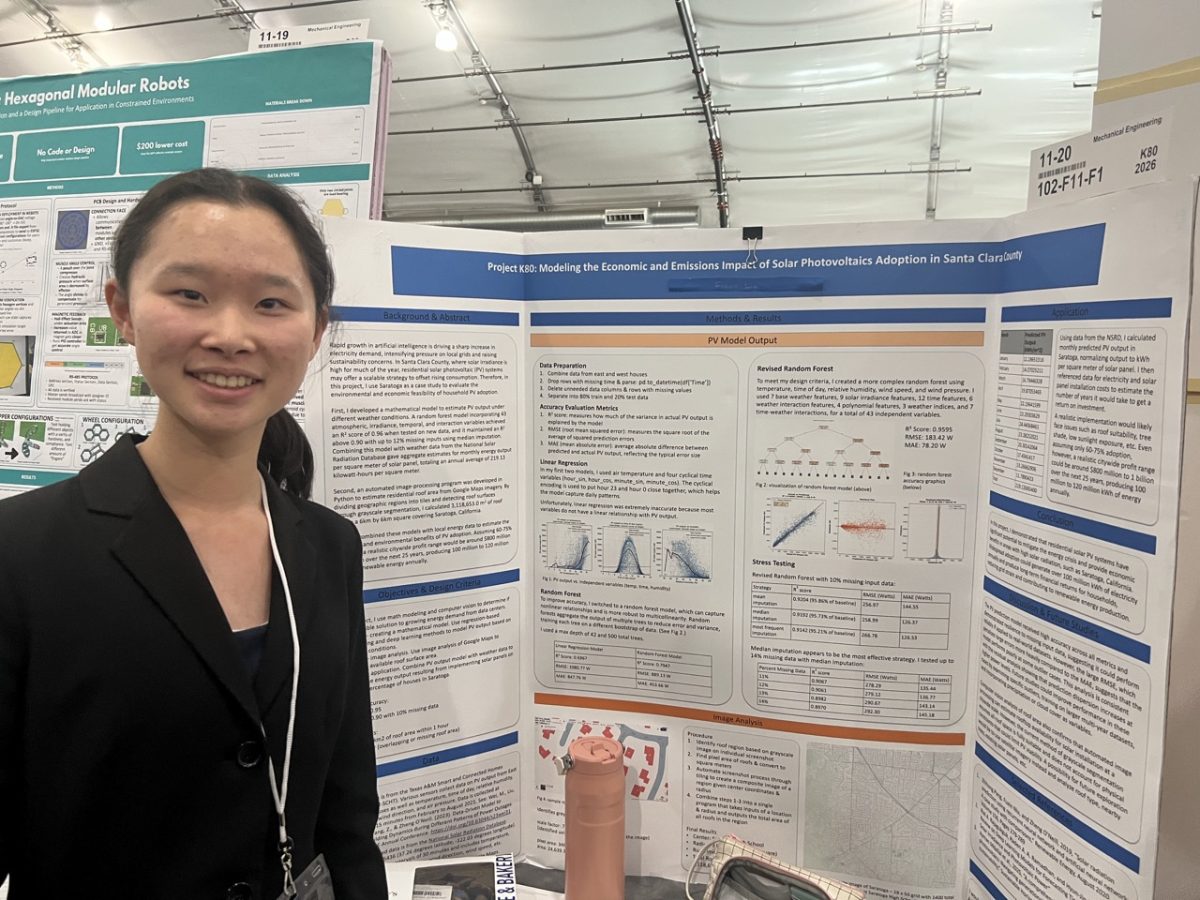
Liu’s project was inspired by AI emergence in Silicon Valley, and the potential use of solar energy to alleviate local power grid strain caused by the increasing number of AI data centers. In addition to the Exceptional Project award, Liu’s project also earned a SPV Market Research sponsor award — a recognition of the project’s aim to improve humanity and innovative work. Sponsor awards are given by private company representatives who attend the fair.
For first-time fair participants like Liu, sharing research with peers and judges was a meaningful experience that taught her the significance of scientific research applications to the world.
Said Liu: “I was surprised to learn I won a sponsor award, but it was validating to know my research area had relevance to current societal problems. Winning sponsor recognition made my project even more meaningful because it showed me that the work I did could have impacts beyond theoretical results.”
Speaking with professionals in the solar panel industry provided her with new knowledge and guidance on ways to deepen her research project. After hearing valuable feedback from judges, Liu was inspired to continue her work and submit to Synopsys again next year.
Liu said winning a sponsor award makes her project feel more meaningful because of the research’s potential for greater impact in the world.
“All the judges seemed genuinely interested in the projects being presented, and having the opportunity to participate in an event that required so much coordination and volunteer effort deepened my appreciation for living in an area where youth interest in STEM is so enthusiastically supported,” Liu said.
Club adviser Jennifer Lee was especially proud of the implementation of a cohort system by this year’s club officers, where officers split club members into groups based on their project topics and each officer monitored one group. This system greatly streamlined the project editing process and improved communication between club members. Overall, Lee felt that this year’s science fair season was very successful, with many members conducting meaningful and in-depth research.
“I was really impressed with how well everything went. ASR-C is tricky because [everyone’s] projects are different, driven by [each] student’s interests. So, we don’t have enough time to mentor [each] project closely,” Lee said. “But even given limitations to how much time we can spend together, I think all the groups had some really cool outcomes.”
