
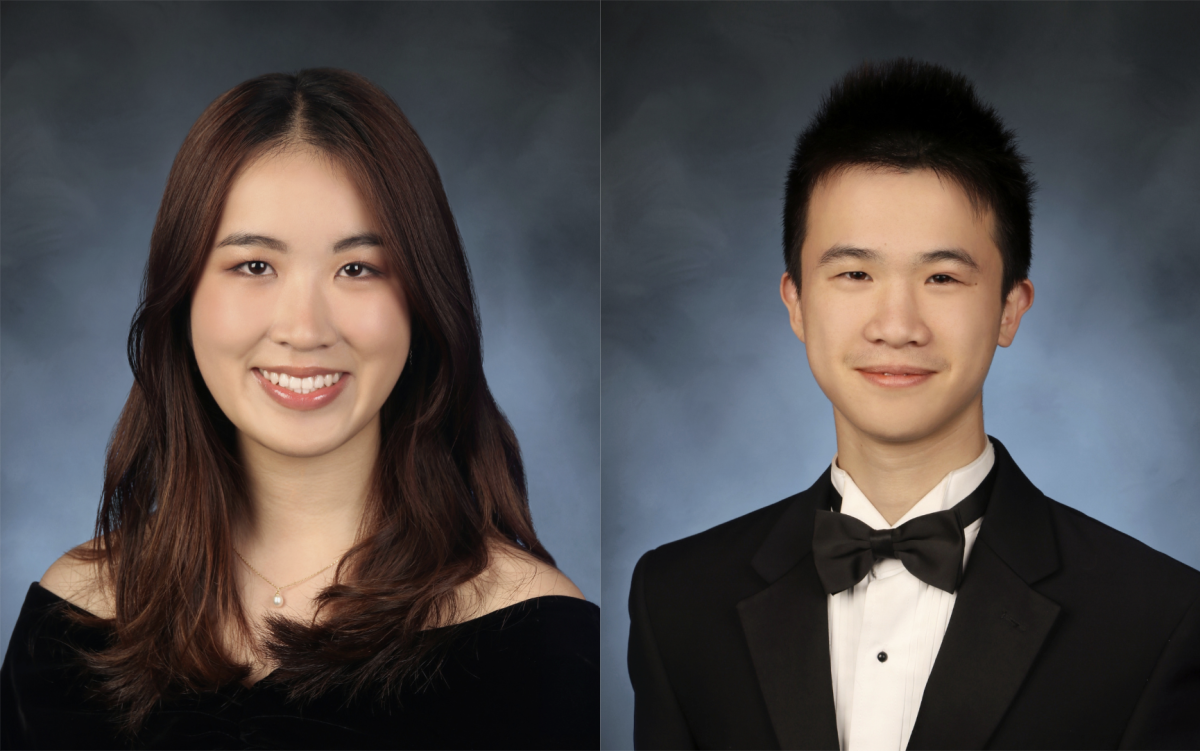




On June 5, 2025, the 293 members of the Class of ‘25 flipped their tassels and officially entered the next chapter of their lives as high school graduates. Now, nearing the end of the second semester in college, some of the freshmen have not only accustomed themselves to different environments outside the Saratoga “bubble,” but have also explored exciting paths as college life has taken shape.
Skyler Mao navigates the halls of MIT
As Saratoga High only has an enrollment of around 1,200 students, adjusting to the larger campus of the Massachusetts Institute of Technology (MIT), with an average student body of 12,000, was a large step for Skyler Mao. Mao, who is majoring in mathematics and computer science, said his assignment to a dorm helped him get used to the dynamics of attending a bigger school.
“You see the people in your dorm almost every day,” he said. “Splitting people up into smaller communities really helps you develop social circles and friends. It’s all very connected.”
He has also seen the academic structure shift from the tight, rigid style of high school classes to the freedom that college provides and many different courses for students to choose from. MIT offers 2,000 courses.
Similarly, MIT has more than 450 extracurricular opportunities, allowing students like Mao to pursue passions they began in high school. Mao, a participant in Science Bowl and math competitions in high school, has been writing problems for the Harvard-MIT Mathematics Tournament (HMMT) and the MIT Science Bowl, another competition that he competed in during high school.
At MIT, Mao said he continues to follow the mindset he set for himself at SHS: “At the end of the day, just be yourself. Do the things you want to do and set your own goals and aspirations and work towards them.”
Timothy Leung finds a home in the residential community of Yale
For Yale freshman Timothy Leung, who is majoring in psychology and computer science, the transition to a larger population of students was eased by the university’s unusual residential college system. The residential halls house the 1,600-person freshman class in smaller groups for all four years. Despite being initially intimidated by a bigger campus, he has been finding ways to navigate it.
“In high school, you basically know everybody. Here, you’ll know people through other people,” Leung said.
Leung credits his teachers for giving him college prep skills like critical thinking, though the format of learning changed when he arrived in college.
“AP Lit and English 11 Honors really helped me learn how to formulate a good paper,” Leung said. “[High school] walks you through the material more, whereas in college, you’re kind of expected to learn it on your own. Some of my classes only meet twice a week or three times a week, and so a lot of the learning is done asynchronously.”
Even Leung’s extracurriculars have taken on an even more professional edge. As a former editor-in-chief of SHS’s yearbook, he now works as a designer for the Yale Daily News, which covers stories daily online and has two print editions per week (Tuesday and Friday). Leung also participates in a range of other activities: He competes on the mock trial team and even traveled as far as China to perform with a student-funded a cappella group. To help support his lifestyle and pay his tuition, Leung coaches speech and debate online and works as a Yale campus tour guide.
Rylee Stanton transitions from the MAP to the film sets of NYU
For NYU student Rylee Stanton, who is majoring in film and TV production at NYU’s Tisch School of the Arts, the freedom of college course selections meant finally being able to narrow her focus to what she loved most in high school: the arts and film.
As a former student in the Media Arts Program (MAP) and a prominent member of the school’s drama program, Stanton has seen how the shift that comes with a specialized college curriculum has enabled her to go past general education requirements and spend her days doing screenwriting, performing and editing clips for projects.
“The workload is definitely more, but the work is a lot more fun in my eyes because it’s all stuff that I want to do,” Stanton said.
To support herself in Manhattan while honing her skills, Stanton also works with business founders to create launch videos for Bay Area tech startups. She also plans to work as an intern full-time over the summer.
By drawing on the foundation she gained from MAP, Stanton has been able to navigate the pressures of a high-stakes environment at a prestigious film school with the confidence she developed at SHS.
Tarun Ramakrishnan aspires to do scientific research at UT Austin
As a high school student, alum Tarun Ramakrishnan, who is majoring in neuroscience, aspired to create an impact at the intersections of health and technology. At the University of Texas at Austin, he has been able to work toward that goal through two organizations: Engineering World Health, where he worked on the proposal and implementation for a medical device, and Longhorn Neurotech, where he learned neuroimaging by building and designing projects like prosthetic hands.
A major part of Ramakrishnan’s SHS experience was being in the choir. Ramakrishnan loved singing and wanted to explore the fusion between Indian music and Western music, an experience he was able to get in college as a member of an Indian a cappella group. The ensemble travels around the country and has become a strong source of community for Ramakrishnan.
“In January and February, we flew out to Ohio State to go compete against UT Dallas, UC Davis and different schools from around the country,” Ramakrishnan said. “It’s been a long-term commitment: we rehearse Monday, Wednesday and Sunday for two hours each week, but it’s been a great experience and because I’m surrounded by great singers, it has pushed me to get better.”
Whether it’s Mao at MIT grabbing a late-night snack, Leung taking a two-hour train ride to New York for a hot-pot friend reunion, Stanton filming on the streets of Manhattan or Ramakrishnan enjoying a Texas Longhorn football game, the Class of ‘25 has found ways to adapt to their new college environments while finding unique opportunities for themselves.
“I feel really grateful to Toga for helping me shape myself into the young adult that I am,” Leung said. “Toga has made me a person who can take risks and at the same time take on college with open arms, so my time in high school will always hold a special place in my heart.”

