










Courtesy of Mathematical Association of America
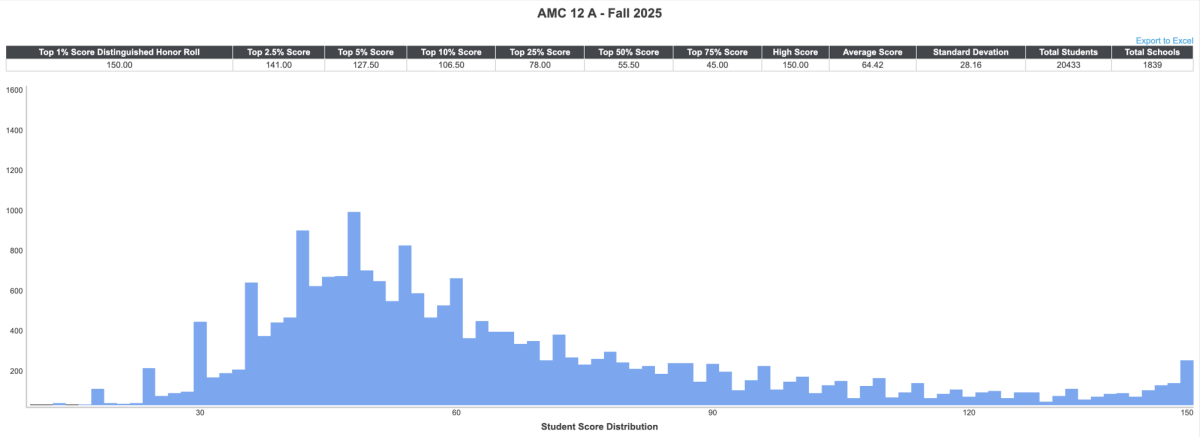
This year’s AMC 12A score distribution saw a big spike of perfect scores in comparison to previous years — which many have attributed to higher cheating rates.Achieving success in Olympiads such as the USA Math Olympiad (USAMO) and the USA Coding Olympiad (USACO) is seen as a big accomplishment, often recognized by colleges and universities and set as a lifelong goal for thousands of teens. However, many of these accomplishments are now being undermined by cheating, which has become much more prevalent with the rise of AI and online answers.
To deliver the tests for the American Mathematics Competition (AMC), the Mathematical Association of America (MAA) sends digital copies of the test in advance for administrators to print and scan. This creates a window of opportunity for test leaks, such as a particularly devastating one three years ago. In fact, there has been an extensive history of test leaks, with the majority of the AMC 10 and 12 in the past five years leaked to some extent.
Of course, cheating can also happen simply by friends giving the answers to another friend taking the test later.
The cheating on this year’s AMC 12A in particular was quite alarming. Normally, only around 50 participants achieve a perfect score of 150 points. However, on this year’s AMC 12A, there were around 300 people scoring this perfect score — a 600% increase. This was likely because of cheating rather than the test being easy, since the perfect score was a clear spike in the data; other score distributions remained roughly the same.
This has also caused the Distinguished Honor Roll, an award given to the top 1% of participants, to be the perfect score, something that has angered many mathletes.
Cheating also drives up other cutoffs such as the qualification for the American Invitational Mathematics Examination (AIME), leaving non-cheating students at a disadvantage.
Cheating is arguably an even bigger issue in the USACO. Since the contest is held online without any restrictions, participants can very easily access AI and cheat. Of course, AI does well on test questions: ChatGPT’s GPT-5 model can solve almost 70% of all USACO problems accurately.
USACO has made many efforts to reduce cheating, such as requiring starting in the first 15-30 minutes of the contest for a “certified score,” prompt injections to catch AI and also establishing MOSS (Measure of Software Similarity) systems to catch people copying code. However, determined cheaters can still get around even these measures.
As a result, cutoffs for USACO were inflated due to many cheaters gaming the algorithm, putting the integrity of the test at high risk.
What is to be done about all these issues?
One solution is to ramp up test question security — leaks should be rare and taken seriously. To cut down on leaking, tests can be administered at the same time for everyone, with multiple versions of the test if necessary.
Another idea is to start in-person proctoring for USACO. Doing so would allow students’ device use to be monitored, preventing students from using AI or getting test leaks from others.
Whatever the means of reducing cheating, the need for it is clear and urgent.