











Courtesy of Sophie Poon
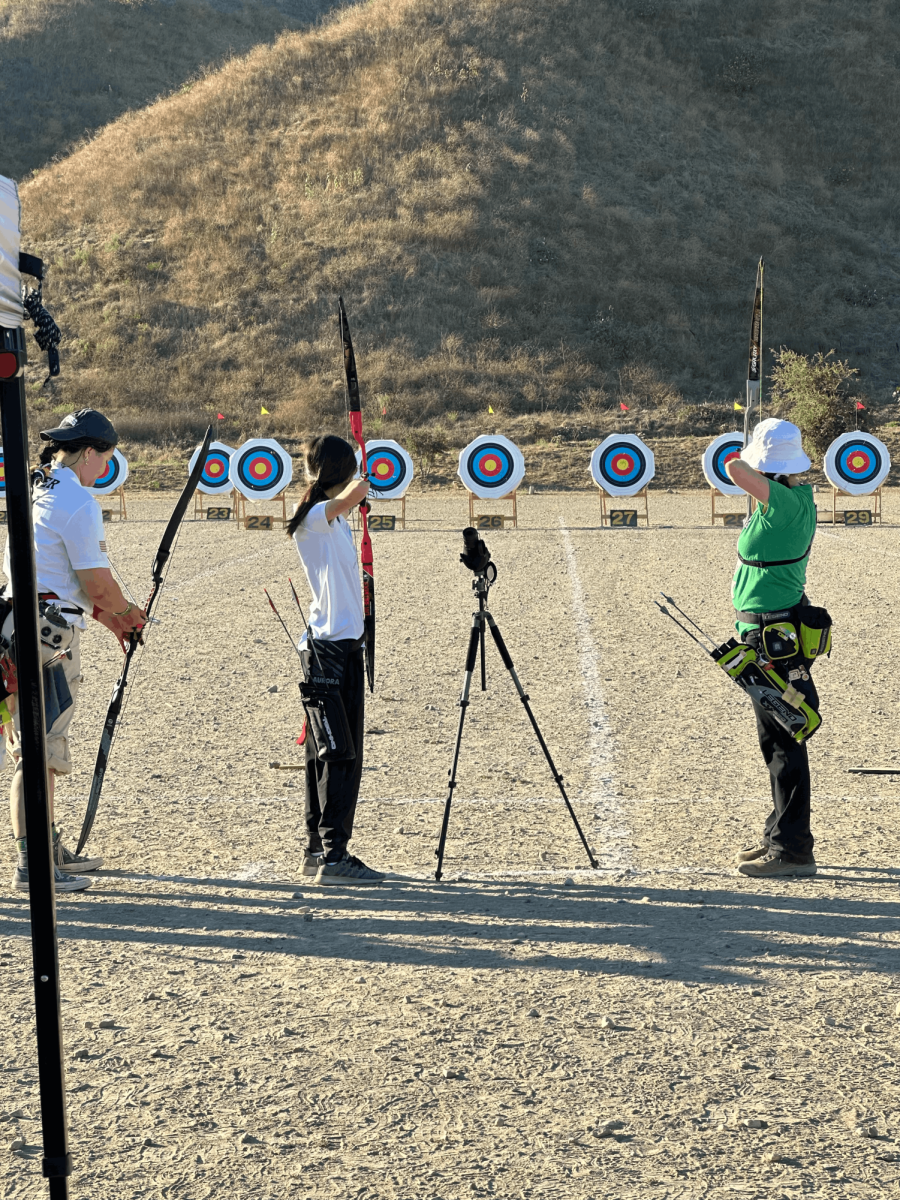
Poon (center) competes at the California State Outdoor Championships in 2024.For about four hours every week, junior Sophie Poon stands laser-focused at the in Black Mountain Bowmen archery shooting range, eyes locked on the target and her bowstring pulled taut. Sometimes her bow wavers, but she always perseveres.
Since seventh grade, Poon has been doing archery competitively on the state level after attending an archery summer camp at the California Archery Center. Two years ago, Poon moved to the Invictus Legion Club in Santa Teresa. By 2024, she was ranked No. 1 in California for her age group — a level she hopes to return to in the months and years ahead.
As she became more competitive in the sport, she always enjoyed each tournament, where she began to see familiar faces and fell in love with archery as a sports community.
“It’s just fun, going through the shot (and feeling) the satisfaction when it hits the target,” she said. “And when you compete, you start to see the same people at every competition. You get to talk to the people around you; everyone is really nice and it’s just a really cool community.”
But after suffering a shoulder injury last year, Poon found herself struggling with another issue: target panic, a common anxiety disorder in archery that hinders shot execution. It manifests itself in inconsistent aiming, rushing shots or flinching.
Poon suspects that the injury, likely caused by slightly improper technique that built up over the years, had subconsciously altered her technique to put less strain on her shoulder while also discouraging practicing, since it always made her shoulder hurt. Combined with the mental stress to maintain good shots, target panic was a natural but unfortunate road block in her development.
In a sport where precision — the consistency and repeatability of shots — is of utmost importance, target panic prevents athletes from getting good groupings.
“I think archery is a very mental sport. (With target panic), I get in my own head, and then I release before I’m ready,” Poon said.
As a result, she has been unable to compete in most tournaments since last year. Still, she continues to put the work in to recover and get back on track.
“(When I’m shooting), it feels like, ‘I have to shoot and it has to be good’ or whatever, which stresses me out, and then it doesn’t shoot right,” Poon said. “I’ve been working a lot with my coach, trying different things to reroute my brain from this path that it’s been on.”
Following one technique to avoid releasing too early or too late, Poon has also been switching from barebow archery, which relies solely on instinctive aiming and muscle memory, to trying out compound archery, a style of archery involving pulleys, cams and cables that mechanically releases the shot and also significantly decreases the strength needed to fully draw the bow. Unlike barebow archery, compound shooting allows for cleaner shots and prevents early releases, countering possible inaccuracies caused by target panic.
Since practicing with only one target and distance can increase pressure and anxiety over hitting the bullseye, Poon has been practicing a more varied set of distances and angles to avoid this negative feedback loop. Instead of outdoor shooting, which has farther targets — usually around 50 or 60 meters — she has also been shooting in indoor ranges with small targets 20 meters away.
Poon emphasizes that focusing more on the process instead of the product has helped her stay more relaxed. Still, she admits that growing out of target panic has proven to be a long, especially arduous process — and she sometimes becomes discouraged.
“I realized I much prefer practicing at a range with other people than when I’m practicing on my own, because it feels a lot less lonely and sad,” she said. “I think it’s also really easy for me to be really hard on myself about target panic because it’s been happening for so long. But I think recently it has been slowly getting better.”
Poon is aiming to move past target panic and start consistently competing at tournaments again, with the goal of being nationally ranked. In addition, she hopes to earn an archery coaching certification and continue archery as a hobby throughout life.
“Even though I’ve been struggling with target panic for so long, I still love the sport so much, and I don’t want to give up,” Poon said.
