

















Courtesy of Matthew Hahn
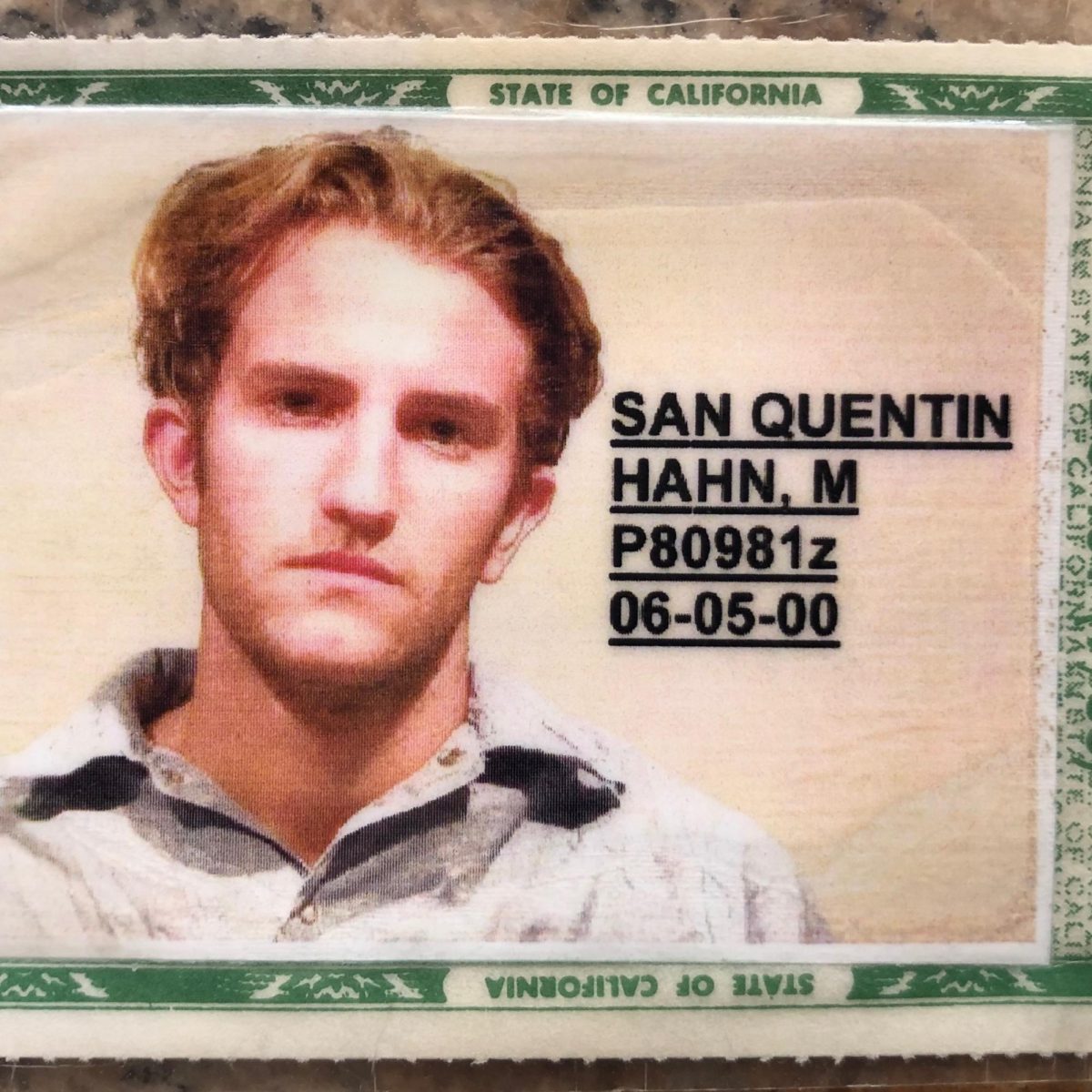
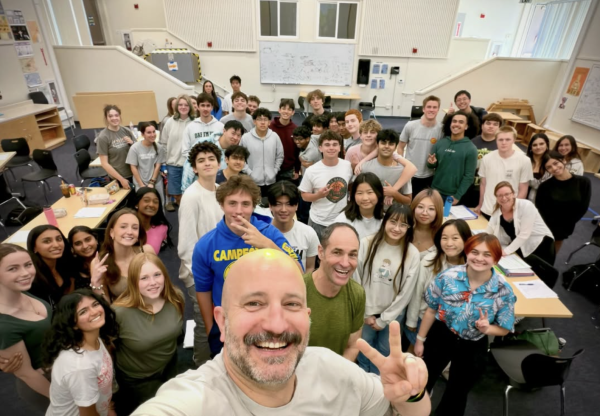
Hahn’s first prison ID.On March 16, a 46-year-old former student named Matthew Hahn stood on the small stage inside the Media Arts Annex. He faced a room of students not much younger than he had been when his life began to unravel as a junior and senior here in the mid-’90s. Some giggled with their friends, others tapped their feet anxiously, waiting for the lunch bell. But the moment Hahn opened his mouth to tell his harrowing life story, all fell quiet.
For the past 15 years, longtime history teacher Mike Davey has invited Hahn, a former felon who has spent more than a decade in prison, to speak to the juniors in his Media Arts Program classes.
The talk is one students say they will never forget — a tale of crime, addiction and redemption through a life-saving moral choice that Hahn made when he was at his lowest point.
Struggle with drug use
Hahn, born in 1980, had what he described as a “normal ‘80s childhood.” He lived in Saratoga, attending Foothill Elementary and Redwood Middle School.
Hahn’s parents, both employees at Hewlett-Packard, chose to send him to Bellarmine College Preparatory School, an elite San Jose private high school. He was a student there for two years — until he was expelled.
Hahn described himself as “a bit of a partier” throughout his teenage years, a tendency that worsened with time.
In 1996, Hahn and four of his friends were attending a dance at another private school, Presentation High, when one of them was caught smoking a cigarette indoors.
He and Hahn were thrown out of the party.
When they returned later to pick up the rest of their friends, the dean of Presentation saw them and reported the infraction to the headmaster of Bellarmine.
While deciding how to punish Hahn and his friends, it was revealed that they had been drinking earlier in the day. So, Hahn was expelled from Bellarmine and started attending SHS as a junior.
“It’s funny, because it might be the only time in my life that I got in trouble and didn’t deserve it,” Hahn said. “But it was also a pivotal moment for me.”

Courtesy of Matthew Hahn
Hahn’s sophomore school picture from Bellarmine.
Before his expulsion, Hahn had always considered himself “a good student” — albeit one with a rebellious streak. He even entertained aspirations of becoming a biologist in his future.
But with the sudden transition to SHS coupled with his parents’ separation, Hahn’s once-rebellious antics took a sharp turn into drug use and, eventually, criminality.
Like many teenagers in the ‘90s, Hahn drank alcohol and smoked recreationally. At the start of his senior year, though, Hahn also began using something far worse: methamphetamine, a highly addictive substance that is a felony to possess or sell according to the California Health and Safety Code. He said he first started using it because he had contracted mononucleosis and had to miss the first six weeks of his senior year.
“When I came back, I had chronic fatigue syndrome. I couldn’t stay awake and I had a hard time catching up with everything I had missed,” Hahn said. “So, as silly as it sounds, I initially bought the meth to study.”
His continued use of the drug had life-changing implications.
Having potential, living a lie
At the time, Hahn was one of Davey’s students.
“I remember my first impression of him: he was funny, but I also knew he wasn’t going to do any classwork,” Davey said. “I knew that he was going to be a project for me.”
Hahn was a bright student and obviously eager to learn, Davey said. Hahn participated in class, and while he misbehaved — turning in careless class assignments and constantly missing work — it was never anything dangerous.
“He just wanted to shock us,” Davey said. “And as a teacher, I was like, ‘I’m not going to be shocked.’”
The following year, Davey even offered Hahn a position as his teaching assistant, hoping that their day-to-day contact might influence him to go in a positive direction.
However, Hahn remained chronically absent, and three months into his senior year, he dropped out.
“I was just heartbroken,” Davey said. “I could tell that he was a good kid at heart, and that he just needed more guidance. In some ways, it felt like my fault too. And when he dropped out, I felt like I had also failed.”
While his teachers and his parents were aware of his spiraling behavior, no one was able to effectively help him with his troubles.
“I wasn’t receptive to help,” Hahn said. “I was angry, combative and scary because I was so erratic. The way meth affected me, I got delusional, paranoid and started having hallucinations. And if [my parents] had really drawn a hard line, I would’ve just left.”
To reassure his family, Hahn secured a General Education Diploma (GED) early in 1998 and enrolled at West Valley College. But his continued drug use made school nearly impossible, so he dropped out a month after enrolling.
Around the same time as his brief stint at West Valley, Hahn began stealing from houses in the Saratoga-Los Gatos community to fund his drug habit.
He started by taking tools from abandoned construction sites at night. Then, he stole from open garages and then he began stealing from empty, unlocked houses. Each boundary he crossed only made the next one feel less severe. Eventually, stealing became “an addiction unto itself.”
Still, Hahn thought his teenage rebellion would only be a small detour in an otherwise successful life for a Saratoga kid.
“Nobody ever thinks that their current actions are going to define the rest of their life,” Hahn said. “And so I think a part of me didn’t actually believe these things were that dangerous.”
Hahn also called his reckless actions a product of privilege. Growing up as a white man in a community as wealthy as Saratoga — where the median household income was $86,674, more than double the national average at the time — Hahn never saw anyone overdose or get arrested. So, he wrote off any warnings as rules that didn’t apply to him.
First arrest leads to prison
Hahn was arrested for residential burglary on Feb. 19, 1999. He was 18. He was arrested in his house, and Hahn’s father was the only family member to see him taken away by deputies.
“I saw my dad, and I just remember feeling shame. I can only imagine what the shock was like [for my mother and sister] at home,” Hahn said. “That’s how it is for people with drug addiction. We cause a lot of harm, and we cause a lot of pain, but very rarely are we around to see it.”
With evidence stacked against him, Hahn was unable to present a viable defense in court and ended up taking a plea deal to serve five years. Of that, he served a total of two years — split between a drug recovery facility, San Quentin State Prison and the California Rehabilitation Center. He was released on parole in August 2001.
For a few years, he stayed out of trouble and fared well. He held down a job as a barista, went back to school and amassed his general education credits at De Anza College.
Deep down, though, Hahn knew that his recovery wasn’t going to stick.
“Getting sober just felt like something I had to do to please others,” he said. “I was convinced that my problem was the hard drugs. So as long as I was staying away from cocaine and meth, I figured it was fine to drink and smoke pot.”
Hahn was still surrounded by a crowd that was using drugs, leaving him vulnerable to relapse. During this time, one of Hahn’s close childhood friends took his own life.
“A death that close to me, and in such a violent way, was just something I didn’t have the capacity to cope with at the time,” Hahn said.
Two months later, he started using meth again.
Succumbing to his old addictions, Hahn fell into a months-long binge of drug use and theft. He had fallen fully into his old life.
February 2005: the moment that changed his life
The houses lining Los Gatos’s Wedgewood Avenue lay dormant in sleep.
Hahn and a fellow user — both looking for a motorcycle that the house had been rumored to have — approached the property, careful not to disturb the soft-pitch night. The lights were off, and inside, the residents were fast asleep.
The pair began searching for the bike, and not finding it, they turned to leave, starting back down the driveway.
To their left was a small cottage, almost invisible against the night. Except in the minutes between their arrival and their decision to leave, the door had opened and the lights had turned on. Someone had woken up and left the cottage.
A safe was sitting on the floor of the now-empty cottage. Hahn grabbed it before slipping away from the property and melting back into the night.
Later, sitting in his house, Hahn opened the safe. Inside were a set of soiled diapers as well as photographs, paperwork, a gun and an SD card.
Connecting the SD card to his laptop, he was able to access photos on it.
At first, he didn’t know what he was looking at. He clicked to the next picture, and the next, his stomach “roiling with disgust” at the contents. There were dozens of images of a man — later identified as John “Robbie” Robertson Aitken, then 21 years old — molesting an 18-month-old girl.
Hahn struggles with what to do with the safe
Though Hahn knew he had to take action about the contents of the safe, he was initially unsure exactly what he should do. He felt he couldn’t simply call 911 and hand over the evidence of this heinous sex crime without implicating himself in its theft. With his prior record, Hahn would’ve faced life in prison — in accordance with California’s 1994 Three Strikes Law.
Hahn’s accomplice, whose identity he has chosen not to reveal, wanted nothing to do with turning in the photos, but Hahn couldn’t bring himself to ignore them, feeling that if he did, he, too, would be complicit in an even worse crime.
“I thought back to a conversation I had had with a former inmate,” Hahn said. “We were talking about snitches, and I asked him ‘what happens if you discover someone doing a sex crime?’ He said, ‘there ain’t no such thing as snitching when it comes to those crimes.’ So that morning, I thought to myself, ‘this isn’t snitching, I’m just protecting someone.’”
So Hahn placed the SD chip in a coin purse, along with Aitken’s address, and a note that read “please remove this animal from the streets,” before mailing that package to the local police station.
Aitken was arrested about a week after Hahn sent the package.
Only years later, after reading the grand jury testimony of Aitken’s case, did Hahn realize what a coincidence the entire theft had truly been. Aitken had woken up in the middle of night, thirsty, and had made a quick trip to the main house — his parent’s house — for a drink. He watched through the kitchen window as Hahn stole the safe and ran off into the night.
“What’s really hard for me to wrap my brain around is that if I’d hit one more stoplight, I would never have found that safe, and I wouldn’t be talking about this at all,” Hahn said.
Hahn faces his second prison sentence
Six weeks later, Hahn was arrested for burglary after a stolen item he resold on eBay was traced back to him. This was his third strike, and he faced 400 years to life if found guilty — a much longer sentence than Aitken faced as a first-time offender.
The district attorney responsible for Aitken’s case approached Hahn, who was in the middle of his own trial, to ask him to secure the chain of custody for the images on the SD card. If Hahn agreed, he would no longer be able to present a viable defense and would be at the mercy of the courts.
Hahn’s attorney advised him not to give up his life.
But Hahn knew that “the only right thing to do” was to tell the police that he was the one to give them Aitken, effectively relinquishing his opportunity to go to trial.
While the district attorney responsible for Aikten’s case was unable to offer Hahn a plea bargain for his help, she did leak his story to the Mercury News, generating public support for a reduced sentence. Davey and SHS History teacher Kirk Abe also sent letters to the district attorney in charge of Hahn’s case, standing up in favor of his character.
Hahn ultimately pled guilty to six of his 16 total charges, and after the media publicized his situation, he was granted a plea sentence of 14 years, which he took. This time, he was determined never again to return to prison.
Hahn works toward a better future in prison
Over the course of his two arrests, Hahn’s first attorney, Steve Cougill, became like “a father figure” for him — and in the midst of his second trial Cougill confronted Hahn about his future.
“This arrest isn’t like your first term, where you’ll serve a year or two and go back home,” Cougill told Hahn. “You are going to be gone a long time, and prison will be your home. However you come out is dependent upon what you do now.”
Cougill passed away from a heart attack six months into Hahn’s trial, and those words stuck with Hahn, prompting him to take action for his future self. Hahn hired another attorney, Alan Schwartz, for the remainder of the trial and sentencing process.
Just like his descent into drug use and crime was never defined by one singular moment, neither was Hahn’s recovery from it.
Rather, it was a long series of choices spanning more than a decade — a gradual effort of trying to make a better life for himself. He split his time between DVI Tracy, Folsom State Prison, the Sierra Conservation Center and Fire Camp — where he worked as a volunteer firefighter.
“When I wasn’t sentenced to life in prison, I felt like I was living on borrowed time,” Hahn said. “I figured that my life was so bad that it couldn’t get any worse, so the worst thing that could happen if I tried getting better was nothing.”
So he tried.
Hahn joined a 12-step recovery program and got sober for the first time since high school.
Davey also reached out to him, mailing him letters and books.
“I could see his healing through the letters,” Davey said. “Part of it was that he was sober, but his perspective also shifted in prison. He was already a thoughtful person, but I could tell he had grown a lot more reflective about his life — in ways that I’m still not today.”
They communicated for years as pen-pals, developing a true kinship as both men navigated difficult periods in their lives. Davey still has many of Hahn’s letters saved in his house, more than 20 years after their correspondence began, and he even officiated Hahn’s wedding in 2015.
“It was just a human connection,” Davey said. “It wasn’t a one-way exchange; he genuinely had really insightful things to say. I was also going through a hard time, and neither of us were where we expected to be in our lives, and so our communication meant a lot to me, too.”
In prison, Hahn also rediscovered his love for learning, devouring every book sent to him by Davey, and enrolling in distance learning courses at Ohio University.

Courtesy of Matthew Hahn
Hahn poses with his mother outside of Folsom State Prison in 2007.

Courtesy of Matthew Hahn
Hahn (left) works as a volunteer firefighter.
After seven years in prison, Hahn secures a stable and successful life
Hahn was paroled and returned home on Feb. 14, 2012, a new man.
He soon gained admission as a transfer student at UC Berkeley. Though he was still on parole, he commuted to Berkeley and graduated as a 4.0 student with a bachelor’s degree in anthropology in 2013. It was then that he also met his future wife.
Despite having his diploma, finding work in his field as a former felon proved nearly impossible, so Hahn pivoted and joined the San Mateo branch of the International Brotherhood of Electrical Workers (IBEW). There, he worked as an apprentice electrician and then became a journeyman, and he now serves as a member of the San Mateo IBEW executive board.
Hahn also founded Recovery Dharma, a drug rehabilitation program centered around mindfulness and Buddhist beliefs.
Aitken was released from prison in 2022.
Courtesy of Matthew Hahn
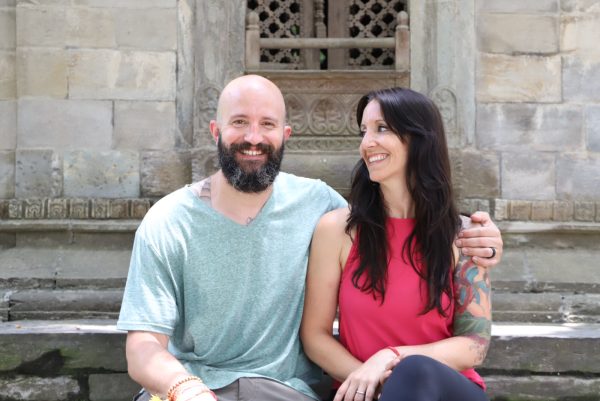
Hahn and his wife Noell travelled to Nepal in 2019.
Making a difference, making amends
Davey invited Hahn to speak to his class for the first time in 2012, only a couple of months after Hahn’s release from prison.
“I knew it’d be hard for him,” Davey said. “Being in front of a large audience like that was not an easy thing for him, at the start, especially. But I still wanted to ask him, and he ended up agreeing.”
Over the past 14 years, Hahn has worked to build a successful life for himself and leave his previous life far behind. He has done podcasts about his life’s journey and opened up to an audience far larger than a single classroom. He’s even working on releasing a book about his experience within the American prison system. At Davey’s behest, he returns every year to the school to speak to the next batch of MAP juniors.
“He has such a unique perspective,” Davey said. “In an environment like SHS, where students put so much pressure on themselves not to fail, Hahn is a person who’s failed over and over again, and is still a role model in many ways. I want students to build that empathy — not only for him, but also for themselves.”
Even today, Hahn’s greatest regret is the harm he has caused to others as a young man.
“My entire life was my choice,” he said. “There were unfair things that happened to me, but it didn’t mean I had free license to completely obliterate my life and harm everyone around me.
“I love my life now, and I wouldn’t have it any other way, but I know that I will be working for the rest of my life to try and reduce the suffering in this world in any small way I can.”
Courtesy of Matthew Hahn
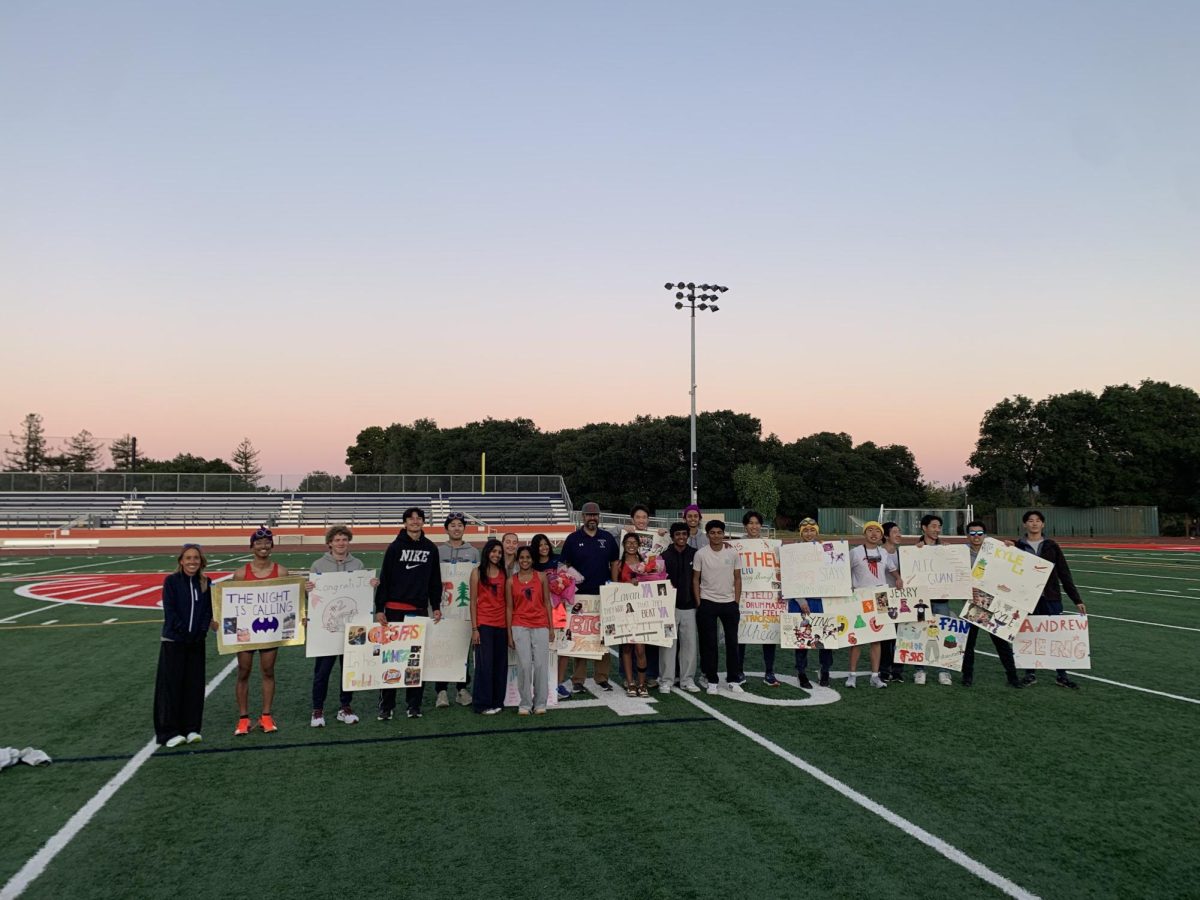
The entire class of MAP juniors take a picture with Hahn at the end of his talk.
