









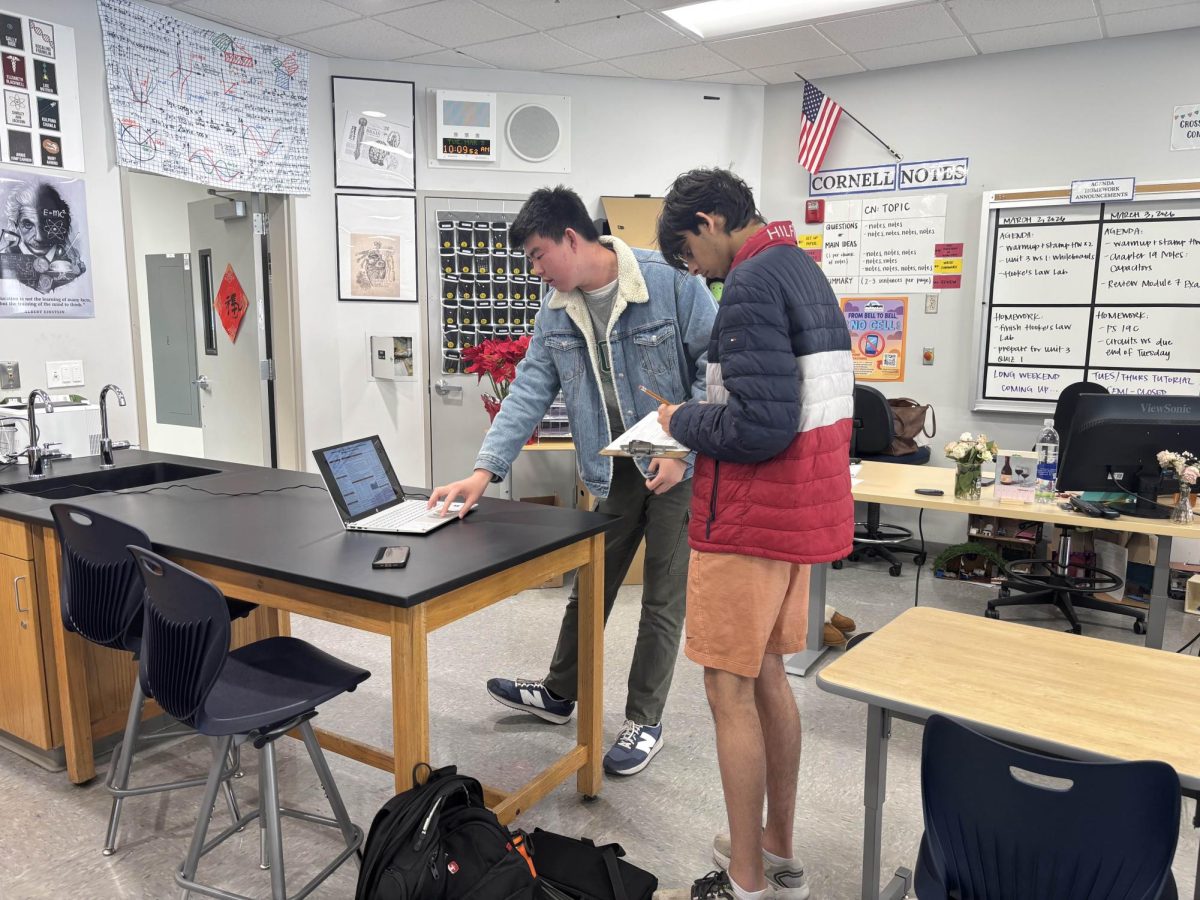
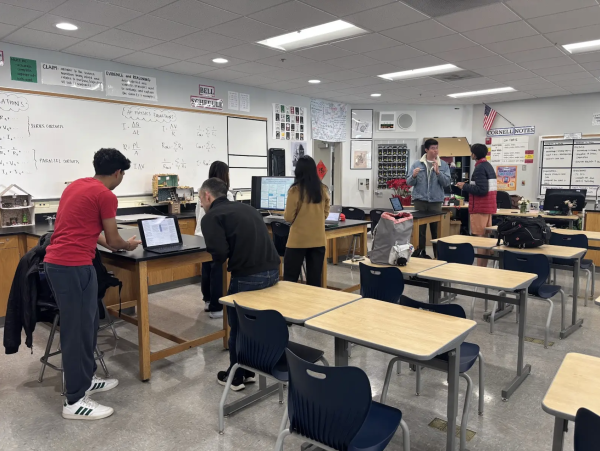
Room 1021 was packed on March 3 and 5 with students stationed at each lab table, standing over their posters and computers. Members of the Advanced Science Research Continuation (ASR-C) Club simulated a mock run-through of the Synopsys science fair that was later held on March 10.
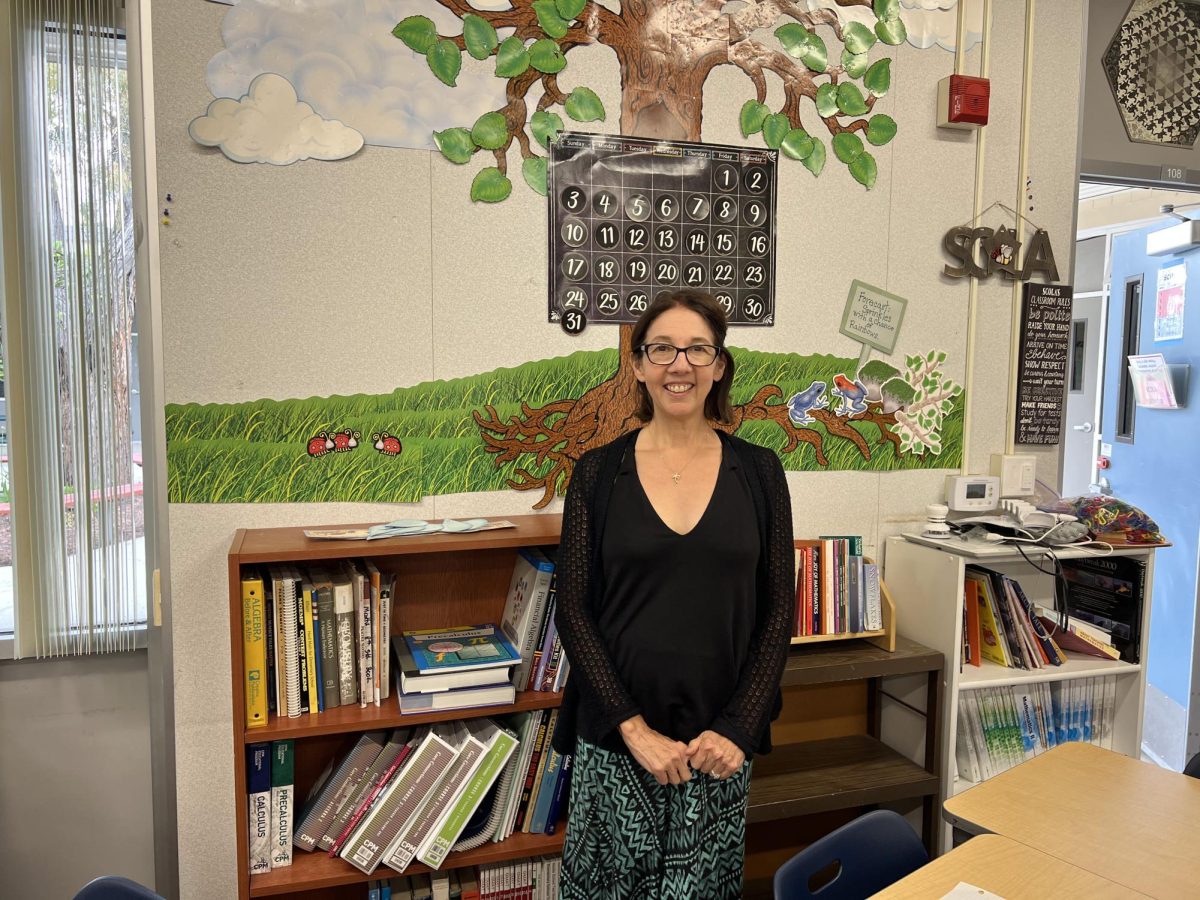
Science teacher Jennifer Lee has been the adviser to the club for three years. The club’s officers include seniors Ella Li, Yash Sharma, Viki Toram, Ashley Xu and sophomore Michael Zhao.
Together, the officers and science teachers Kristen Thompson, Matthew Welander and Lee reviewed projects that ranged from the intricacies of biological systems to the craft of computer science, acting as judges and providing feedback for the students competing.
For 12 years, the club was a formal elective course offered to students at Los Gatos High, while SHS students could take it if scheduling worked out. Because specialized equipment and instruction were centered over there, SHS students had to get on a van to go there and conduct research with the advanced appliances.
Students were involved in advanced, independent science research over a full year, carrying out their own projects while navigating the full research process in literature review, methodologies, experimentation and data analysis.
“It very much mimicked real research, but at the high school level,” Lee said. “Most of these students had access to equipment such as autoclaves and PCR machines. So it was quite advanced research for high school.”
However, the course began to dissolve over time when former science teacher Cathy Messenger from LGHS began contemplating retirement, making the class harder to maintain. As the class neared its end, collective student interest in the class culminated in the ASR-C club. Today, it remains an outlet through which students passionate about delving into research are able to independently participate in science fairs.
Student officers have shaped the club around the annual Synopsys science fair, an annual regional science and engineering fair for students in grades 6-12 in Santa Clara County; this competition also acts as a pathway for winners to advance to state and international level competitions.
According to Lee, companies send representatives who check out projects in their fields, looking to offer special awards that might have monetary value, recognition or an invitation to an event as a way to honor individual work.
For club members, choosing a topic mainly comes down to interest and what skills students hope to learn. One method to help pique student interest is “literature reviews,” or looking at published research articles to discover what methods are out on the horizon of research.
“We talked a lot about closing the gaps or looking for something, which doesn’t have to be magical,” Lee said. “You’re looking for something different or new, addresses a problem or improves something. So there’s got to be value to your project — not just a ‘I’m doing this because I want to’ mindset.”
Sometimes, the only limitation to projects is time and the resource cost of materials, as students are on their own to fund their projects. Lee and peer leaders give support and feedback to guide project direction, but are not often involved in funding.
The opportunity of the tutorial mock run-throughs was valuable, participants said, allowing them to practice answering questions while being put on the spot — a testament to seeing how comfortable they can be in representing their work in a very short amount of time.
(Andrew Gong)
Additionally, in preparation for the competition, the club has prepared timelines in order to facilitate the ongoing projects. There have been a lot of internal deadlines for checkpoints, such as making the research abstract and project idea proposal. These check-ins allow ample time for officers to provide review or feedback ahead of submission to the official application process.
“We have a really great group of club leaders this year,” Lee said. “They’ve been awesome about giving background information and teaching skills to the group.”
To Sharma, being a leader of ASR-C rounds out his journey with research in a full circle. As a longtime participant of Synopsys since middle school, he has always enjoyed ideating and creating projects, alongside the prospect of seeing other content created by like-minded peers.
Besides reviewing student projects for mistakes, officers work with spreadsheets, assign students to different groups and keep forms and project checkpoints updated promptly. Notably, new to this year’s ASR-C club is the cohort system.
Smaller groups are assigned under individual mentors, where the students are able to work one-on-one with them. Sharma believes that these condensed cohorts create a destigmatized place to ask questions, with the convenience of communication through a quick and simple text.
In the future, the club hopes to invite scientists, researchers and even judges from other companies to make the experience more vivid and fun. Additionally, officers hope to increase engagement in students and increase participation while lowering the rate of students who struggle with their projects and end up having to rush or drop out completely.
Lee views ASR-C as beneficial to both discovering passions and delving into the realm of research.
“What I like about the club is that I get to work with students on science who teach science, but in a way where everyone drives their own learning, so you can get as much out of it as you want,” Lee said. “If you really put in time and you’re really passionate, you will learn so much about your topic; if you do it more cursory, it’s still all a great experience.”

