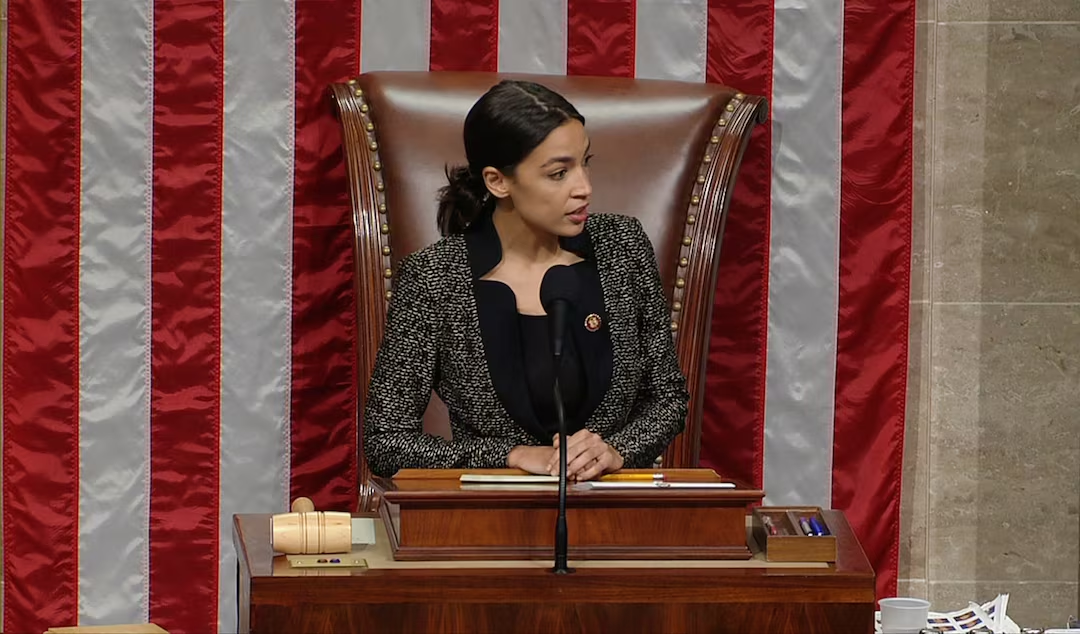
Congresswoman Alexandria Ocasio-Cortez is just one of many female politicians who have been criticized for her appearance.
Although it’s been more than a century since women first gained voting rights in the United States, it’s embarrassing to admit the fight for gender equality is far from over.
While the wage gap between women and men has slowly decreased over the years, subtler — but still pervasive — forms of discrimination in jobs have remained particularly strong in public jobs like politics. Women have entered politics in record numbers in the past few decades, but rather than being evaluated for their leadership alone, they’re instead often judged on their appearance and fashion choices.
Look, for example, at well-known Democratic congresswoman Alexandria Ocasio-Cortez (NY-14), who has faced repeated criticism since she was first elected eight years ago. People deemed her exorbitant for spending over $300 on a haircut, criticizing her for preaching socialism while living the life of the privileged.
However, these arguments seep with irony because it seems like women can’t win either way. While Ocasio-Cortez was condemned for her pricey haircut (which, by the way, isn’t out of line in expensive places like New York), female politicians are still often criticized regardless of the effort they put into their appearance. If female politicians don’t wear makeup, do their hair just right or change up their attire daily, they’re called “lazy” or “disrespectful.”
Story continues below advertisement
No matter what a female politician does, whether she puts effort into her appearance or not, she’ll face criticism either way, even though her looks have nothing to do with her job performance.
This intense fixation on the appearance of female politicians is wildly disturbing and a clear double standard; think of the abominable fashion choices Donald Trump makes at rallies and other public appearances with his ubiquitous “Make America Great Again” caps and overbronzed makeup.
Politicians shouldn’t be judged solely on their looks, as though they were actors or fashion models. Their job is to legislate, defend and represent their constituents. Unless it’s truly bizarre and out of bounds, what they wear or don’t wear does not demonstrate their proficiency in their field. By centering their roles on appearance, society subtly sends the message that females’ worth has to do with how they dress, how they do their hair and how they do their makeup (if they wear makeup at all).
And this issue is not just party-specific. Recently, social media trends have included people attempting to imitate stereotypical caricatures of Republican women and their makeup, featuring exaggerated features, no blending, outrageous orange shades, over-the-top eyelash extensions and gaudy eyeshadow, clearly making fun of women like Kristi Noem and Karoline Leavitt.
Although people may never align on beliefs and values in political leadership, criticizing women’s looks in isolation never helps the political landscape and divides people.
This also isn’t just an issue in the U.S.; the internet heaped onto the all-female Italian cabinet in 2014 for their attire. Italy’s Minister for Constitutional Reforms and Relations with Parliament Maria Elena Boschi wore an intense blue pantsuit, which caused severe criticism and uproar — oh my, a woman wearing blue; how scandalous and disastrous for the economy!
Similarly, it was absolutely preposterous to hear the criticism about her pregnant colleague, Minister of Public Administration and Simplification Marianna Madia. Stylist Chiara Boni told La Repubblica that Madia’s minimalist black ensemble was “unacceptable and a woman of her beauty should do more with her clothing.”
Courtesy of Andrew Medichini
Maria Elena Boschi (right) was criticised for her “outrageous”blue suit and pregnant Marianna Madia (second from right) was also criticised for her “minimalist” outfit.
It’s absurd because Madia and Boschi both represent polar opposites of each other, one full in color, and one in typical formal clothing. Yet criticism was delivered to both of them.
This constant scrutiny has genuine consequences: If women are forced to be pushed and pulled by impossible societal expectations, their work is consistently overshadowed and their credibility questioned.
In fact, heavy peer pressure has dictated women’s appearance as politicians since the beginning of their political careers. It wasn’t until 1993 that Carol Moseley-Braun broke the rule that women were forbidden from wearing pants on the federal Senate floor. Senate doorkeepers could turn away people they thought looked “inappropriate.” Similarly, in the FBI, pants were forbidden until 1972 when J. Edgar Hoover died. Apparently, he hated seeing women in pants.
How ridiculous is that? Women weren’t allowed to wear pantsuits (generally considered formal clothing) in government offices even in the ‘70s just because a man hated it. The men’s references would dictate how women were presented, which continues to reinforce the idea that female politicians cannot truly be equal to their male counterparts.
Some women have started to push back, using their clothes and style to their advantage instead of obligation. For example, former Homeland Security Secretary Noem has repeatedly “cosplayed” versions of law enforcement and workers to promote her policies. But in her case, the heavy emphasis on her appearance risked making more serious issues such as job opportunities look more like publicity stunts.
On the other hand, former first lady Michelle Obama utilizes more deliberately to reinforce her views. In her new book “The Look” she reflects on how clothing communicates identity and values, emphasizing it can amplify a woman’s voice as well.
“The thing about clothes that I find is that they can welcome people in or they can keep people away, and if you’re so put together and so precious and things are so crisp and the pin is so big, it can just tell people, ‘Don’t touch me,’” Obama writes.
Ultimately, the obsession with what female politicians look like is heartbreaking and says far more about society’s position toward women in power. These powerful female politicians are not defined by their wardrobe but by the choices and policies they continue to pass and support. Until appearance stops overshadowing their proficiency and ability, politics remains a space where women are visible, but can never be fully taken as seriously as their male counterparts.
Renisha Mandal, Class of ’27, is an entertainment editor for the 2025-26 school year. Renisha enjoys reporting on various aspects of her life, students around campus, pop culture moments and especially Taylor Swift. Outside of journalism, Renisha spends time doing robotics, with her friends and family and listening to Taylor Swift.
Donate to The Saratoga Falcon
Your donation will support the student journalists of Saratoga High School. Your contribution will allow us to purchase equipment and cover our annual website hosting costs.