















Courtesy of The Wall Street Journal
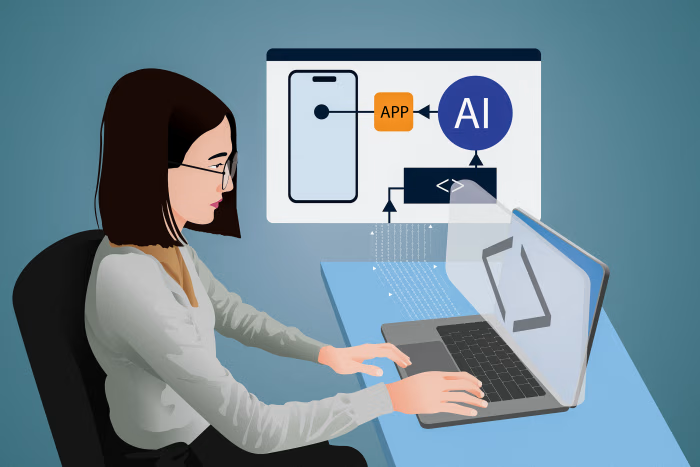
“Vibe coding,” or coding with AI dependence, is becoming increasingly common.The rise of artificial intelligence has changed the computer science job market at a rapid pace in recent years. Tools that were once just used to fix small bugs can now write entire programs with one-sentence prompts. Various companies have released AI chatbots and Application Programming Interfaces (APIs) that allow different software to communicate and share data. Powerful tools including Anthrophic’s Claude, Google’s Gemini, Meta’s open source Llama AI and Cursor AI have emerged and are becoming more powerful.
In a few short years, AI has improved tenfold and is able to code large-scale projects in just a few seconds, potentially endangering many jobs in computer science. Now, given a simple prompt, AI is able to produce some collegiate-level research, make realistic videos and even automate ordinary everyday tasks such as managing personal calendars, managing emails, summarizing documents and much more.
At the same time CS majors fresh out of college are having trouble finding jobs, facing a higher unemployment rate compared to other majors. Most IT companies have lowered hiring significantly to optimize their workforces with AI, using it to automate repetitive tasks, predict their analytics and improve their decision making based on data insights.
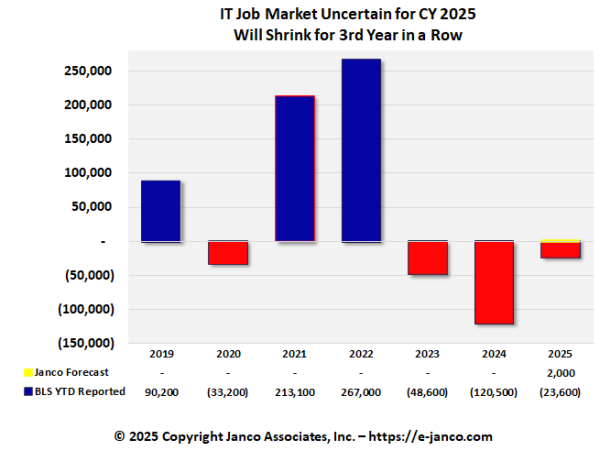
Courtesy of Janco Associates, Inc.
Bar graph showing the loss of IT jobs over the years AI has been prevalent (2022-2025)
Workers who already have jobs in tech are also being affected by AI. In 2025, Intel cut 27,100 roles from its workforce, Microsoft cut 15,387 roles from its workforce and Amazon cut 14,625 roles from its workforce. The companies laid off over 35%, 15%, and 4% of its employees respectively. Meta also conducted one of the largest layoffs in the industry, removing more than 21,000 positions in multiple rounds. Meta, along with various others, cited restructuring and a shift toward AI-focused initiatives as key reasons for the cuts. The Falcon spoke to various experts to see their views of the AI revolution.
Sunil Thomas: a parent working at an engineering company
SHS parent Sunil Thomas has seen first hand the effects of AI at Zendar, a software company where it has been implemented to help various processes.
For instance, Zendar developed a visualizer to depict what the sensors like cameras, radars, etc., are seeing around a car as it drives. A section was originally developed over a period of nine months by two engineers but had several shortcomings and bugs. Later, one of their engineers rebuilt a similar visualizer using Anthophic’s AI model Claude. The engineer’s visualizer was better in quality in every way than the original, and also just took him three days to develop from scratch and pass a quality test.
“We believe that AI can improve productivity within the company by several folds,” Thomas said. “In that sense, we are rolling out AI coding agents company wide.”.
Shreyas Rana: young CS major early in his career
SHS Class of ‘22 alumnus Shreyas Rana (the older brother of one of the writers of this story) majored in CS at UC Berkeley and has witnessed this shift firsthand as AI models reshape how students approached their coursework. He is also currently working as a cardiovascular image segmentation software engineer at Edwards Lifesciences.
“When I first got to college, the main focus was to learn to code on your own,” Rana said. “Soon after the release of advanced AI models, many of my peers began relying heavily on AI, to the point where they no longer understood the code they wrote and submitted, essentially ‘vibe coding’ their entire projects. Many recruiters even expect you to know how to efficiently work with AI tools and build with them.”
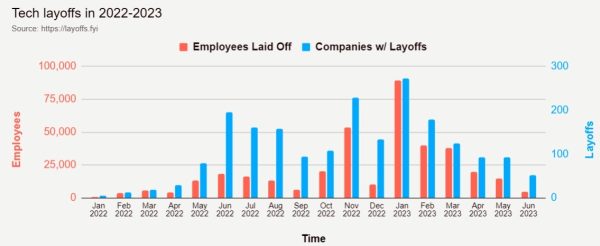
Courtesy of Technology News and Literature
Histogram showing the dramatic increase in tech layoffs after the release of advanced AI tools.
Rana has noticed that the number of startups basing their model off of AI is rapidly growing, usually following the B2B SaaS, a model where companies sell their own service to other companies, or “business to business.”
“There are so many AI startups trying to do the same thing that it becomes very hard for us students to know which skills will matter when we apply to jobs by the time we graduate,” Rana said.
Conway Wang: CS teacher
Computer science teacher Conway Wang, who previously worked as a software engineer at the San Francisco Airport, doesn’t believe in AI’s capability to fully automate sectors in industry yet.
When ChatGPT was first released in 2022, it was at a point where Wang thought it wasn’t sufficient for programming. Even though AI has become integrated in various industries since then, Wang still doubts its ability to completely take over the human-dominated parts of most industries.
Instead of all jobs being replaced by AI, Wang believes that the skills that are valued will differ over time in a different landscape.
“The fear of the industry not having any jobs is overblown,” Wang said. “There’s still going to be jobs. The jobs will just look a little different, with workers focusing more on system design and managing the AI models.”
Hayden Fu: Current CS Major looking to start working in the coming years
Another computer science major who is hoping to enter the job market also agrees. Class of ‘25 alumnus Hayden Fu, currently a computer science major at Cornell University, has been programming as long as he can remember.
Fu now uses chatbots like Claude and Gemini in his daily tasks, such as debugging, proofreading and writing small scripts. However, despite having many peers who do so, he has a strong distaste for those who “vibe code” — the practice of using AI to generate, refine and debug code.
“Some people rely on AI way too much. It’s important to have a real foundation instead of letting AI do the thinking for you,” Fu said.

