









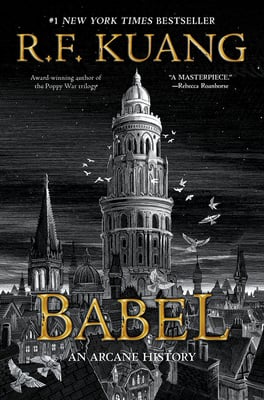
Courtesy of Books a Million
The mystery, rich world-building, and compelling characters help draw readers into the world “Babel” illustrates.Editor’s Note: Minor spoilers for “Babel.”
If anyone knows me, they know that I am the epitome of a bookworm. Each summer, I curate a reading list to make the most of the time I am confined to my air-conditioned bedroom. Last summer, as I was despairing over my long-completed list and suffering from the repetitive plot devices in the last three fantasy novels I’d read, a friend brought up a book they’d recently finished: “Babel” by R.F. Kuang.
Published in 2022, “Babel” is considered both speculative fiction and alternative historical fiction, though it contains many features of the now-popular dark academia genre. The book is set in the prosperous Victorian era of an alternative timeline and follows the story of four young students at Oxford University in the 1830s: Robin from China, Ramy from India, Victoire from Haiti and Letty, a British national.
At the Oxford Translation Institute, they eventually learn how to use “silver working,” the magic of translation that runs all of Victorian England.
Although the magic system is somewhat complex, based on words of many different languages carved on silver bars, it is a unique and innovative take on the overused incantations in many fantasy books from “Harry Potter” to “The Lord of the Rings” to “Earthsea.” Due to this complex web of languages that play a central role in the book, there are a number of passages devoted to explaining the specific words, as well as their effect.
Though this could be distracting for readers who simply want to read an action-packed fantasy novel, I feel that the passages delving into the magic’s etymology allows me to further understand the context of important plot points without pulling out a dictionary.
The book mostly focuses on Robin but breaks off to follow Ramy, Letty and Victoire later on; it allows a better understanding of each of the characters and their motivations, whether it be simple survival or the destruction of what they believe is a cruel and oppressive empire.
However, since only one short chapter is dedicated to each main character other than Robin, the perspective change feels a bit like an interruption and is disconnected from the rest of the narrative.
As the plot progresses, one unsolved mystery in particular only becomes more tangled and complex — specifically with regards to Robin’s brother, Griffin. Despite the fact that Robin and his friends tread in the footsteps of Griffin’s cohort, readers never get the full answer to what transpired during Griffin’s time in Oxford and what led to his cohort’s disbandment, a major loose end that left me wanting more closure.
Though the book contains many fantasy elements, it ultimately is a historical fiction. Much of the time period, many key characters and events line up well with the historical timeline of the Victorian Era, including the 1884 Colchester Earthquake, the unrest of the working class due to the industrial revolution and the events leading to the First Opium War.
Kuang even includes key political and historical figures of the time. This is reflected in the second half of the book, with a distinctly darker and more down-to-earth tone, as the major revelations and plot twists are unearthed, eventually ending in a way that connects back to the historical timeline.
With bloodshed resulting in the death of characters, the ending is certainly not a “happily ever after.” In my opinion, this grim ending is far more powerful than the conventional fairy tale ending.
“Babel” is a vividly memorable read that had me on the edge of my seat despite already having background knowledge on its historical underpinnings, with characters that grow in many ways as they also understand more of their world.
