






















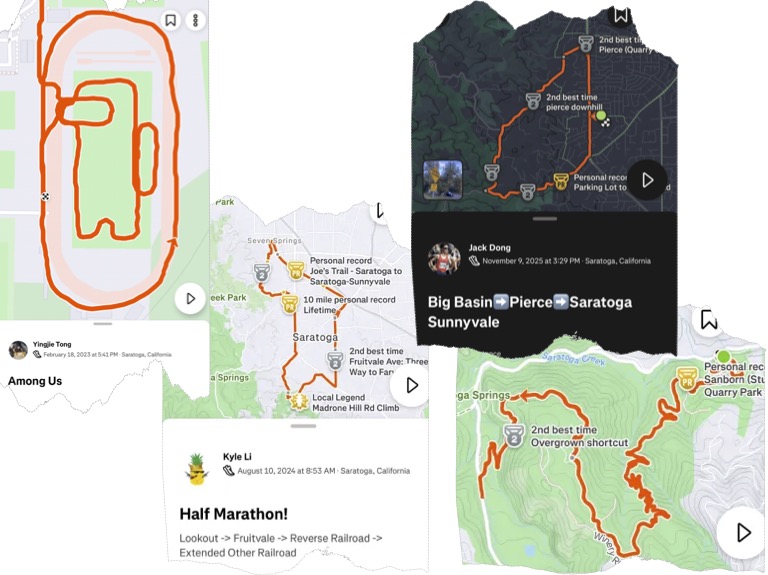
Breathing hard, sophomore cross country runner Mihith Verma glanced down to check his pace on his watch. Sprinting across the finish line, he clicked the button on his watch. Within seconds, he uploaded the results onto his favorite running app: Strava.
Verma, a member of the varsity team, is among the many runners who use a sports app to track his fitness. While the idea of a fitness app is not new — the first one was Fit Phone founded in 2010 — there has been an increasing number of runners who use them.
The increase can be attributed to an advancement in technology and a greater understanding of the value and advantages of physical activity in a healthy life. Specifically, fitness apps employ approaches such as feedback, incentives and social support to encourage healthy behavior changes. These can be seen through virtual badges, group comparisons and the ability to share achievements among a group of like-minded users.
Several popular sports apps include Strava, Garmin Connect, Apple Fitness, MyFitnessPal and Nike Training Club. Strava is the one cross country team runners use.
On Strava, a workout can be recorded on the app or imported from another device, such as a watch. Verma uses a Garmin watch to record his workouts on Strava. Sophomore varsity cross country runner Advay Salhotra imports activities directly into the app or uses his Apple Watch.
Popular features on Strava include social media-like features that allow users to view other people’s activities and “give kudos.” Due to these features, senior Jack Dong views Strava as a “social app for runners.”
For Dong, Strava’s main features are planning routes and tracking the mileage on his shoes in order to know when to retire them. Bonus features that he enjoys are the local legend awards to people who run a segment the most during the past 90 days and local segment or course records.
Verma enjoys the built-in race predictor and viewing his teammates’ runs. He notes how Strava has allowed him to run faster through setting concrete goals.
“I think Strava has helped me improve because it makes me set a goal for a certain mileage. So, if I feel like I didn’t run enough, I will just run [the extra miles],” Verma said.
Sophomore Advay Salhotra also noticed his improvement from the use of Strava, especially through increased motivation.
In contrast, Dong views Strava differently. He sees it as a way to look back to his runs, not necessarily as a tool to improve.
“For me, Strava acts like a training journal where I can log my workouts and jot some notes down about how the workout went and if I have any problems,” Dong said. “In terms of improving, I don’t think it has any direct impact, but the motivation from your friends is real, and I think one is more likely to get into running this way. I use the app mainly to record my running memories, where I can look back on past runs and the people I ran with.”
Verma, Salhotra and Dong all plan on continuing to use Strava to track their runs and motivate them to exercise.
“[Using Strava] is a great way to organize things. If running is an academic subject, I would compare Strava to my notebook,” Dong said.
