




















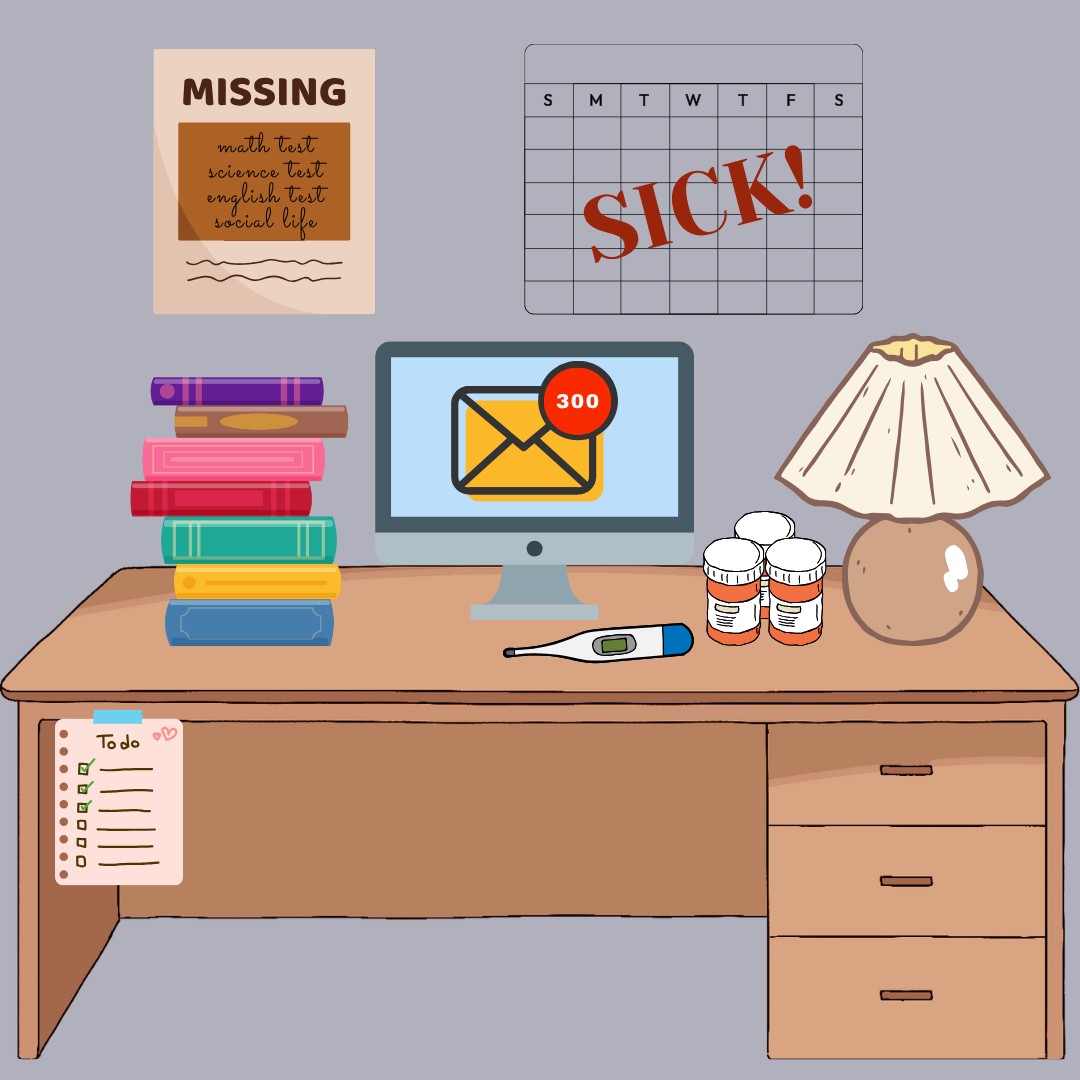
Don’t miss test days, but also don’t take tests when you’re sick. Do all your homework, but also get eight to 10 hours of sleep each night. Remain excellent academically, but participate in enough extracurricular activities to stand out to colleges. Also, don’t forget to have fun in high school because these are the best four years of your life.
These are contradictory messages high school students hear all the time from adults. But the one advice all adults seem to agree on is to avoid skipping classes.
But I’m here to tell you that advice isn’t always true or smart.
As a frequent visitor to the attendance office, a common recipient of off-campus passes and a near-professional absentee (apologies to whichever class I’m supposed to be in right now), I’ve personally come to understand that skipping school is not the pipeline to juvenile delinquency it’s made out to be.
When I say “skipping school,” I’m referring to being absent even while technically able to attend classes — for instance, when you’re coming off of a sickness but not contagious.
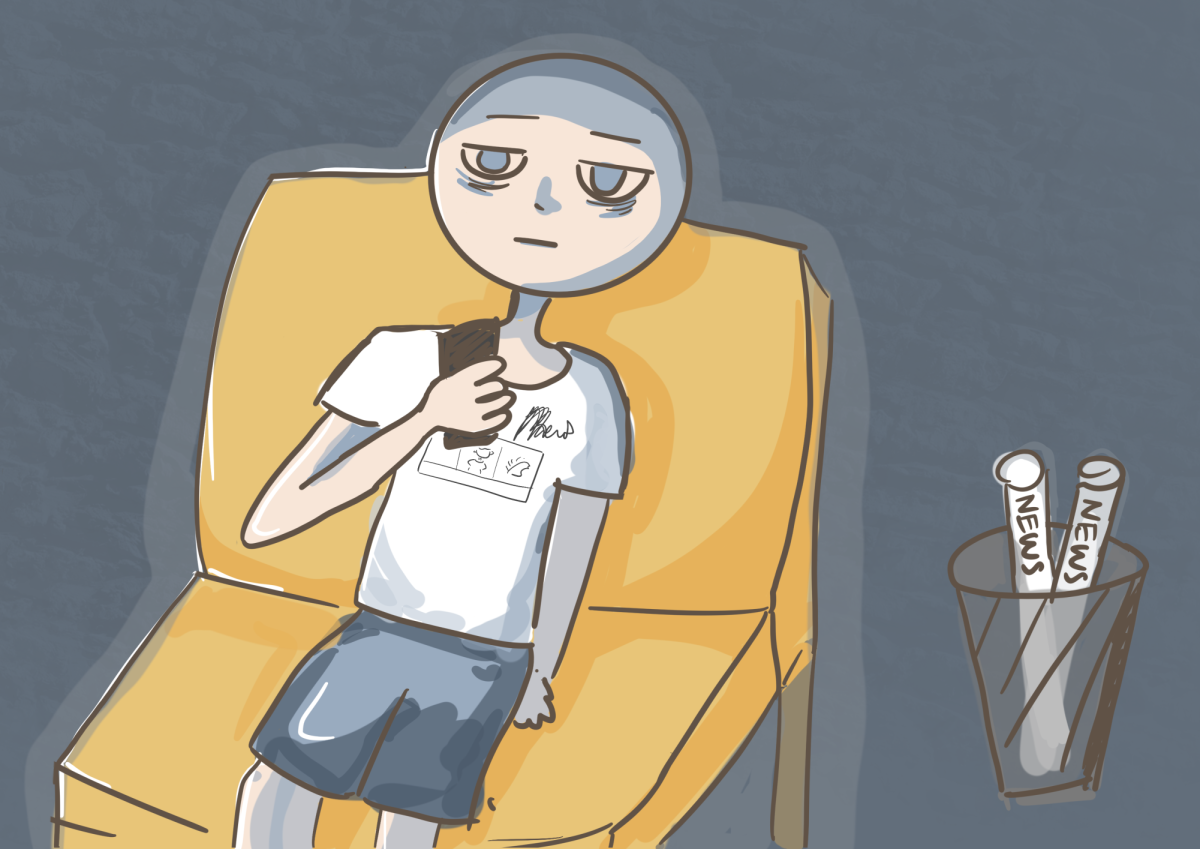
Personally, over the last two years, I have spent weeks in and out of school because of bad reactions to medication — throwing up multiple times and completely losing my appetite leaves me too exhausted to get up. Not to mention, the notion of an upcoming math or history test right after nauseous episodes doesn’t exactly have me jumping out of bed in the morning.
In cases like these, it’s time to examine the system and culture that forces students’ hands.
High school students are increasingly faced with days that never seem to have enough hours, stuck in a world that doesn’t stop turning just because you’re sick. School doesn’t exactly wait for you to catch up, the work keeps piling up the more you miss.
As any doctor will tell you, recovery requires rest, lots of it. And as any teacher will tell you, school requires studying, lots of it. Unfortunately, no matter how hard you try, productive studying and effective recovery are mutually exclusive.
When I’m not busy throwing up, I’m lying face down trying to stop another wave of nausea or taking a nap to regain a sliver of energy — meanwhile, I’m losing precious homework time at an exponential rate, missing lectures and watching my grades drop.
But even when I feel well enough to be productive, I have two choices: attend my classes or skip school to try to “lock in” at home. When presented with this choice, many adults — and a few students — will view skipping school as careless.
After all, if you don’t have a legitimate reason to be absent (limited to sickness, doctor’s appointments and family emergencies), the expectation is that you’re ready and eager to learn. However, in my experience, sometimes it’s more efficient to base my decision on my workload and sense of what is best for me to do at the moment; this is where I’ve noticed that students actually act very responsibly when weighing the costs and benefits of their choices.
For example, if I know a teacher’s lesson plan for the day (both direct lecturing and activities-based teaching) revolves around content covered by the textbook, I know that my teacher will spend 90 minutes covering something that might only take me 20 minutes to read and understand. If I feel decently comfortable with the content/class, I’m willing to forsake the additional understanding/expansion for more unstructured time.
With those extra 70 minutes, I can clear my platter of around five homework assignments I missed while sick. At the cost of one lecture, I’ve suddenly significantly reduced my academic debt. Yes, I’m missing out on the chance to ask my teacher questions and hear the deeper explanations, but it’s not worth the workload I would be postponing to attend class.
Even if I skip a class to study for a test in a different course, I consciously take on the responsibility to catch up on missed notes and classwork from the class I’m skipping; but at the same time, I am reducing my anxieties about another class while trying to be as successful as possible. Isn’t that the definition of self-determination and self-efficacy? Isn’t that what education is ultimately all about?
More controversial than missing lecture notes is the process of skipping tests. Although every situation depends on individual circumstance, as long as there are no violations of academic integrity, I don’t understand why teachers and others get so heated over this practice.
My advice is simple: If you don’t like skipping tests, don’t skip tests. I admit, I’ve skipped tests because I was sick the weeks prior (or even the day of), still catching up on lecture materials and in no position to take an assessment. Why should I have to take a test I know I’ll bomb due to a lack of preparedness for circumstances out of my control? It’s not like I postpone my makeup for months — I usually take them the next week or a couple of days after I feel well. No harm, no foul.
What’s truly harmful is having to take makeup exams 10 times more difficult than the original one.
This consequence makes sense for students to try to game the system by consistently skipping test days as a way of studying more, but what about those who were legitimately sick? Regardless of whether you were actually sick, this degree of increase in difficulty feels like a punishment. Not only that, it creates unnecessary anxiety for students who are in no state to take a test (again, speaking from experience). I know life isn’t fair, but setting sick students up for failure with extra difficult makeup exams seems a little cruel.
Environmental Science teacher Kristen Thomson uses a different policy that is a model for fairness: Miss three tests, and the multiple-choice portion on your third makeup turns into fill-in-the-blanks.
I like that this policy is based on individual student records (forcing students to take responsibility for their decisions), as opposed to a blanket policy for all absentees; the “three strikes and you’re out” policy gives important leeway to students for valid absences.
But as a whole, these conversations only happen because our educational environment does not account for the fact that there are only 24 hours in a day.
Well, 12-14 because we’re expected to sleep for eight to 10 of them. Except, we still need to account for seven hours of school every weekday. And don’t forget to subtract family time, and self-care and meals — you get my point.
Ultimately, something out of our schedules has to be sacrificed to keep pace with academics, and MOSAIC lessons have taught us that it cannot be our sleep.
So the sad truth is that at SHS, students generally cannot afford to be sick for any length of time without major consequences. Missing one hour here and there is negative enough, but entire days out of school are a death knell. Small setbacks can have massive consequences; therefore, to keep their heads above water, strategically but legitimately skipping school is the smartest choice and one that doesn’t deserve the bad rap it usually gets.
A previous version of this story and a December 2025 issue graphic misstated the current makeup policies of several science teachers.
Chemistry Honors — Kathy Nakamatsu
Correction: The policy referenced in the article and in the issue graphic referred to a quarterfinal makeup policy from prior years. This year, if a student misses a test on a unit (e.g. Unit 3) they will take a makeup exam on ONLY that missed unit (e.g. Unit 3). The student would only take a test on two units if they were to miss both units. The makeup is given once every six weeks during tutorial, usually on a day near the end of the grading period.
Environmental Science — Kristen Thomson
A previous version incorrectly stated: “Miss three tests, and the multiple-choice portion on your third makeup miraculously transforms into a much more difficult free response.”
Correction: If a student misses three tests, all the multiple choice questions on the third makeup turn into fill-in-the-blank questions.
AP Biology — Cheryl Lenz
If a student misses a quiz, they must complete the makeup quiz during the next class or tutorial. The graphic in the issue misstated that “afterwards, overlapping topics from the test will be used as your quiz grade.”
Correction: If a student does not complete the makeup quiz, then the percentage of correctly answered questions on the following test that cover the quiz topics will be used for their quiz grade.
The Falcon is dedicated to providing accurate news and information to our readers. Please contact [email protected] for fixing any mistakes.
