






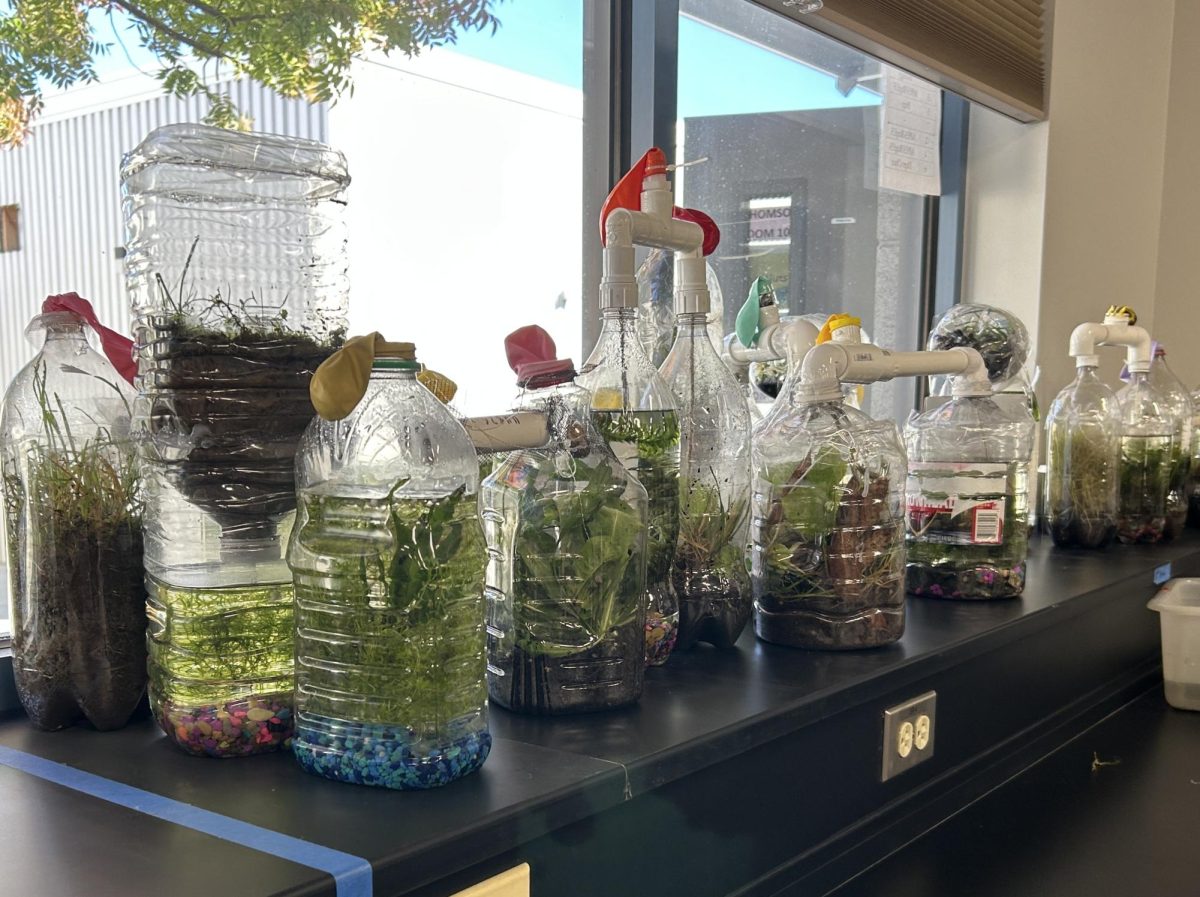
Anyone walking near the science wing in late October and early November may have noticed an array of large plastic bottles lined up in front of Room 1015’s windows.
Each bottle was filled with life and mini ecosystems that pairs and trios of students in Kristen Thomson’s AP Environmental Science class maintained for two weeks.
The goal of the biobottle project was to set up two connected ecosystems — one land and one aquatic — and build an environment that could support all organisms.
Students were required to include at least one producer, consumer and decomposer in each ecosystem. Each school day, either during class or tutorial, students had to record observations on every component of their biobottle.
Thomson was able to provide students with some communal materials and even aquatic plants and snails. She also gave tips for success, such as avoiding organisms that prefer drier conditions, placing the land ecosystem above the water one and using a balloon to regulate air pressure within the bottles.
Materials and construction
Each had similar setups: Our two groups decided to place the terrestrial ecosystem above the aquatic one.
Both inverted a bottle and placed it above another after cutting out the top, and they added different natural materials and organisms. For the land portion, Mona’s group included moss, woodlice (rolly-pollies that can’t curl up) and earthworms; for the water environment, they used pearl weed, water snails and a ghost shrimp. The only major difference between the two biobottles was that Medha’s group used a beta plant instead of moss.
Observations and results
For Mona’s group, the land ecosystem erupted in chaos over the two weeks. The larger worm died early, eventually getting broken down by mold and the woodlice. A mysterious seedling appeared, and the woodlice grew a visible amount after completely devouring it. The water ecosystem, on the other hand, was a huge success; all organisms survived, and the originally cloudy water even turned clear, meaning the system grew stable.
“I was almost emotionally attached to the shrimp after the worm died,” said senior Florence Wei, a member of Mona’s group. “When we opened the bottle, we were all holding our breath and were so relieved to see that the shrimp survived.”
The group also noticed that the soil was wet and muddy, unlike when it was first placed inside the bottle. The humidity likely suffocated the larger worm; the smaller worm was not found so they assumed it suffered the same fate.
Medha’s group’s biobottle opening was a tad bit daunting, as they were all scared of opening the bottle and dealing with the organisms wiggling around.
Upon opening the bottle, they discovered all three worms limp and dead, halfway toward decomposing in the soil. The rolly-pollies were all happily crawling around the dirt, and they were eventually released into the wild.
Unfortunately, the aquatic organisms suffered death and destruction. The snails all perished on top of the gravel, a somber sight given their original vitality. Meanwhile, the group buried the dead shrimp’s body in the soil near Thomson’s room, lamenting its premature death. Luckily, the plants in both ecosystems were well and alive — thriving with vibrant green leaves and mossy finishes, reminding the group that even in the midst of loss, the plants continued to endure and adapt.
Our final thoughts
For many students, the biobottle is one of the most harrowing projects in APES. Death is almost inevitable within these mini ecosystems and it’s difficult for many to see their organisms dying.
There were several ways we could have optimized our bottles. One of the most common mistakes (one that Mona’s group avoided) was adding excessive plants, which seems to produce more oxygen but actually leads to oxygen depletion at night. Many groups also underestimated the amount of space each organism needed, overloading the system and causing it to collapse. Adding a layer of gravel for drainage under the soil would have prevented the worms from drowning in the soil.
From this project, we learned how fragile ecosystems are and how easy it is to overstress them, which is what we’re doing to our world right now. A stable ecosystem requires not only the essential components but also balance. Our final takeaway from the project: It is crucial for more people to beware of the dangers of overexploiting Earth’s resources so we don’t damage the biosphere we all depend on to live.

