






















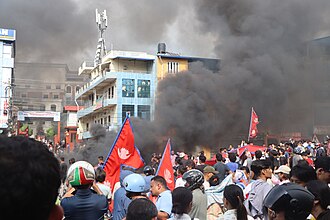
Courtesy of Himal Subedi
Protesters march in the streets of Kathmandu despite burning buildings and growing violence on Sept. 9.While many parents have experienced the wrath of angry teenagers forbidden from using social media, those feelings pale in comparison to the fury and violence of the Gen Z protests in Nepal that started on Sept. 8.
The violent protests were triggered by the banning of 26 social media platforms — including WhatsApp, YouTube, LinkedIn and Facebook — by the Nepalese government, which citizens across the nation saw as an infringement of their rights to free speech and expression. The movement was also inspired to challenge deeper issues, including the country’s significant wealth disparity, rampant nepotism, corruption and rising unemployment.
Initially, youth organizers took to the streets of Kathmandu, the capital, with a peaceful demonstration. They soon, however, devolved into violence. Police fired tear gas, rubber bullets and live rounds into the crowd, and protesters set fire to buildings. Throughout a period of about two weeks, the Nepali youth were able to cause President Sharma Oli’s resignation, and interim president Sushila Karki’s selection, both through physical violence and online campaigns.
Though Nepal has a relatively young democracy, it has been a chaotic and unstable one fraught with conflict, with 14 different ruling parties since 2008, though not a single one has completed its 5-year term.
Before 1951, Nepal was governed by a monarchy, the Rana dynasty, who were eventually overthrown through pro-democratic revolts. Their downfall led to the formation of a constitutional democracy ruling in tandem with a monarch with limited power, though a later monarch attempted to consolidate power and was overthrown by left-wing Maoists.
The civil war sparked by the Maoists in 1996 lasted a decade, killing more than 17,000 people, the monarchy finally abolished in 2008, though the succeeding government, as shown recently, has grown to be deeply unpopular as well.
With a population of almost 30 million but a youthful median age of 25.3, Nepal has issues with unemployment and inequality, while the children of rich, corrupt politicians are often perceived as doing nothing but opening box after box of luxury brand gifts.
Though a youth rebellion against an oppressive government can absolutely lead to beneficial changes, the acts in this case were innately violent, resulting in widespread repercussions that should be fully condemned.
Current estimates of financial losses have reached 3 trillion Nepalese rupees — half of the country’s GDP — as many government buildings, as well as the homes of rich politicians believed to be corrupt, were burned. The death toll stands at 72 people, including children, participants of the protests, bystanders, people trapped in burning or looted buildings, as well as police and prisoners killed during the various jailbreaks across the country.
Without an official leader, the uprising has generated a vulnerable power vacuum, leaving the country in an unstable position and in danger of being usurped by another dictator.
On the one hand, the protesters have certainly been successful in making change — the most significant undoubtedly being former President Sharma Oli’s resignation and the installment of former Supreme Court justice Sushila Karki as interim president. Ironically, Karki was elected via a livestreamed Discord election, held on one of the formerly government-banned platforms.
On the other hand, the protests have also perpetuated violence, burning and attacking the homes of politicians, and even setting fire to key government buildings.
Besides just passion, wisdom and experience are also needed to propel positive change that leads toward stability. Though it may be easy to claim or hope that the new government will be fair and democratic, it is far harder to run such an idealistic government, as reconciling differences in wealth and status has proved difficult for so many historical predecessors. Adding radical approaches fraught with violence and destruction simply adds fuel to the fire.
Historically, struggles against oppressive governments have usually been bloody, ending with lackluster results ranging from the rise of another autocrat to a weak government that preserves many of the former’s problems.
The mass destruction of property will necessitate costly repairs from an unstable and poor government that has larger issues to grapple with at the moment — adding to the growing list of problems Nepal faces. The order and priority for infrastructure and building repairs could even spark debate and division among the fragile government, which may descend to petty squabbling and political posturing, distracting from the true goal of legislative reform.
An example of potential conflict lies in the presidential elections Nepal is set to hold in six months. While some push to prioritize the election, others believe it is better to delay it, allowing for more time to mitigate the strain it will have on the already overtaxed economy. This issue has already proven to be controversial and polarizing, splitting the current regime, as well as the youth movements into smaller groups with divided agendas.
Now, weeks into the aftermath, the significant governmental changes that the protesters have been pushing for have mostly remained unachieved. New factions have sprung up, and some factions are even taking advantage of the chaos and leaderless nature of the revolt to push their own agendas, whether it be a return to a monarchy or the abolishment of federalism altogether.
Whether a violent rebellion by a leaderless and faceless group of youth can truly bring long-term change remains to be seen, but the stakes are the nation’s stability — and the whole world is watching.
