

























Courtesy of Techcrunch
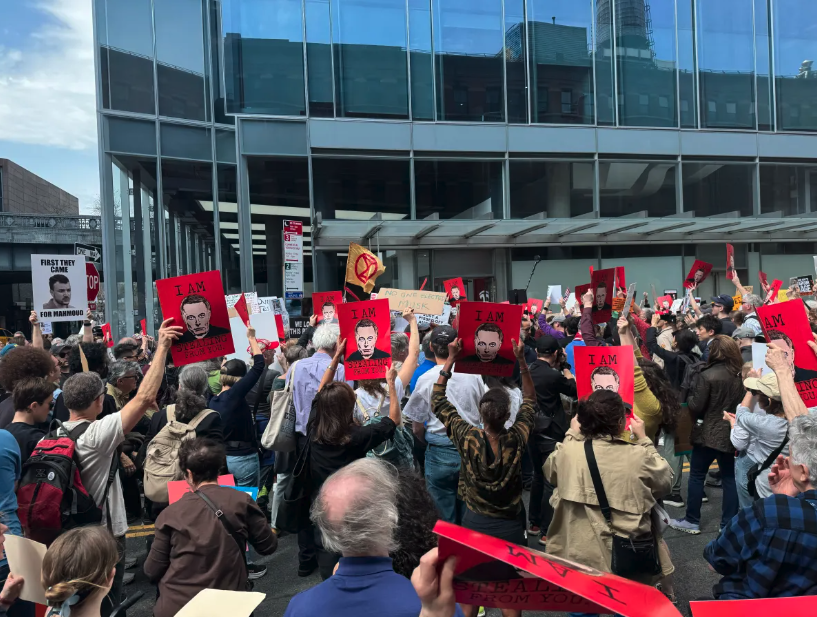
Protesters gather outside of Tesla factory on March 29 in New York City.What does it mean to have political power?
If it entails the ability to sign legislation, billionaire Tesla CEO Elon Musk has none. Though if it entails shaping public discourse and influencing industries, he might have more power than most politicians, despite having never been voted into office.
Since the 2024 US presidential election, Musk’s political activity has become a focal point of contention – from his endorsement and lavishing of hundreds of millions on Donald Trump’s 2024 campaign, to his involvement in the controversial cuts to governmental services through the Department of Government Efficiency (DOGE), to his support of Alternative for Germany (AfD), a political party in Germany that embraces right-wing Nazi extremist policies such as anti-immigration.
Musk gained an especially bad batch of publicity as the head of DOGE, whose abbreviation was inspired by a popular internet dog meme. Ironically, he has since left the Trump administration with his tail between his legs.
Musk’s unjustified power in government undermined the principles of democratic accountability
When Trump held the first cabinet meeting of his second term, it was Musk, Trump’s billionaire endorser, who was one of the first advisers to speak in front of the camera. During the meeting, Musk offered a passionate defense of his work as head of DOGE — highlighting his extensive political participation.
Being the head of DOGE did not make Musk the leader of an official government department, as it was established as a temporary advisory body through one of Trump’s presidential executive orders instead of an act of Congress. However, the unofficial government title never deterred Musk — under his leadership, DOGE fired over 200,000 federal workers from more than a dozen agencies such as the Department of Education, the Department of Homeland Security and the Department of Health and Human Services.
With Musk’s expanding political power comes a fundamental constitutional crisis — one that galvanizes the nation’s concern over the health of American democracy. Dozens of lawsuits that emerged, challenging Musk’s unwarranted government position, illustrate a concerted effort to protect the integrity of the federal government. As District Judge Tanya Chutkan pointed out, 14 states and a group of advocacy organizations argued that Musk and DOGE’s efforts to slash the government violate the Appointments Clause of the Constitution.
Musk did not cut inefficiency by dismantling these departments. Instead, he bulldozed the Constitution’s separation of powers on which democracy relies by making radical cuts without the authority of an official government position. The workers DOGE fired are essential for sustaining the infrastructure and opportunities that power future generations. Simply, Musk overstepped his role in politics as an unelected mogul.
Additionally, Musk’s actions at DOGE, with the support of the Trump administration, violate the Fourth Amendment, which protects people from “unreasonable searches and seizures” of their “persons, houses, papers, and effects”, and more broadly threaten the democratic principles of our constitution. DOGE has seized access to multiple federal computer systems that house the sensitive personal information of millions of Americans — including bank accounts, health records and Social Security numbers. Federal judge Theodore D. Chuang of the U.S District Court in Maryland expressed concerns about DOGE’s access to sensitive personal data. Consequently, he cut off DOGE staffers from sharing it outside the agency.
Notable political think tanks — institutions that conduct research and analysis to solve social and political problems — like the Brookings Institution warned of a major backlash caused by DOGE cutbacks over a wide array of issues. From delays in tax refunds, to disruptions to Social Security benefits and increased risks of domestic terrorist attacks, these political analysts raised red flags for various potential catastrophes caused by DOGE’s unsolicited cuts. Public opinions echoed the sentiment. For example, a poll by Quinnipiac University revealed that 60% of voters disapproved of the way Elon Musk and DOGE dealt with federal workers.
Public retaliation to Musk’s power reflects in Tesla boycotts
With such resentment toward the DOGE cuts, people have turned their anger to his companies. Owning a Tesla today often comes with a deleterious reputation, largely due to Musk’s incendiary actions — which stretch far beyond his government influence. Tesla drivers in America have been at the receiving end of verbal attacks, spreading messages to “Sell your swasticar” — a play on words referencing Musk’s controversial support for AfD.
When people began buying Teslas in 2018, a multitude were motivated by the cause of reducing emissions and fossil fuels. Now, these Tesla owners feel betrayed and are increasingly subjected to backlash for the mere association with Musk. Numerous owners started to display anti-Musk stickers on their vehicles; in a remarkable record, Matthew Hiller, the owner of online shop MadPufferStickers, earned more than $100,000 selling such stickers in just a 30-day period between January and February this year.
As an example on a local scale, more than 100 people gathered outside of a Tesla showroom in San Jose, California on March 28 to protest Musk’s role in the Trump administration. Ongoing “Tesla Takedown” demonstrations like these are taking place in the United States, Canada and Europe, as activists escalate the opposition against Musk’s efforts to reduce federal government staffing and budgets. On March 29 specifically, protests occurred in at least 253 cities around the world, making it a “global day of action.”
The campaign also urges people to sell their Tesla vehicles and their shares of Tesla stock as a way to denounce Musk, whose wealth is overwhelmingly linked to his Tesla holdings.
As a result, Tesla owners nationwide are trading in their vehicles at record rates, according to Jessica Caldwell, assistant vice president of insights at Edmunds, which tracks new and used car sales. At the same time, she added that online interest in shopping for a Tesla has hit its lowest point since 2022.
What began as a movement to revolutionize clean energy has become a brand tainted by power, ego and far-right alignment of one man. Tesla drivers who once embraced the car for its climate-conscious design now find themselves caught in the moral crossfire of its CEO’s political games. Musk’s unchecked influence is eroding the goodwill that once made Tesla a symbol of progress.
The controversy around Musk only intensifies as his influence in government diverges from the traditional boundaries of democracy. Even though he has never held elected office, the power he holds in politics has elicited backlash, from protests to dropping Tesla sales and even vandalism, as the American public sends a signal of discontent. Furthermore, this growing sentiment extends to a global scale, affecting Tesla markets worldwide as owners and the public alike castigate his violation of democracy.
According to The Independent, at the beginning of the year, Tesla’s share price was at an all-time high. But within one month of Musk’s appointment to DOGE, it plummeted 16.5 per cent.
On September 15th, the stock was finally worth more than it was at the start of the year, rising 3.6 per cent to $410.26. In fact, it was up an overwhelming 85 per cent since bottoming for the year at $221.86 on April 4. A pivotal factor for the staggering rebound was Musk’s decision to distance himself from DOGE. According to Benzinga, the shares skyrocketed 20 per cent following his shift from the advisory body.
True democracy lies in shared political input
Amidst today’s political landscape, political influence lies not in one concentrated body, but rather in the dynamic interplay between common people and oligarchs. Citizens have the ability to veto policy through protests and create a desired change; through voting, they use their influence on politics to confer legitimacy.
Oligarchs exert proactive influence through lobbying, the act of influencing decisions of government officials such as legislators and regulators. Their status as powerful moguls is a stem of political influence, which enables them to control the media and amplify certain political messages by steering public opinions.
Musk’s actions with DOGE constitute a violation of this balance, as he bypassed not only the political influence of the people, but also the proper influence of oligarchs by performing government duties without undergoing the Senate scrutiny and checks through voting.
As legal battles and protests escalate, one question looms: When billionaires wield unprecedented sway over policy and public discourse, can democratic institutions — and the voters they serve — reassert control? If the reaction to Musk’s time in government is any indication, citizens are more than ready to give billionaire egomaniacs the heave-ho.
