





















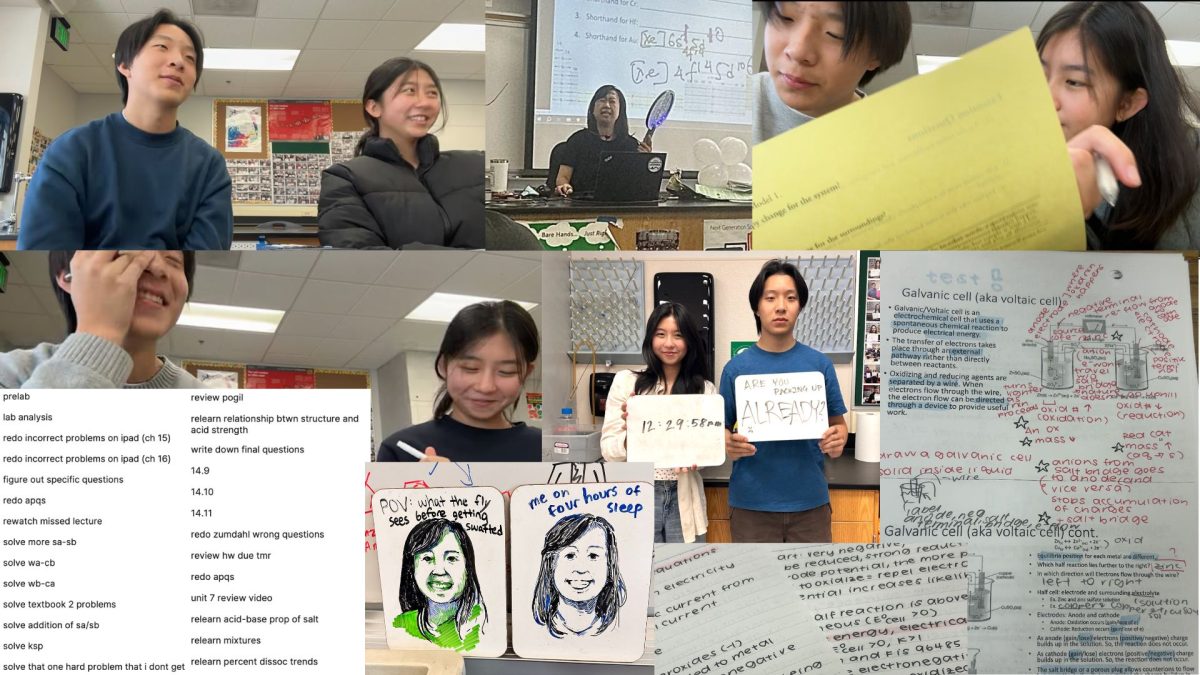
If you’ve ever taken a class along the science wing — or just strolled by at the right time, you’ve undoubtedly witnessed some of the magic of AP Chemistry, whether it’s science teacher Ms. Janny Cahatol’s booming voice echoing across the wing into fellow science teacher Ms. Kathy Nakamatsu’s classroom, students scrambling to finish another titration or an electric fly-swatter crackling against its prey.
But for a select group of brave juniors and seniors every year, the daily chaos of room 1010 is their reality. From complex labs to dense lectures and frantic, tear-filled exam preparations, AP Chemistry has earned its reputation as one of the most challenging courses on campus. Taking the class unprepared is a formula for disaster.
Luckily, having survived both semesters (mostly) intact, we’ve compiled some solid strategies to ensure that you have a successful year and enjoy AP Chemistry to the fullest.
Do make the chemistry classroom your second home for tutorials
Ms. Cahatol will show you her love through her energetic and often humorous teaching style. The best way to respond and engage with her class is to do just that — don’t shy away from matching her energy.
Her No. 1 tip for success: Always talk to her during her tutorials if you have any questions at all — whether you’re asking about the most painfully worded Zumdahl textbook problem or just need a refresher on the strong acids and bases, she’ll be there to help. She loves to connect with her students, and she’s always appreciative of students who make the effort to get to know her.
Do up your concentration game
As Ms. Cahatol will tell you throughout the year, 85-minute class periods aren’t nearly long enough and are a curse for the AP Chemistry curriculum, making labs and lectures a constant rush. When your assignment calls for six titrations, multiple trials or a lengthy set-up process, be sure to read through the instructions beforehand to prevent making easy mistakes — like forgetting to add indicator to your beaker or accidentally pouring your magnetic stirrer into the waste funnel.
During lectures, which can be extremely content-dense, resist the urge to multitask. One page of her lecture notes can take up to 20 minutes to cover, so zoning out for even a couple seconds means missing crucial information.
Of course, even though sitting behind someone tall or having a comfortable A in the class does give you a bit of leeway before Ms. Cahatol yells at you for working on your APUSH notes, it’s always better to stay focused. The last thing you want is to be caught dozing off and turned into an example in front of the entire class.
Don’t leave homework for the tutorial before it’s due
Since Ms. Cahatol’s homework is always due the day of the test, it’s easy to procrastinate all your textbook problems until the tutorial before your test. But no matter how busy and crowded the room is from stressed students asking her what acids and bases are, she will catch you frantically copying the solutions from your friend and call you out.
The homework will genuinely prepare you for the exam, so make sure to complete it genuinely before the test and ask her questions.
Don’t overtitrate!
If your lab partner (who coincidentally dropped the magnetic stirrer into the waste container) insists the titration is not pink enough, do not listen to them! The smallest drop of base will turn your solution dark magenta — you can count on Ms. Cahatol to make fun of your titration skills. Additionally, calculating your percent error will become a shameful process that you don’t want to turn in.
Don’t assume you understand thermochemistry
For one of us, thermochemistry was easily the worst part of the year — do not expect a curve even if she says that it’s the hardest test of the year because all of a sudden, your entire class will transform into the Science Bowl team and have an incredible understanding of obscure topics like enthalpy. If you do badly on even one test, you’ll need to work extremely hard to catch up during the rest of the semester if you want an A — it’s not impossible, but you need to dedicate considerable time to solely chemistry.
Ms. Cahatol might end up curving some tests near the end of the year based on students’ performance, but do not rely on it.
Do embrace the subject matter
Ultimately, whether you’re taking AP Chemistry right now or you choose to take it at some point in high school, take every opportunity to enjoy the class.
You’ll inevitably run into some tough moments — the first half of second semester, to be specific — but the best way to make the experience worthwhile is to make friends, put effort into your work and constantly challenge yourself to do better.
Follow these tips, and when the AP exam eventually rolls around in May, you’ll be able to breeze through without any trouble at all. Better yet, you’ll be rewarded with a stress-free May in the class — a just reward for all the hours of studying and all the late nights that the class naturally entails.

