























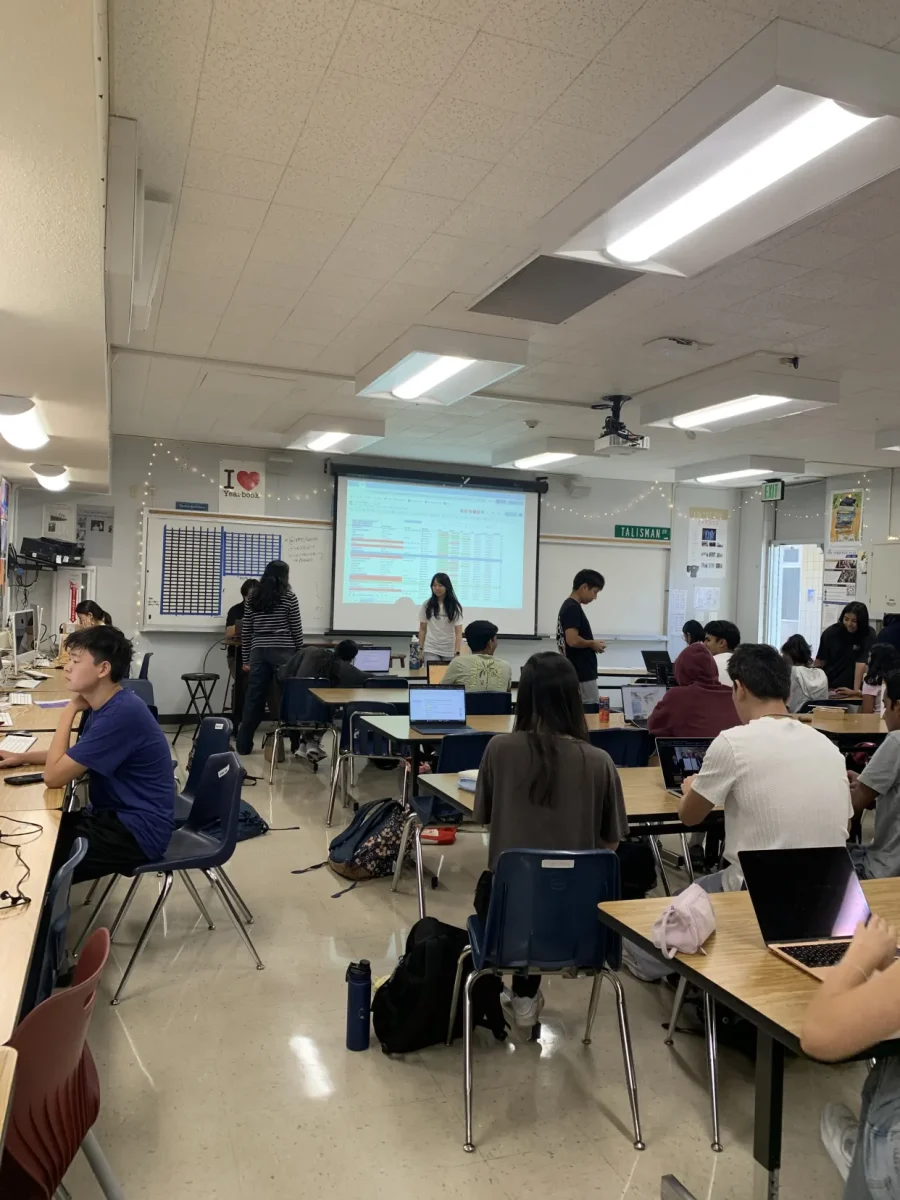
Take a look into most classrooms these days, and it’s unsurprising to dozens of students with their laptops out typing essays or hunched together collaborating on projects. However, even as recently as 2019, this reliance on technology wasn’t as common.
Class of ‘23 alumna Apoorva Talkwakar said that before the COVID-19 pandemic, Chromebooks were essentially only used for occasional assignments, projects and research — and were far from a daily learning tool.
This was also before implementation of the district’s Bring Your Own Device (BYOD) policy that requires each student to have their own laptop or borrow a Chromebook. Because the Chromebooks also required students to log in from their school account, most of their activity was monitored under the school domain, making it harder for students to access unnecessary websites, Talkwakar said.
Talkwakar also recalled that most homework assignments were also physical, as opposed to digital, and students’s notes were more often handwritten. Most of her teachers distributed printed worksheets, and although there were a few classes that required occasional online research, the overall classroom environment was still centered around physical materials.
According to longtime science teacher Cheryl Lenz, before 2020 nearly everything was on paper and most teachers did not have a large or sophisticated presence on Canvas, the school’s Learning Management System.
However, during the COVID-19 lockdown, both teachers and students’ reliance on technology increased significantly as school became fully online for a year. They were forced to learn how to navigate Zoom as well as new homework and test policies now that everything was online.
All class materials were shifted online, and almost all students used personal devices. Junior Max Rombakh, who was in middle school at the time, noted that this made it easy for students to play video games, watch TV or scroll through Instagram during classes.
“Many of my friends would just show up to class in pajamas, and I think that mindset entirely took me out of learning mode,” Rombakh said.
Students generally found it more difficult to focus and stay engaged in an online setting. As schools navigated the end of hybrid learning and returned to in-person classes in 2021, the school introduced the BYOD policy. Chromebooks were too pricey for the district to keep buying and maintaining, and insuring them against a variety of issues such as cyberattacks was also prohibitively expensive.
The number of classes that used computers daily also increased significantly. Talwalkar recalls less than half of her classes using computers at all before COVID-19. In contrast, after COVID-19, all of her classes required iPads or computers.
Even though it has been more than five years since the COVID-19 pandemic began, the level of computer usage in the school has never gone back down to its pre-pandemic state, and it appears likely to remain this way even as teachers are having to deal with difficult issues such as students’ AI usage for cheating.
While laptops are meant for productive classwork, teachers often find students using them in unproductive and unauthorized ways in calls. One junior told The Falcon he regularly plays games such as “Ragdoll Archers” in three out of four of his Red Day classes.
Some teachers have enforced the use of “phone caddies,” places for students to place their phones in the beginning of class, in their classroom to reduce the distraction of mobile devices, while others are trying to reduce the reliance on technology within their classrooms.
“When I didn’t do [phone caddies], students would always be looking at their phones,” Lenz said. “[The addiction] was still there before COVID-19 — it just multiplied after. People can sit there and watch a TV show [during a class], where maybe five years ago this behavior wasn’t as prevalent, so students wouldn’t do it.”
Studies have shown that constant exposure to technology, especially social media, can negatively affect their attention span.
“For a lot of my friends, I see the palpable impact that fixation on phones and computers has had,” Rombakh said. “It’s pretty commonplace for me to notice people looking at their phones instead of the person that’s talking to them.”,
Though the increase in technology dependence has caused some negative consequences, the shift to digital learning has also proven beneficial in many subjects. For example, math and science videos recorded during the pandemic have become key resources for students, offering them the flexibility to review lessons outside of class. Many teachers, like Lenz, now post online almost everything they teach in class, including unit schedules and lectures so students can go back and review them.
“I try to make [things we do in class] available to students on Canvas, so if they do miss a class that’s the first place they can go and get a lot of information,” Lenz said.
Students such as Rombakh find the ability to do homework anywhere they want with a laptop extremely helpful, as this way students don’t always have to bring notebooks and pencils everywhere they go to work. However, many students are still seeking help for screen time management and focus during classes.
“I’m honestly interested in some programs that can teach digital wellness,” Rombakh said. “It’s important we learn how to manage screen time and maintain a healthy balance between online and offline activities.”
