










At the back of the University of Dayton Arena stands a massive red brick wall: On one side lies an endless parking lot bleeding into the flat landscape of southwest Ohio, and on the other is a 10-foot-wide, 100-foot-long tunnel leading down into a vast event space.
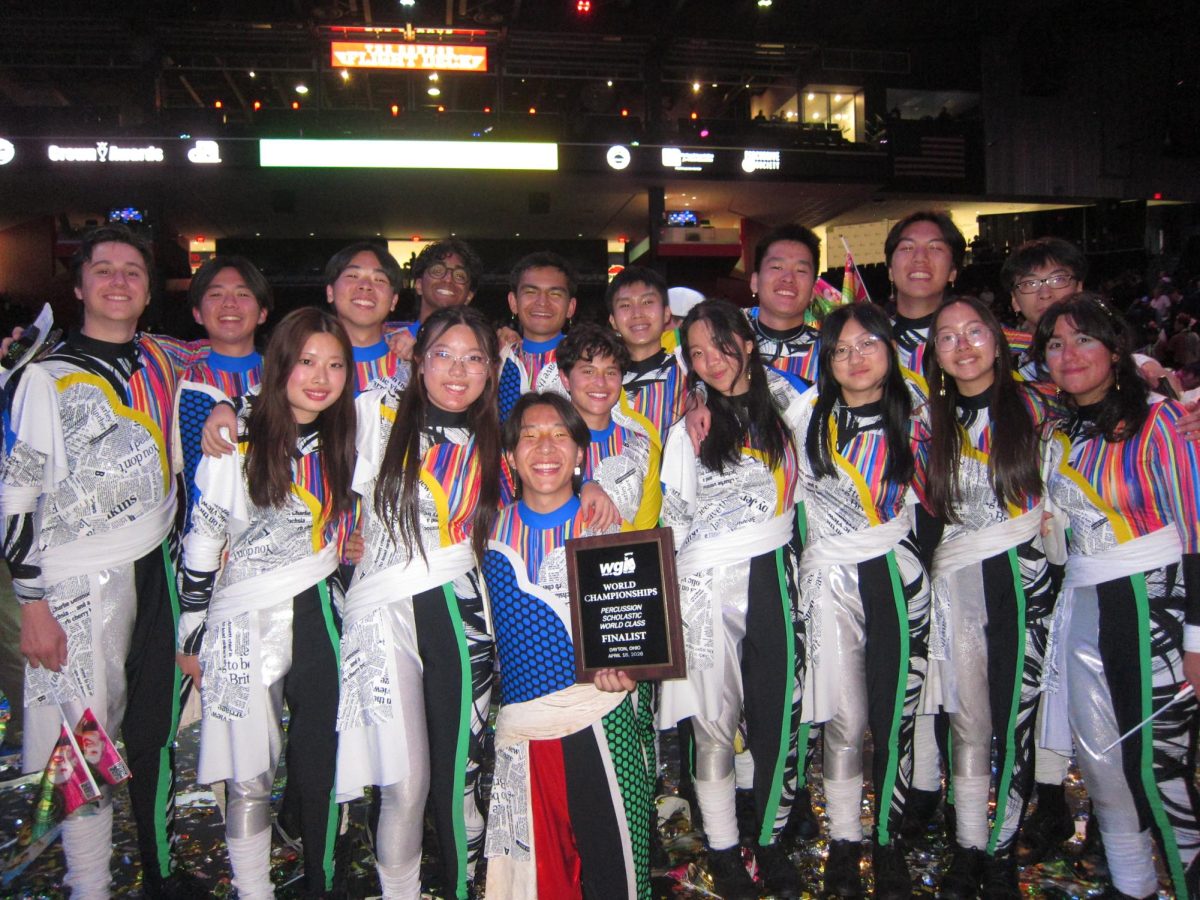
The arena is most often used for collegiate basketball games like the NCAA First Four, but between 6:06 and 6:17 p.m. on April 18, the floor belonged solely to the 39 students of the world class winter percussion ensemble as they competed in the finals round of the Winter Guard Invitational (WGI) Percussion World Championships.
6:08 p.m: A mysterious synthesizer melody sets the stage as performers donned in colorful uniforms reveal themselves from the back-left of the stage, where a massive book prop opens. A snare drum solo is joined by an intricate melody played by the marimbas. Slowly, more and more drums add in as the music swells to a climax, before it suddenly stops, clearing the way for a lyrical sample from Frank Sinatra tune:
“Once upon a time, everything was ours.”
Eight minutes later, my career in the marching arts was over.
Coming into high school, I could never have imagined myself in an environment like winter percussion. The prospect of doing essentially a second marching band season — minus all the wind instruments, color guard, and conductors — seemed completely foreign.
Even after joining the group in November of my freshman year, learning to play the vibraphone for the front ensemble, the activity felt just like another avenue in the world of music I was beginning to explore. After I had to miss WGI Finals as a sophomore to attend a national debate tournament, I took a break from the world of marching percussion to focus on my junior-year academics, returning to it only as a senior.
So when I decided to march one last season last November and switch to playing a battery instrument — the marching bass drum — I saw nothing more than an opportunity to make some final memories with my closest friends.
For dozens of hours every week starting in December, we learned and rehearsed our production, “Those Who Tell Stories,” performing across Northern California at local competitions: From broken-down buses, malfunctioning props, rehearsal spaces covered in geese waste and endless late-night dinner excursions, I got exactly the memories I wanted. But my experience ended up affecting me far beyond what I could have expected.
As an activity, the marching arts are unusual in that even at their most elite levels, they are made up of performers no older than 22. More importantly, every show, every ounce of effort poured into affecting an audience and reaching perfection, ends with the last show.
For four months, “Those Who Tell Stories” fit perfectly into these limitations. Our show explored the ways in which storytelling — in its physical, oral and visual forms — can shape the world, bringing people together and capturing what fades.
And on the night of our final performance, with blood, sweat and tears pooled on the 90-foot-wide floor we performed on, these ideas became our reality.
6:10: The front ensemble is on the floor now, holding megaphones and grooving out to a medley of Kimbra’s “Settle Down” and John Cage’s “Living Room Music” alongside the visual ensemble. Each battery section is featured; the audience erupts after the bass drums complete their moment.
The book prop moves center stage, and dancers come out from a gap within the pages. Frank Sinatra’s “Once Upon a Time” scores an emotional ballad; the cymbals play delicate rhythms as two soloists join each other in a waltz. The battery, having taken their drums off, enters the stage with roses as the front ensemble blissfully erupts into melody.
The tenor drums move center-stage, playing an intricate, mixed-meter feature while the visual ensemble captures photos across the floor with disposable cameras. The focus shifts toward the snare drums, then the basses; the audience explodes into applause after an extended isolated moment.
The entire ensemble explodes into their final melody. The audience is on their feet. The battery plays their last note. The drummers make their way to center stage as the book closes.
Lyrics from Lauv end the show: “The story never ends.”
We carry our floor out the same 100-foot-long tunnel, dumping it on the concrete to fold it one last time. The front ensemble hurries past us, making their way to our equipment trucks to load up for departure.
Our directors — Sean Clark and Chavadith Tantavirojn — call us over for a final talk. I’m surrounded by family — some of them I’ve known for months, some of them I’ve known for over a decade. Tears are streaming down our faces; hugs are being exchanged.
I can’t help but stare at the red brick wall in front of me.
On one side, months of effort, exhaustion, frustration, anxiety and joy begin to fade into memory — a story told one last time echoes faintly in the humid air.
On the other side, another story has only just begun.
