





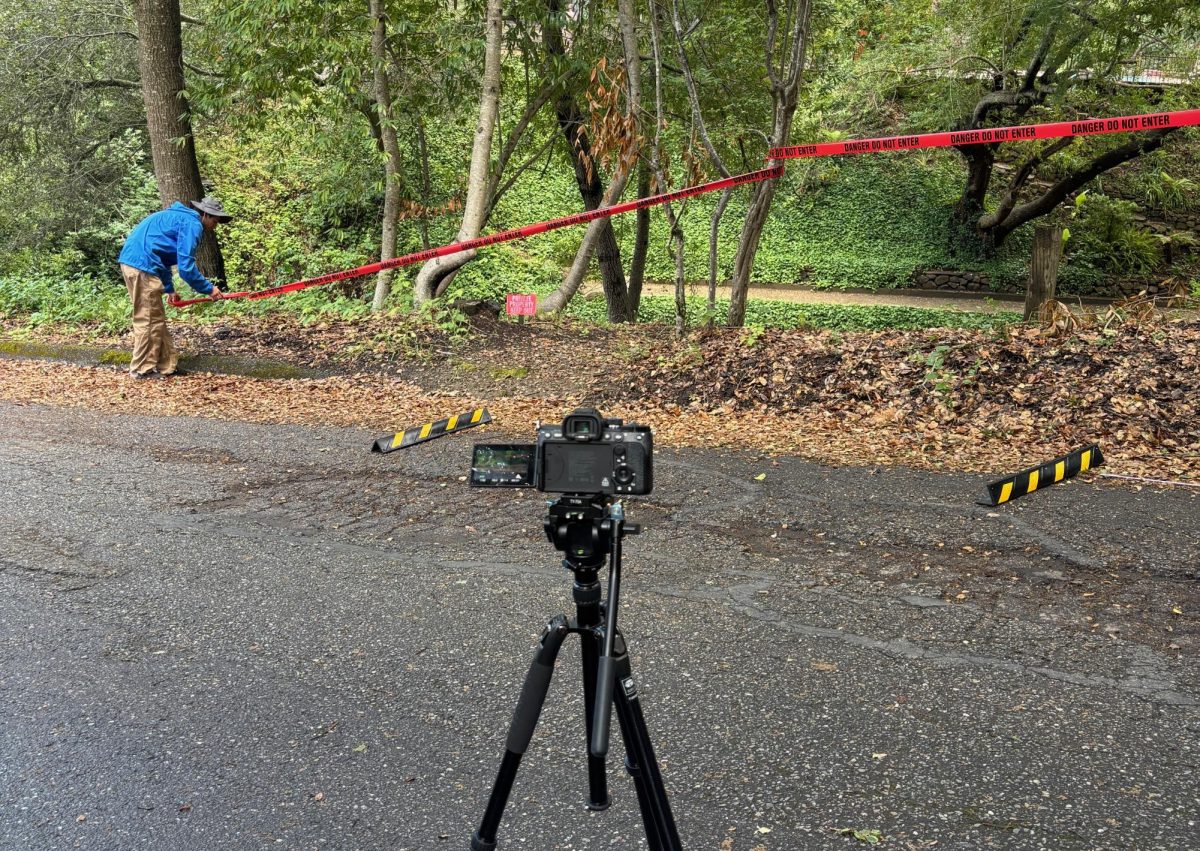
One year ago, senior Anjali Sahni’s group sat and watched a group of seniors’ “Love Sick” short film, where the protagonist ends up killing her crush. Inspired, they knew that they wanted their Capstone project to end leaving their audience unsettled. From there, they crafted their entire project around building up to the final moment of murder by shaping the plot, characters and visuals to lead up to it.
Every year, at the annual Saratoga Film Festival SMASH’N, groups of senior students eagerly await the announcement of the best Capstone project: a year-long project where groups of five can choose to produce any creative film or multimedia project with the skills they’ve accumulated in MAP. The most common type of capstone project, a 10-minute narrative film, challenges students with filming, lighting, audio and other technical skills. Not only does the project challenge students in the technical aspect, but it also pushes them to think creatively through tasks such as scriptwriting.
“This project has been different from our previous big projects like our junior year American Story project because the filming process has been a lot longer; it means that we can focus more on pre-production and post-production, instead of trying to cram everything in for a close deadline,” Anjali said. “But because we have increased time, the teachers expect more so we really have to push ourselves.”
Anjali’s group, which includes senior director Mindi Hendley, chose to tell a story that is equal parts thriller and emotional drama. In their film, Anjali plays one of two childhood friends whose bond slowly fractures as they grow older and in different directions. In a dramatic conclusion, the increasingly unstable friend acts on her suspicions in a moment of panic, accidentally killing the person who once knew her best.
Though it took the group a while to figure out the plot details, they had their ending planned out long before filming.
Mindi noted that filming techniques matter almost as much as the plot. Their group particularly focused on keeping continuity in lighting and experimenting with technology such as a gimbal to create stable tracking scenes.
Other groups, such as Alex Sinton’s, also opted for a thriller film. They drew out suspense through flashbacks that slowly revealed what really happened between two friends who experienced a car crash.
Alex’s group got their inspiration from films that changed the color grading and aspect ratio during flashbacks. Color grading, Alex explained, is manually adjusting the tones of each hue to create a cohesive aesthetic for a film. They chose to make their flashbacks a purple hue to contrast the base tone of their film, which was green.
“One of my favorite moments was on the roof and we were filming our ending scene. Our actors [group members Lucas Hawthorne and Nik Srivatsa] started going off script and having a genuine argument about how to pronounce ‘Jamal Murray.’ We thought it was so funny we decided to use it as our closing scene,” Alex said.
Though the majority of groups choose to do a 10-minute fictional film, Orion Tamas Kings’ group took up the option to create a video game. Rather than storytell through film, they created a different immersive experience. Their game follows a ragtag group of kids who accidentally wander into an ancient dungeon and find the relic to open the path to get up to the surface.
“Doing a video game comes with its own sets of skills and challenges. Unexpectedly, something our group quickly realized is it’s hard to show off our work during checkpoints, [so] we had to condense our game and all its mechanics into a short video to showcase the nuances of the film for the teachers,” Orion said.
Some of the skills Orion’s group tried to highlight in their showings were 3D modeling, level design, game design programming, networking, sign design and so much more. Their group chose to use the programming language C# for its versatility.
Whether it was working through mistakes in lines of codes or spending hours trying to find the best lighting, the senior Capstone project has pushed students to truly be original and persevere through the inevitable difficulties.
“Honestly, all the challenges and work we had to go through only made it more gratifying in the end,” Orion said.
