
























The New York Times, founded in the mid 19th century, is well-known for its Pulitzer-winning journalism, but among Gen Z, it has gained recognition for something else — its daily games.
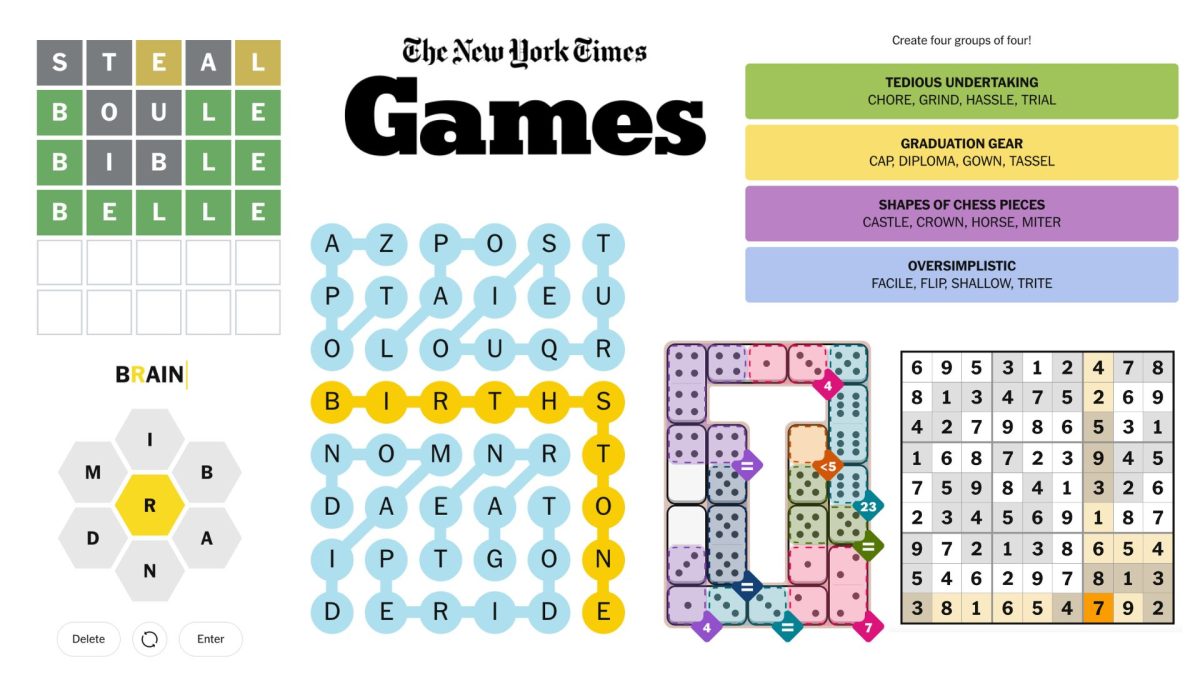
Although some games such as the Crossword are behind a paywall, there are six games that are free-to-play: Wordle, Connections, Spelling Bee, Strands, Pips and Sudoku. I play most of them daily, and each one provides its own kind of fun.
Wordle is a short and simple word-guessing game
Every morning when I wake up, the first NYT game I open is Wordle. After seeing my friends play the game in 8th grade, I have played it every day since.
Wordle presents a new five-letter word for players to guess in six tries. With each guess, information is revealed about the answer word: Letters turn green if they are in the correct position, yellow if they are in the word but in the wrong position and gray if they aren’t in the word at all. There is also a keyboard showing every letter and their color, with letters not guessed yet remaining unhighlighted.
Wordle strategies are fascinating. One strategy is to use common letters early on to solve the word in as few guesses as possible. Some use “ADIEU” to get four vowels, but it has been proven to be more effective to get common consonants from a word like “SLATE.”
Wordle also has a “hard mode” where yellow and green letters found in previous guesses must be used in all subsequent guesses. In this mode, solvers must get more creative to avoid losing by carefully choosing words that eliminate as many other words as possible. I don’t play with this extra twist, but many others do.
The social aspect of Wordle makes it much more fun. My brother also plays Wordle daily, and we share our results once we both finish it. It is also fun to see how the general population fared against the daily word through the Wordle Bot. Although Wordle Bot is behind the paywall, I can watch Wordle YouTubers such as Rangsk to see how everyone did.
Wordle also provides a streak of successful solves. My current streak is 96 solves and my best streak was 145. Although I have had my streak snapped a few times by obscure words such as “GOFER,” Wordle always provides good fun.
Rating: 4.5 out of 5 Falcons
Connections provides an enjoyable mental workout
The next NYT game I have added into my routine is Connections. In this game, players must group 16 words into four groups of four related words. Players must correctly guess the groupings with fewer than four mistakes. Solvers are also informed if their guesses are one word away from being a correct grouping. The difficulty of the categories are ordered from easiest to hardest by color: yellow, green, blue and purple.
The categories can range from synonyms to trivia and clever wordplay. For example, an easy category could be “synonyms for running” and a difficult one could be “starting with dog breeds.”
There is also often a red herring, a group of words that are related but are part of different categories. This promotes the strategy of figuring every category out before submitting anything and entering them from hardest to easiest, a solution known as the “reverse rainbow.”
Just like Wordle, I share my results with my brother. There is also a paywalled Connections Bot that shows how players did on the puzzle, also accessible via YouTubers.
I’m not very good at Connections and have a 40% solve rate. Still, it can be quite fun and satisfying when I get it correct.
Rating: 4 out of 5 Falcons
Spelling Bee is a fun word-building game but isn’t fully available to free players
In Spelling Bee, players are given seven letters with a yellow letter in the middle. The objective is to create as many words as possible using those letters, with the middle letter being required. The game uses a point system, and longer words reward more points. These points go toward levels of achievement for each puzzle, from Beginner to Genius.
Spelling Bee is a fun game, especially when searching for long words and pangrams (words that use all seven letters). Even when I’m stumped, I still enjoy staring at the letters for the eventual epiphany.
However, for free players like me, the Spelling Bee gets paywalled after reaching the Solid rank, the fourth rank out of eight ranks, meaning free players never get the full experience.
Rating: 3 out of 5 Falcons
Strands is an interesting word search game
Strands is a word search game where players connect any adjacent letters together to form words that follow a given theme. If players get stuck, they can get hints by finding non-theme words greater than three letters to reveal hints. There is also a special “spangram,” a word touching both ends of the grid that usually explains the topic.
Strands is an enjoyable game when the topic is familiar to me, in which my goal is to solve it without using hints and finding the spangram first. However, it can become a hassle when the category is niche or if a few obscure words are included.
Rating: 3 out of 5 Falcons
Pips is an entertaining domino challenge with three difficulties
In Pips, players place dominoes on an irregular grid to satisfy constraints placed on squares or groups of squares. For example, one constraint could require one square to be a four and another could require a pair of squares to sum up to less than five.
There are three difficulties: easy, medium and hard. Players aim to solve the puzzle as fast as possible. For me, easy puzzles usually take around 20 seconds, while medium puzzles can take anywhere from 30 seconds to four minutes and hard puzzles can take several minutes, with some even being too hard for me to solve.
Pips is an enjoyable strategy game that’s perfect for when you have five to 10 minutes of spare time.
Rating: 4 out of 5 Falcons
Sudoku: my least favorite NYT game
Lastly, there is Sudoku. This challenging numbers game also offers three difficulties of easy, medium and hard. The goal is to fill a 9 by 9 grid so that every row, column and 3 by 3 box contain the numbers 1 through 9. Easier puzzles have many prefilled numbers while harder puzzles only have a few numbers on the board at the start.
Sudoku is a game filled with strategies, from simple ones like row-scanning to various complex strategies like the X-wing strategy, where solvers remove possibilities when two rows and two columns lock a number into a rectangle pattern. Sudoku also allows you to highlight “candidates” on empty cells so you can jot down possible numbers.
After trying it out, I realized it is not my favorite type of game. I spent almost 20 minutes on the easy puzzle and ended up giving up on the medium puzzle. There are many people out there who love Sudoku. I’m not one of them.
Rating: 2.5 out of 5 Falcons
Like all engaging time wasters, NYT free games provide a lot of fun every day. It always feels nice to solve a Wordle in three or fewer guesses or to perfectly solve a Connections puzzle. Even if I do poorly, I still find enjoyment in seeing other players’ results. Although it’s a bummer that some NYT games like the famous Crossword puzzles are paywalled, the free games are still enjoyable and have become a cornerstone of my daily routine.
Overall rating: 4 out of 5 Falcons