
















Tricks like somersaults, backflips and twists are hard enough to do on land, but sophomore Katie Lee is daring enough to attempt them 3-meter-high, mid-air, before diving into a deep blue pool of water. In a sport that may often leave competitors with bruises and painful injuries, Lee thrives as an artistic diver.
Lee was inspired to start diving when she tried using a diving board at a friend’s birthday party at age 9. With the encouragement of a classmate, Lee started the sport the summer after seventh grade. Now, she regularly attends practice for the Stanford team at the Stanford swimming pool 2-3 times a week, participating at competitions once a month. She is not on the school’s swimming and diving team.
“Like any sport, there’s challenges, and can be really frustrating especially when you can’t do something, like a dive,” Lee said. “But it’s also very rewarding to try something and then have it come out pretty well.”
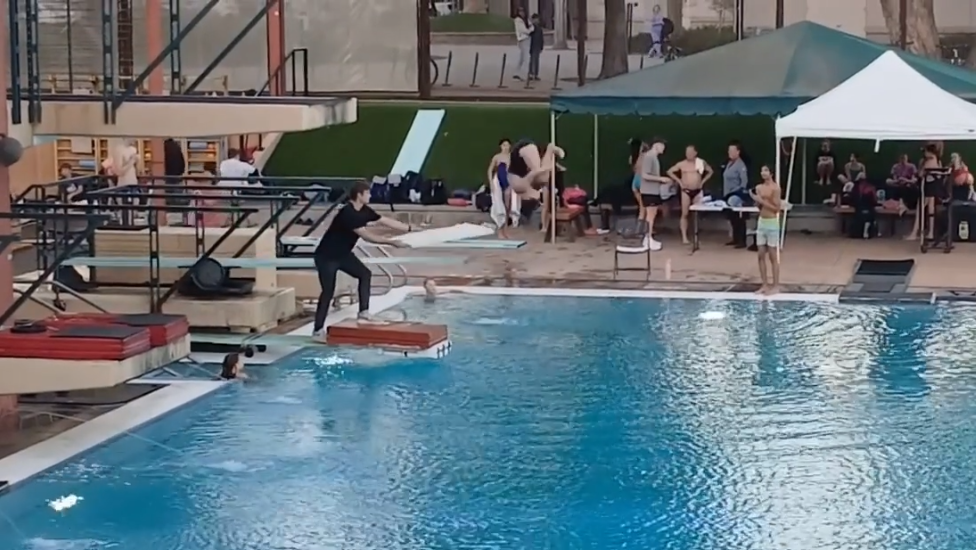
Since the commute to Stanford takes about 30 minutes, Lee travels directly to the swimming pool after school. At practice, her team first starts by doing stretching and conditioning, which includes exercises for core strengthening and handstands. Then, they practice their dives on dry boards, which are diving boards on land. After these exercises, she goes into the pool.

When learning a new dive, Lee said she first attempts the move on land. Divers are put into a harness which Lee calls the “Belt” — a spotting rig — which the coach uses to pull divers up in the air to practice their rotations. Then, they practice the dives into a foam pit. For safety, diving headfirst is allowed only when the Belt is used; if not, the divers have to dive feet-first.
Once her coach approves each dive, Lee attempts the dives in the pool. To cushion the impact, her coach turns on the Sparger system, a diving training tool that injects high-pressure air into the water directly below the diving platform to reduce the water’s surface tension and increase the comfort of entering.
Depending on its intended height and complexity, the time it takes to master a dive can greatly vary, she said.
Lee has become comfortable with many dives, including the 103C, 402C and 101C. A 103C is a forward one-and-a-half somersault in the tuck position, a 402C is an inward somersault in the tuck position and a 101C is a forward dive in the tuck position.
She often practices “inwards,” which is where the diver stands on the edge of the board facing away from the water and rotates forward, reverses, takes off and rotates backward toward the board. The dives usually take place on 1-meter and 3-meter boards, but 5-meter, 7-meter and 10-meter boards are also used.
At competitions, divers only have one attempt per dive, but they are required to dive in all four directions: forward, backward, inward and reverse. Along with the basic dives, there are also optional harder dives for divers to attempt. Divers are judged on their takeoff, their moves in the air, their entry, whether their toes are pointed and how tight their tuck is.
Despite her passion for diving, Lee admits that it can be dangerous and frightening, especially on first-dive attempts. She recalls diving in the foam pit and coming out with a small dent in her head. When she “belly flops,” which is common when learning new dives, bruises tend to form on her legs.
“When you’re doing a new dive and you hit the water, it hurts, and you could potentially hit the board, which would also hurt,” Lee said. “There are also a lot of unknown factors, and it’s a very short amount of time to do everything, so it’s scary, especially when you’re tired, you’re even more scared.”
Lee’s experience with the sport is starkly different to playing basketball, her main sport before she took up diving.
“In basketball, if you miss a 3-pointer, nothing happens. However, if you do something wrong on a dive, even if it’s not your first time doing it, things can happen and it hurts,” Lee said. “It can also cause a mental block, since it is really hard to try it again because you’re scared of landing badly.”
She plans to continue to dive next year, especially since she recalls how diving has helped her put her life in perspective. It has helped her be braver and more perseverant.
“Some practices are really bad, and you don’t know why your dives aren’t going in well, but you have to get back up after you fail and keep diving,” Lee said. “When I’m standing on the diving board, I always tell myself, ‘Never back down, never give up!’”
