




























In the age of artificial intelligence, numerous concerns about developing technologies, such as loss of creative jobs, training on stolen data and unethical use, have risen.
One of the foremost concerns is AI’s environmental impact. Each ChatGPT prompt uses 0.34 watt-hours, which adds up with the billions of prompts constantly inputted worldwide. It is estimated that data centers use 415 TWh (terawatt-hours, equal to one trillion watt-hours) annually, around 20% of which is from AI.
Although this seems like an astronomical amount of power used, it isn’t actually that much. Annually, the world uses around 29,000 TWh, so AI makes up less than 1% of global energy consumption. Also, for the average person, AI uses less power than many other aspects of life — for example, a book takes about 2.5 KWh to produce, equivalent to thousands of AI prompts.
Critics point out how AI also uses considerable water for data center cooling. With each prompt using 0.3 mL of water (not a bottle of water, contrary to popular belief), AI is projected to use more than one trillion gallons of water by 2027.
In some ways, this is a shockingly high number, but it isn’t as much as it sounds when compared to some other sources of water consumption.
For example, 1.7 trillion gallons of water per year are used from showering in the U.S. alone, with the average person consuming 5,336 gallons of water per year for showering. The average person can save much more water by taking shorter showers than cutting down on AI use.
Regular household water leaks consume more than 1 trillion gallons in the US alone. This number could be reduced drastically if people were more careful about water leaks.
Looking at the big picture, the world uses 4.3 billion cubic meters of water per year, which equates to 1.136 quadrillion gallons of water per year. Even when only considering industrial water, which makes up 20% of global water consumption, AI water use still consists of less than 1% of the water footprint.
Nevertheless, even if AI does have a measurable environmental impact, its utility, just like books, is immense.
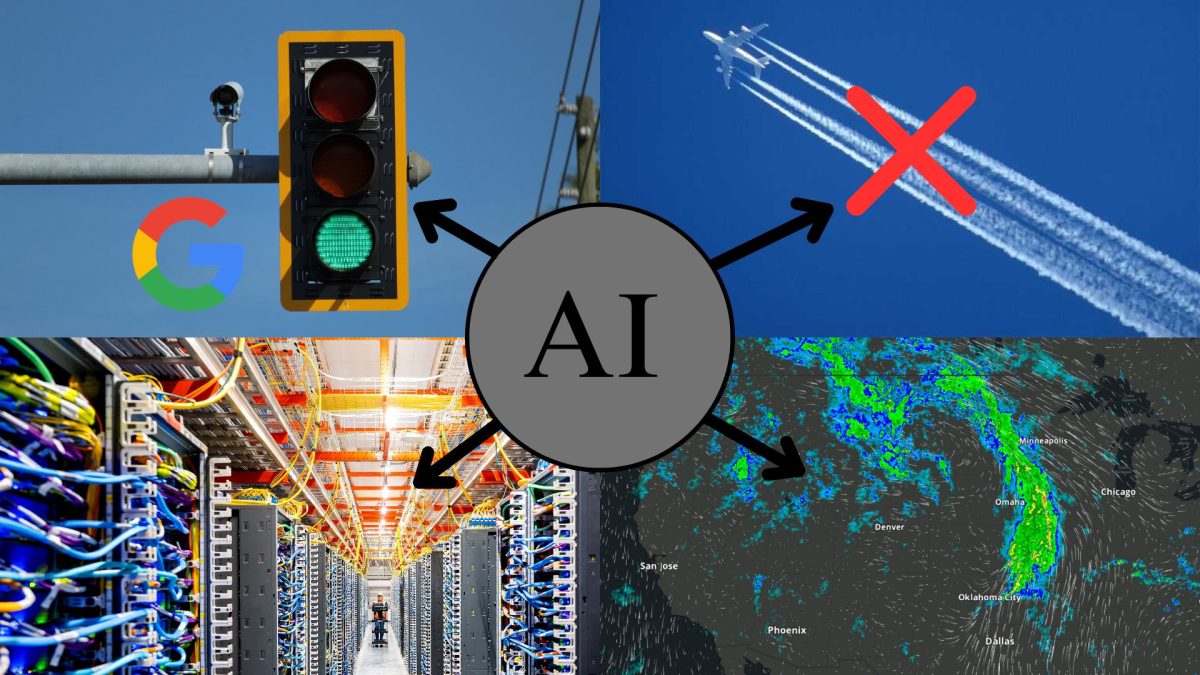
And companies are also addressing environmental concerns. Google is currently piloting many AI-driven programs to independently help the environment. Project Green Light helps optimize traffic lights to reduce vehicle emissions, fuel-efficient routing helps drivers save money and fuel; Project Contrails uses AI to reduce contrails, airplanes’ condensation trails, which account for 35% of aviation’s global warming impact, by 54%, and much more.
In many fields, AI is also the most energy-efficient way to make breakthroughs. For example, in weather forecasting, AI can produce faster, more accurate and energy-efficient predictions. AI can also be used to predict weather extremes and earthquakes more accurately.
In the future, AI energy use is projected to continue to increase; however, with enough effort, the environmental impact of AI can be reduced — for instance, Google’s DeepMind AI has reduced data center cooling energy by 40% by using historical data center data to train a more efficient and adaptive framework to understand data center dynamics and optimize efficiency.
All things considered, AI is not yet the earth-ending monster many critics claim it to be. There are still many elements in people’s lives that consume much more energy than AI — and in fact, AI might just be the solution to many of our environmental woes.