















Five years ago, I would have never thought that 64 squares and 32 wooden (or digital) pieces would end up shaping the person I am today. As a game with near-infinite possibilities, fascinating strategic options and fierce competition, chess has attracted and addicted millions of devotees, including me. Over the years, I’ve taken this hobby to another level, and it’s taught me so many valuable life lessons.
My interest started in fifth grade when my parents brought out a chessboard. I found the game quite fun and played with my younger brother for a while before moving online to chess.com, where I could play with anyone around the world. After a few months, I was able to secure an intermediate rating of 1300. Most newbies start out below 1000, and advanced players have a rating of 1800 or more.
To improve at chess, I watched dozens of instructional videos, learned valuable tips on openings and worked through complex chess puzzles. Chess puzzles present specific chess positions where solvers must find the only good move or move sequence, helping solvers practice tactical patterns. Chess.com also has a Daily Puzzle.
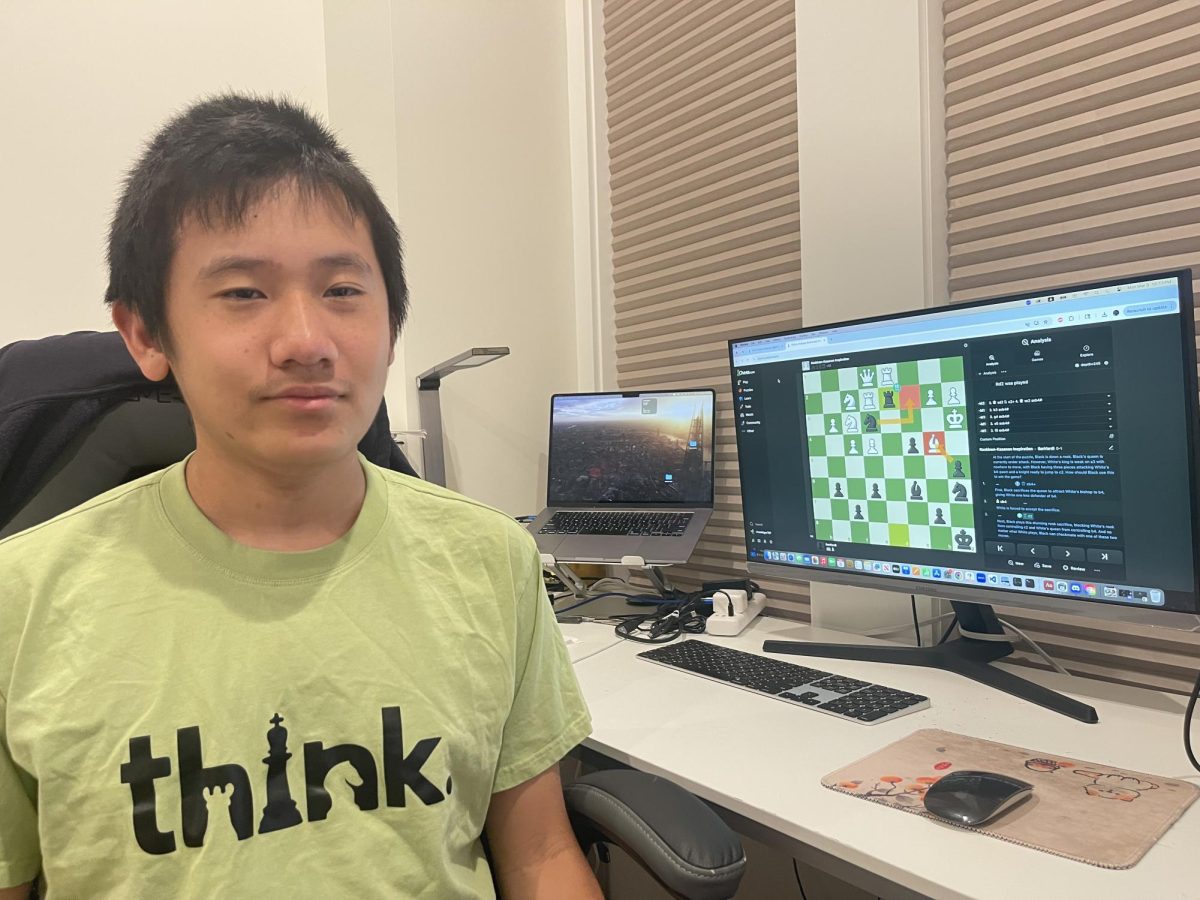
One day, I did the Daily Puzzle and read through the comment section. I noticed one person created a nice analysis of the puzzle with an attached chessboard with annotations explaining every move, as well as showing why other moves don’t work. This comment ended up gathering a lot of upvotes.
I decided to try it out for myself and started to make my own analyses of Daily Puzzles. I found that these were actually pretty fun to construct. I ended up earning many upvotes as well, and because I was still pretty young, I felt happy and motivated to keep analyzing puzzles.
However, the comment section could also turn also pretty spammy, with many people posting discouraging comments. Eventually, a user invited me to a small online club he started where users can discuss the Daily Puzzle without encountering any trolls or spam.
As many more people joined this club, the number of Daily Puzzle analyzers increased. I discussed my successes and failures solving the puzzles with the club members, and in this small community, we all learned from each other. I also eventually started blogging my Daily Puzzle analyses, and many people started sending me friend requests.
However, in the middle of 6th grade, I put my hobby on pause when I fell prey to addictive online games. These games ended up taking up my free time, which left me less interested in chess. I ended up being much less active in the club and the Daily Puzzle comments, and I was only doing the Daily Puzzle and playing my Daily games — games that give players a few days to make moves.
Luckily, in the middle of eighth grade, I lost interest in all the mobile games I played and ended up going back to chess. A unique opportunity soon presented itself: I learned that people could now send chess puzzles to a National Master named Dane Mattson to be used as a future Daily Puzzle. (A National Master is a player who has reached a rating of 2200.) Multiple members of the club had been able to create Daily Puzzles, so I decided to give it a shot.
To create a puzzle, I start with an idea of a puzzle layout, whether from one of my games, one of my brother’s games, one of my past puzzles or just pure imagination.
Then, I use the chess engine Stockfish to ensure that there’s only one unique solution to the puzzle, editing the position until I am satisfied. Then, I post my puzzle on my blog and send it to Mattson. Eventually, my efforts paid off, and some of my puzzles became actual Daily Puzzles. This means a remarkable 1.5 million solvers have tackled each one.
This hobby of creating chess puzzles has given me many fun experiences — I always feel rewarded when I create a really interesting puzzle, and I get dopamine boosts when I find out that today’s Daily Puzzle is one I created.
Outside of the fun and satisfaction the hobby provides, it has also taught me many valuable life lessons.
These days, I’m no longer doing this work for attention or upvotes — I’m now doing it to help many other people improve at chess. I realized that other members of the club were clearly analyzing puzzles for the love of the game instead of individual recognition. This taught me the general life lesson that attention-seeking for its own sake is almost never a good path.
Furthermore, I’ve learned to ignore trolls instead of responding to them, since they thrive on evoking angry responses. This also carries into my general school life, where I have learned to ignore those with bullying tendencies and people who make offensive comments just for attention.
I have also inspired many people to create and analyze puzzles. One time, a member was confused about a puzzle and asked a question in the comment section, but he was attacked by a rude member. I stepped in and told him to ignore the insults, reinforcing the friendly community surrounding Daily Puzzles. Now, he is one of the best puzzle analyzers in the community and is very supportive toward other newcomers.
To this day, I’ve published 18 Daily Puzzles, with more to come: I’m still creating and analyzing as much as I can. Although this hobby can distract me from studying, it is far more productive and less addictive than the mobile games that hook many of my peers. For anyone who is looking for a new hobby, give chess a try because it’s a fun, complex and infinitely rewarding game.