A welcoming fruit stand is nestled within Novakovich Orchards selling delicious fruits and nuts.
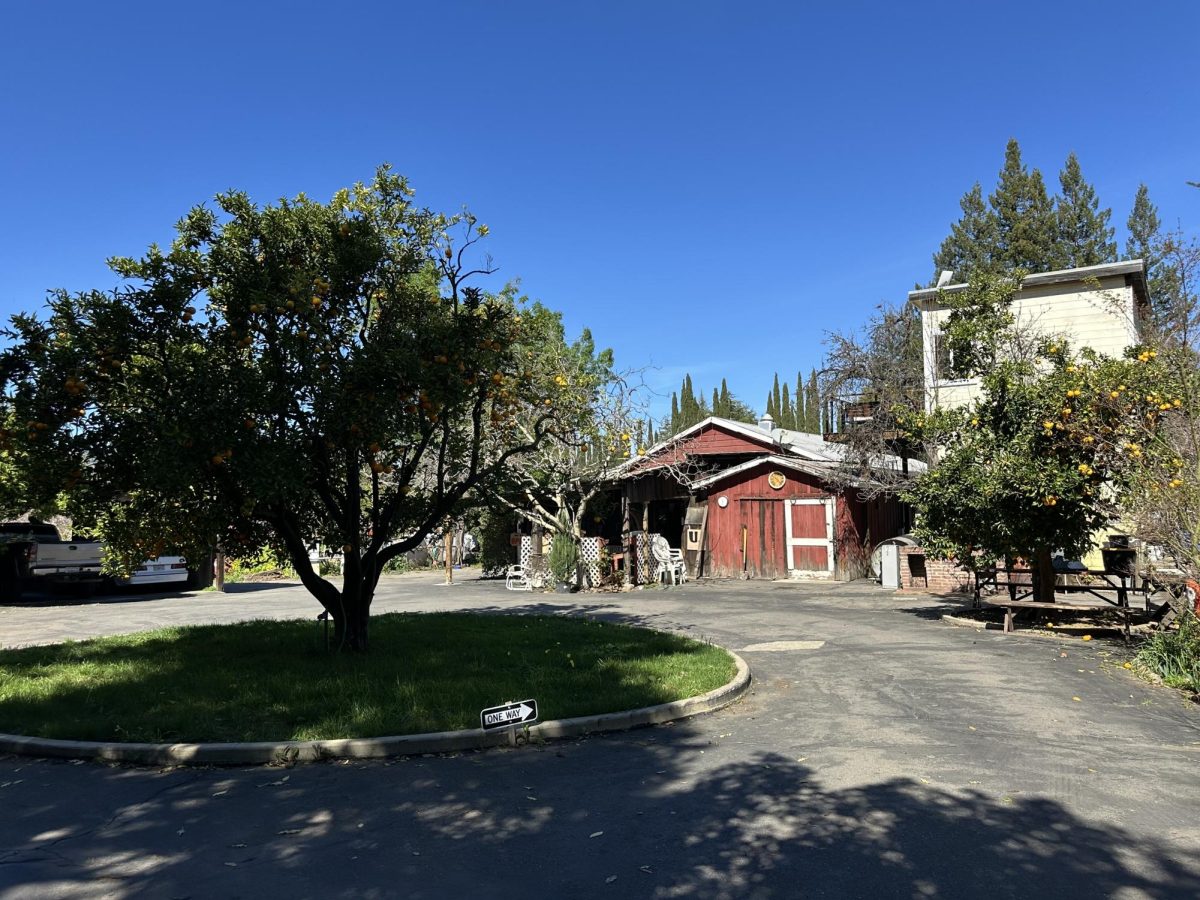
Tucked away along Fruitvale Avenue, a simple sign with the words “Novakovich Orchards” points to a sanctuary hidden beyond a narrow cement driveway. There, a cherry blossom path leads to a cozy fruit stand filled with delicious dried fruits and seasonal produce, a rustic barn, dry yard and an idyllic expanse of orchard that reveals a glimpse of Saratoga’s rich agricultural history.
In the early 20th century, newlywed immigrants Mary and Matt Novakovich left their farms in Yugoslavia, a country known for its cattle and plum orchards, in search of new opportunities in the U.S. The couple traveled through Argentina and Nevada before making their way to the California gold mines.
In 1925, the couple eventually arrived in Saratoga, where the farming industry was thriving due to the town’s optimal weather. For a bag of gold dust, the couple purchased 23 acres of land that would become Novakovich Orchards, an orchard committed to producing a high-quality fresh and dried fruits supply to the entire U.S.
Initially, Novakovich Orchards specialized in producing stone fruits, or fruits with a pit at their center. In the ’80s, it also began offering dried fruits, nuts, jams, jellies and chocolate-dipped fruits. The farm’s handcrafted staples — grown, harvested and processed in the orchard — quickly became sought out by customers as gifts for any occasion.
Story continues below advertisement
When the Novakoviches first moved to Saratoga, agriculture was a big part of the town’s culture, with most of the town’s land having been used as fruit orchards and farms since the 1860s. Saratoga was also a small lumber town powered by water wheels in Saratoga Creek. The town specialized in tree products such as lumber, paper and cardboard due to the abundance of redwoods in the area.
This all began to change in the middle of the last century, said assistant principal Matthew Torrens, a former history teacher who has given walking tours of the city to students.
“With the rise of the defense industry during WWII, many companies popped up that required degrees instead of experience on a farm such as aerospace, computers and technology,” Torrens said.
During this period of modernization — the 1940s to 1960s — Saratoga’s land usage changed drastically. New homes, schools, shopping centers and other buildings were built in place of fruit orchards (including Saratoga High in 1959 on the site of a former plum yard).
Few growers held on to their land, but one of them was the Novakovich family.
Ideas from the newest generation to take the farm into the future
For Lynbrook alumna Emily Novakovich, a fourth-generation member of the family, helping out on the farm has been a treasured part of her childhood. After graduating from college with a major in marketing, she often returns home to be more involved in the family business with hopes to use her skill set for expanding outreach activities.
“I would be over the fruit stand, helping out and whatnot. It’s always been a joy to do that and I think it’s a blessing that I’ve had growing up,” Emily said.
Throughout the year, members of the family work cohesively to ensure the orchard operates smoothly: Emily’s uncle George Novakovich Jr. manages the business and does tractor work; her father Dan Novakovich handles cleanup and maintenance and her uncle Matt Novakovich covers responsibilities involving the fruit trees. Additionally, the family hires a few workers to help pick and sort the fruit, enabling the orchard to be fully functional with around 10-20 workers on a yearly basis.
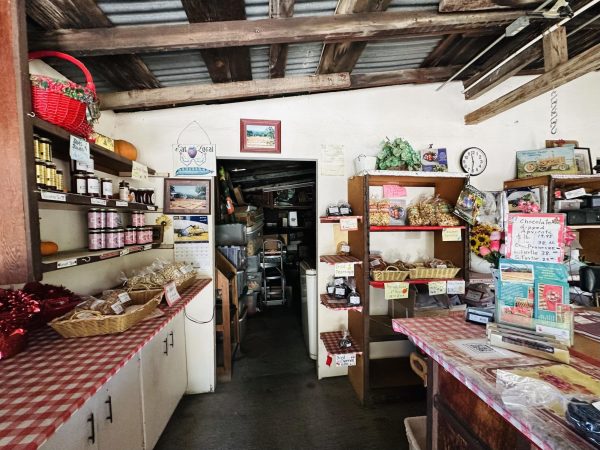
The shelves of the fruit stand hold seasonal goods throughout the year. (Kayley Ren)
The orchard produces a rotation of fruits throughout the year, including cherries, apricots, pears, prunes, peaches and nectarines. From January to May, the orchard’s trees are dormant and don’t produce any fruit — the family uses this period of time to tend to the trees and prepare for the next season.
From March to April, the cherry trees begin to blossom and a wide variety of cherries are ready for harvesting by May.
After the cherries, Santa Rosa plums and Blenheim apricots are in season, followed by French prunes and numerous types of peaches and nectarines. A portion of apricots are saved in the summer for drying and chocolate dipping; by the start of the holiday season, they are ready for gifting.
The orchard assembles its premium fruit products in various gift boxes that vary in quantity and size. For example, one of their bestsellers, “Santa’s special,” contains Chocolate-Dipped Apricots, Fancy Apricots, Super Trail Mix and Raspberry Jam. Their “Market” box contains Fancy Apricots, Smoked Almonds, Apricot Jam and Chocolate-Dipped Apricots. The prices for the boxes range from $35 to $109.
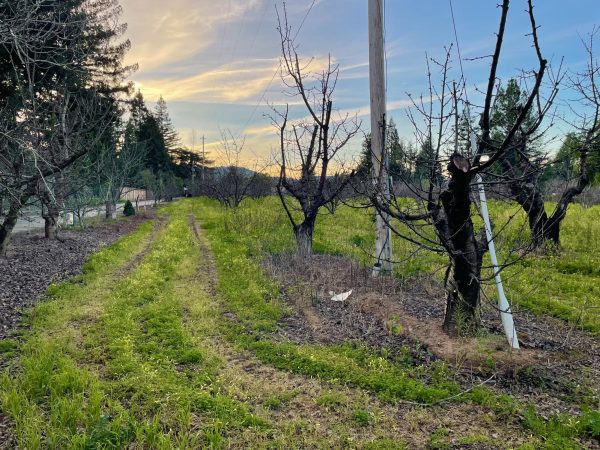
Neat rows of fruit trees line the Novakovich orchards. (Kayley Ren)
One of the main challenges that impact the orchard is unpredictable and changing outdoor conditions. First, there are the challenges of weather-related issues such as droughts, floods or extended high temperature days. Then, there is the problem of mitigating pests such as gophers.
Despite these challenges, the Novakovich family’s business has endured through the decades. Even during the pandemic, Emily Novakovich noticed that business did not slow down — if anything, business might have even been better. With many people wanting to go outdoors after long periods of staying at home, the orchard became a popular destination for families looking for a place to get some fresh air.
Though 10 of the 23 acres of original land were sold to develop West Valley College, the family proudly continues to nurture the last remaining commercial orchard in Saratoga.
For the family, the orchard means much more than just a piece of land — it represents a land of heritage and a symbol of agriculture.
“There’s a lot of respect, understanding and learning of the experiences of how much goes into taking care of that orchard and producing fruit,” Emily Novakovich said. “I think [the orchard] creates a good idea of what goes into farming, so people know how much work it takes to get fruit into the grocery stores that we eat everyday.”
Throughout the orchard’s long history, the business has remained fairly unchanged, primarily focusing on fruit production. To open opportunities for the business in the future, Emily Novakovich hopes to expand the orchard’s outreach and marketing activities. Although the orchard is already open to a couple of tours, she has ideas to host activities like pumpkin patches, Christmas tree farms, or even potentially turning parts of the property into a venue or a farm-to-table restaurant.
“Eventually, I would love to have [the orchard] invite people to come hang out more and for them to really enjoy the property. I definitely want [the orchard] to be a venue at some point,” she said.
Her ideas are still in the planning stage, but she hopes to eventually be able to bring changes to the orchards within the next 10 years.
“I want people to be able to go and enjoy the fresh fruit and gain an understanding of what this valley used to be like,” Emily Novakovichi said. “I don’t want another orchard in this area to disappear, so I’m trying my best to make sure that I can continue on the legacy.”
Kayley Ren (she/her), Class of ’28, is a reporter for the 2025-2026 school year. Kayley has covered topics such as new teacher profiles and summer sports training. Outside of journalism, she enjoys reading books, fencing, and watching comedy movies.
Donate to The Saratoga Falcon
Your donation will support the student journalists of Saratoga High School. Your contribution will allow us to purchase equipment and cover our annual website hosting costs.
It’s wonderful that Emily Novakovich is formulating a plan that will continue her family’s farming tradition. It’s a beautiful spot and will help preserve Saratoga’s histor, too.
Chocolate apricot turtles are a rare treat! Delicious!
i love this story kayley!! it was very fascinating to hear about the novakovichs’ story; the fact that a bag of gold dust led to a community treasure is so sweet. i’ll have to get some jam soon 🙂

















! • Mar 11, 2026 at 9:36 pm
It’s wonderful that Emily Novakovich is formulating a plan that will continue her family’s farming tradition. It’s a beautiful spot and will help preserve Saratoga’s histor, too.
Chocolate apricot turtles are a rare treat! Delicious!
Ananyasri • Mar 11, 2026 at 3:07 pm
i love this story kayley!! it was very fascinating to hear about the novakovichs’ story; the fact that a bag of gold dust led to a community treasure is so sweet. i’ll have to get some jam soon 🙂