











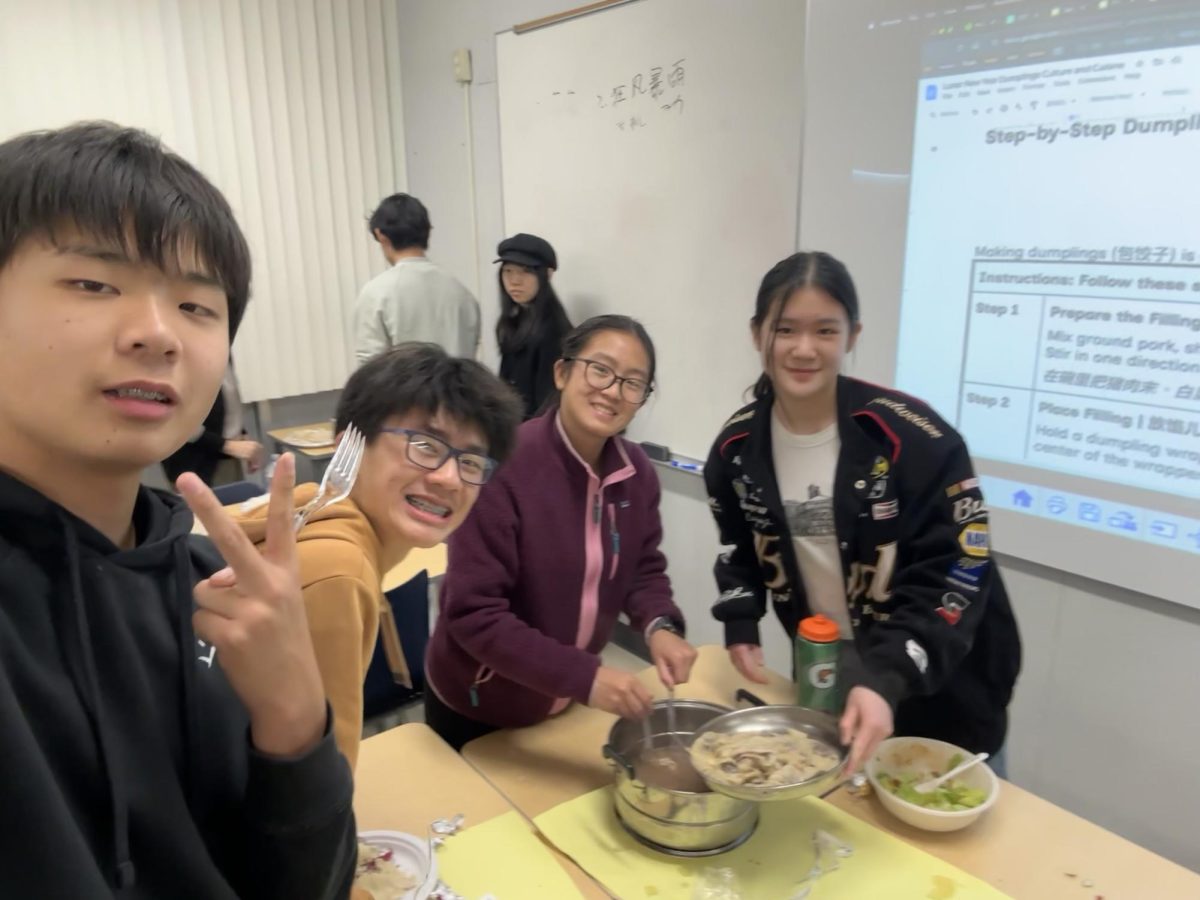
Courtesy of Max Wong
Sophomore Max Wong, Daniel Zhang, Claire Hou and Chelsea Liang with their dumplings.Smells of flour and dough wafted through the AP Chinese classroom on Feb. 9 as engaged students delicately folded dumplings. Amid the lighthearted atmosphere, students laughed as futile attempts were made to salvage the torn dumpling skin, only to result in more damage.
As part of a yearly Lunar New Year unit, AP Chinese and Chinese 3 teacher Sara Tseng incorporates dumpling-making in her curriculum. Days before the activity, students learn about Chinese New Year culture through traditional learning methods, such as reading texts and completing worksheets. Then, presented as a “reward” for the students’ hard work, Tseng announces the fun, hands-on activity.
“My classes made dumplings because I wanted them to learn about what the dumplings symbolize, which is prosperity. Students practiced food vocabulary, teamwork and cultural traditions,” Tseng said. “It also sparked a great cultural conversation as there’s no single ‘right’ way to fold dumplings. Just like families, [every student] has their own style.”
Students are told to bring their own items — pots, pans, utensils, plates, dumpling skins and any type of filling. On the highly-anticipated dumpling-making day, Tseng gives students basic folding instructions. Hot water from a water cooker and a hot plate are provided, and students start folding.
Sophomore Yaryar Chen decided to make dumplings with a homemade filling of cucumber, pork and onion. Along with learning about Chinese tradition through the Chinese New Year celebration, she learned practical aspects of dumpling folding.
“I learned how if you boil your dumplings for too long, they’ll get mushy and it’ll be really hard to pick up with your chopsticks,” Chen said. “You also need to make sure you cover up all the sides of the wrapper, so the fillings don’t leak out.”
Through trial and error, she found the perfect filling to dumpling skin ratio.
“Once, I decided that my dumpling had too little filling, so I decided to grab a whole scoop of filling,” she said. I shoved it in, and my wrapper exploded, and there was filling all over the table.”
Sophomore Chelsea Liang also enjoyed the event. Her group decided to make chocolate dumplings due to the easier preparation and the unique take on dumplings.
She enjoyed the freedom of learning how to prepare the dumplings with minimal instructions.
“We had a tutorial and we had to figure out ourselves, so it was a good hands-on activity to experience,” Liang said.
Despite her group’s vision to recreate Din Tai Fung’s Chocolate Xiao Long Bao, they slightly missed the mark. While the dumplings tasted “decent,” she thought they lacked Din Tai Fung’s clean aesthetic, as the chocolate was leaking out in the pot.

(Claire Hou)
Even though both students had setbacks, they enjoyed the day: Chen relished cooking with her friends, while Liang appreciated the unique learning experience.
“This activity was pretty different because in most classes, you’re not cooking with a pot and hot plate,” Liang said. “It was really fun. We worked together and figured out how to make dumplings.”
For sophomores Isaac Ho and Elaine Che, one of their favorite moments was cutting up dumpling wrappers to create noodles.

Tseng treasured the activity as well. While she was concerned about allergies, sanitation and time constraints, she loved seeing her students happily eat their creations.
Next year, Tseng plans to bring more filling and wrapper, incorporate more folding practice and try to prevent fewer accidents like exploding dumplings.
“Although messy, the joy of making mistakes and having fun are the point of connecting with culture,” Tseng said. “Students also remember vocabulary better when it’s tied to food and laughter.”

Noodle Maker • Mar 6, 2026 at 3:08 pm
Those are some fire noodles.