















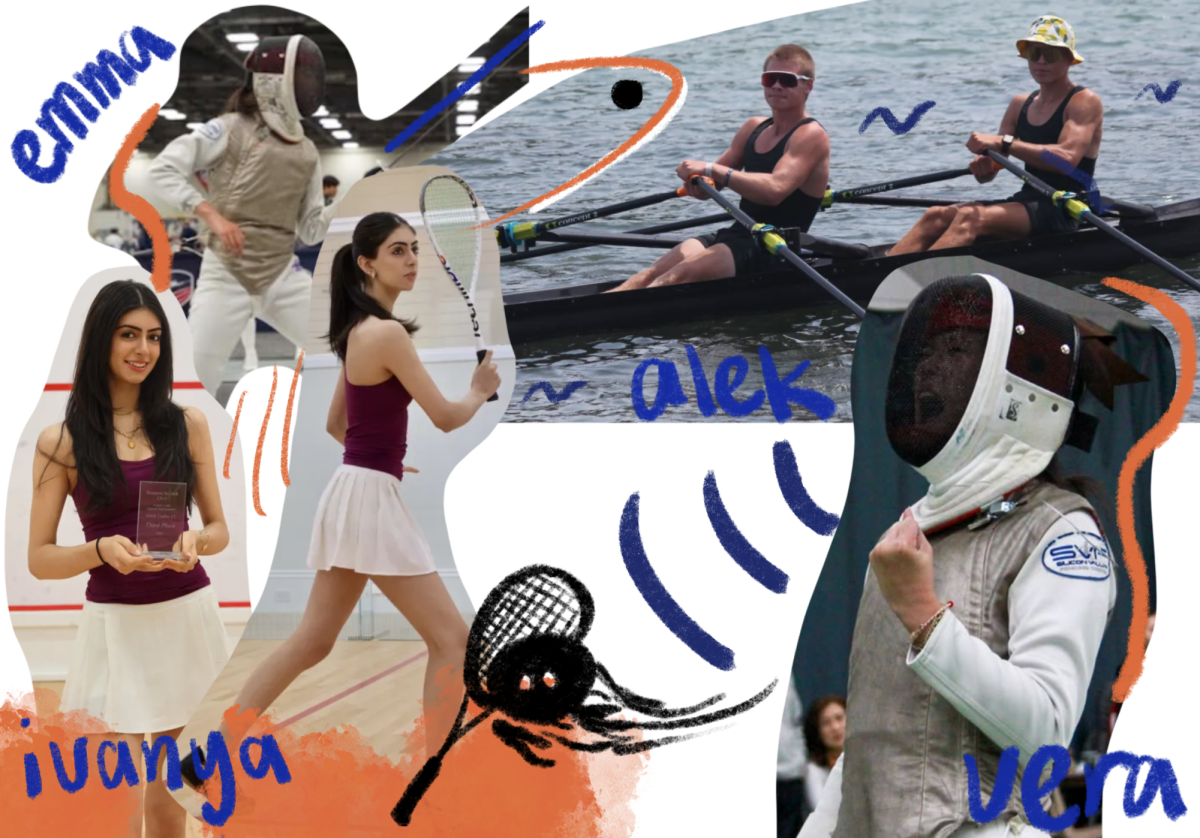
When junior Ivanya Sadana picked up a squash racket at age 10, she had no idea that the sport would come to fill up a good chunk of her future. After all, only around 0.02% of the world’s population plays squash competitively.
Less traditional sports like squash, rowing and fencing are also known as niche sports because they draw far fewer participants than mainstream sports like soccer, football and basketball. This smaller pool of athletes allows competitors like Sadana to have more college recruitment opportunities than they would in a mainstream sport.
College and Career Center adviser Sierra Ward said up to 25% of some colleges’ admitted students are recruited athletes — providing an additional motivation to become skilled at a sport that doesn’t have as much inherent competition.
Statistics gathered from official college rosters show the odds of a U.S. male high school athlete getting to play NCAA Division I in college for a less popular sport such as lacrosse is much higher than a more popular one like soccer. For lacrosse, it’s 32:1, while for soccer, it’s 108:1.
Still, there aren’t that many spots open for scholarships and recruitment opportunities, so student athletes who want to be scouted for a sport, niche or not, almost always have to take matters into their own hands by reaching out to recruiters.
Squash star’s journey
Sadana has been playing squash since fourth grade. While she used to play basketball and tennis, whole seasons were canceled due to the pandemic, which played a large role in her decision to pursue squash.
During the pandemic, squash facilities were open, so she started practicing more and applying herself more seriously to the sport, and she eventually realized how much she enjoyed it.
“I like going to tournaments and meeting people in squash,” Sadana said. “After a hard training session, I feel good about my performance and that’s what makes me keep pushing myself.”
There are not many squash facilities in the West Coast compared to the East Coast, making it more difficult to train and improve. Because of this, a coach has to come to a nearby area, usually a Bay Club facility, and train about 20 people by themselves.
Sadana said she has been able to persevere by finding a strong passion and continually pushing herself past her limit, currently ranking 35th in the country for her age bracket, under 17 (U17).
Still in elementary school, Sadana said it took her a few years to learn about the idea of being recruited for squash, and she only began considering it seriously in her sophomore year.
“At first, I started getting more serious about squash just because I really liked it,” Sadana said. “About a year after I got into the sport, I realized that I could have a future alongside academics with it.”
Squash is not an official NCAA sponsored sport, but there are organized collegiate teams governed by the College Squash Association (CSA). Only 30 U.S. colleges, including all eight Ivy League universities, have varsity squash teams, but Sadana has not yet decided on aiming for a specific college.
Throughout her recruitment process, Sadana, who intends to be a pre-med major, has reached out to coaches and talked to them throughout the year as they watched her performance. Right now, she is open to any opportunities and hoping to find the right fit.
Elite rower advances fast
Junior Alek Shetler was first introduced to rowing through the positive experiences of his older brother, Class of ‘24 alumnus Leo Shetler, who rows for Berkeley’s DI men’s rowing program.
He started competitively rowing at the Los Gatos Rowing Club in eighth grade. With practice six days a week, Shetler alternates between working on ERG machines, which are exercise machines to work on rowing out of water, and rowing on actual boats in water.
“Rowing was a really weird sport at first, but I thought it was fun because you got to be in the water,” Shetler said. “Later on, it got really grueling and tiring, but that has helped me progress by pushing me past my limits.”
Shetler has since continued rowing and has progressed far, winning first in both the Canadian Henley Race and the Head of Charles Race and making the Youth National Championships twice with his team in 2024 and 2025. This past summer, Shetler’s boat was ranked sixth in his age group, U17.
“Not many people do rowing, so I feel like it is really good for getting into colleges, and I think I have a really good shot at it,” he said. “Rowing also helps me stay fit.”
Shetler had previously done swimming competitively and played baseball, but rowing stood out to him as he could feel the work put into practice and see his individual progress clearly.
Shelter is currently talking to UC Los Angeles and Harvard University rowing coaches, among other elite universities, presenting his ERG scores and race results. He hopes to go DI in rowing if given the opportunity.
A fencer’s experience as a freshman athlete
There are three levels in the NCAA: Divisions I, II and III. The intensity of the commitment an athlete puts into a sport depends on the level they play at.
DI is the highest level for the sport — it has a strong focus on nationals competitions, requires large commitment but also provides more athletic scholarships. DII is more balanced, with both regional and national levels. DIII prioritizes academics for a well-rounded student athlete.
For example, Class of ‘25 alumna Emma Fung is attending Wellesley College for DIII fencing while her twin sister Vera is fencing at Brown University. Emma Fung thinks excelling at a niche sport doesn’t necessarily help one get an edge into college, especially in lower divisions.
Fung recalls that the admission process for Wellesley’s DIII fencing placed equal emphasis on high performance both in academics and sports, as she was still expected to reach the same educational standards as other non-athletes to be accepted.
“In the way that other people apply with extracurriculars to boost their application, fencing was pretty much my extracurricular,” Fung said.
In comparison to DI sports, DIII sports focus firstly on academics. According to the NCAA website, the goal of participating in a sport is to learn valuable skills that can improve academic achievement. Alongside keeping up her academics, Fung started emailing fencing coaches in her junior year to look for recruitment opportunities.
According to athletic director Rick Ellis, the process that goes into recruiting for lower profile sports is typically initiated from the student and their family, rather than college recruiters the way it would be for a sport like DI basketball or football.
“Unless you are a five-star athlete in your sport, it’s hard to wait for colleges to come to you,” Ellis said. “It’s really on families to start that process, especially since the less mid-major sports are not in the limelight.”
Students start recruiting at different times in their high school experience but Ellis believes that the earlier students start, the better their outcomes are. Students reach out to colleges and show videos of them playing the sport — as well as their GPA — to demonstrate their skill level. A strong GPA can not only give coaches confidence that you will stay eligible once in their program but also give students a wider variety of schools to choose from.
For most sports, with niche sports included, college recruitment opportunities vary based on where athletes are located. For example, squash recruitment tends to be higher in the East Coast, so it is recommended for West Coast athletes to contact recruiters and attend camps there. Similarly, most rowing camps, clubs and college teams can also be found primarily in the Northeast.
The statistics behind recruitment for different sports
Niche sports include — but are not limited to — squash, rowing, fencing, rugby, wrestling, field hockey, lacrosse, swimming, diving, sailing and water polo due to being high cost and specialized. According to counselor Brian Safine, the percentage of SHS student athletes from 2016 to 2025 recruited for niche sports was around 29% out of a total of 108. This percentage of recruited athletes roughly matches the national estimate of 27% of Americans participating in a niche sport.
For a private university such as Stanford University, roughly 33% of athletes play niche sports. This is significantly higher than public schools like UCLA, where roughly 26% of all athletes participate in unconventional sports.
That being said, private universities generally tend to offer more niche sports through offering a greater variety of sports instead of enlarging the common ones. For example, the top 32 private universities educate 1.8% of all students but enroll about 6% of all athletes. However, the top 50 public universities educate about 20% of all students but enroll only 8% of athletes.
When leaning toward private universities, a student’s chance of getting in may increase if they play a sport, specifically a niche sport, because of the higher athlete-to-student ratio with applicants being spread across more sports. However, public universities generally have fewer sports to offer, so academics may be more crucial for a higher chance of getting in.
Students who play niche sports aren’t necessarily doing it just for college recruitment, but rather for a deeper enjoyment for the sport at the next level. They each still must meet similar requirements as other popular sports. It’s never too late to consider playing a new sport, and recruitment can be a great chance for students to attend a dream school.
“I’ve known students who didn’t even know they had athletic talent, but then discovered sports in ninth, 10th or even 11th grade,” Ward said. “All of a sudden, they were being recruited and admitted to dream colleges that never would have worked out if they hadn’t been an athletic recruit.”

