














Offering over 150 different course options, the school prides itself on the course selection provided to its roughly 1,100 students. Part of that variety comes from the flexibility of course difficulty: AP, Honors and regular class levels are spread out throughout the course catalog. However, these classes typically do not interact, having different pacing, homework loads and curricula.
In a couple of cases, though, Honors, AP and regular class curricula are combined into one period — and teachers have found ways of making the combination work.
MAP AP U.S. History (APUSH) and MAP Regular U.S. History (RUSH)
MAP APUSH and MAP RUSH students are taught together in a combined class that blends the two curricula, a system that has been used for over 10 years.
APUSH students face a greater course load that is geared more towards preparing for the AP exam, such as learning how to answer short-answer questions (SAQ) and long-answer questions (LAQ). Additionally, they are met with a larger homework load, as they must learn more of the course content outside of class.
“It’s harder [teaching a combined class], but I think it’s better for the students,” history teacher Mike Davey said. “I think the regular US History curriculum is way better — APUSH is too broad, too much cramming.”
Although creating and organizing different homework loads for the two curricula can be a challenge for teachers like Davey, the combined classroom setting also allows students to interact with a larger range of peers.
For some regular class students, the class may feel slightly harder through the mixed environment with higher in-class expectations for AP students; however, teachers take care to make the curriculum similar to non-combined periods.
“In general, I like [the combined classroom environment],” RUSH junior Kaitlyn Cheng said. “It feels like I’m learning with a more diverse group of students.”
AP Environmental Science (APES) and Environmental Science
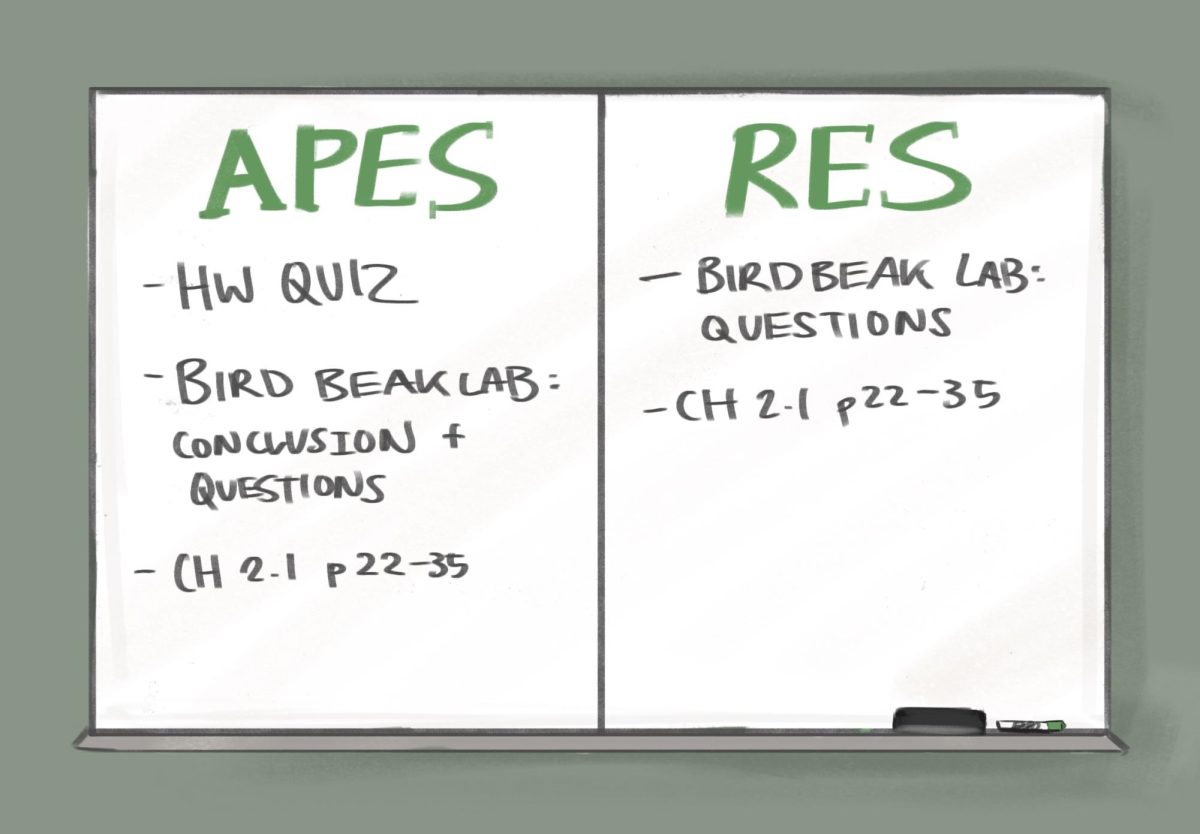
For four years, both AP Environmental Science (APES) and regular Environmental Science (RES) have been taught by science teacher Kristen Thomson. The two courses contain the same content and activities — the only difference is the homework load and how the students are assessed. Through all four years, there have only been 2-3 regular students per class period.
For students who aren’t taking APES, the problems they are assigned are simpler and they have the option to work together in groups. Meanwhile, APES students are required to complete more challenging problem sets and assignments on their own. Even though RES students are able to earn full credit on homework quizzes simply by taking notes, AP students must take graded quizzes.
Despite the differences between APES and RES, Thomson noted that teaching both groups together keeps the course accessible, as her goal is to give all students a chance to learn.
After years of teaching the class in a combined format, Thomson would not change how the class is designed, noting how students enjoy having the option to drop to RES or move up to APES depending on how they feel, without needing to change their schedule.
All in all, though managing a combined class can be challenging for teachers, the consensus between both students and teachers is the same — combined course level classes offer greater flexibility for student schedules, offer a more diverse range of classmates and allow for a strong learning experience.
