










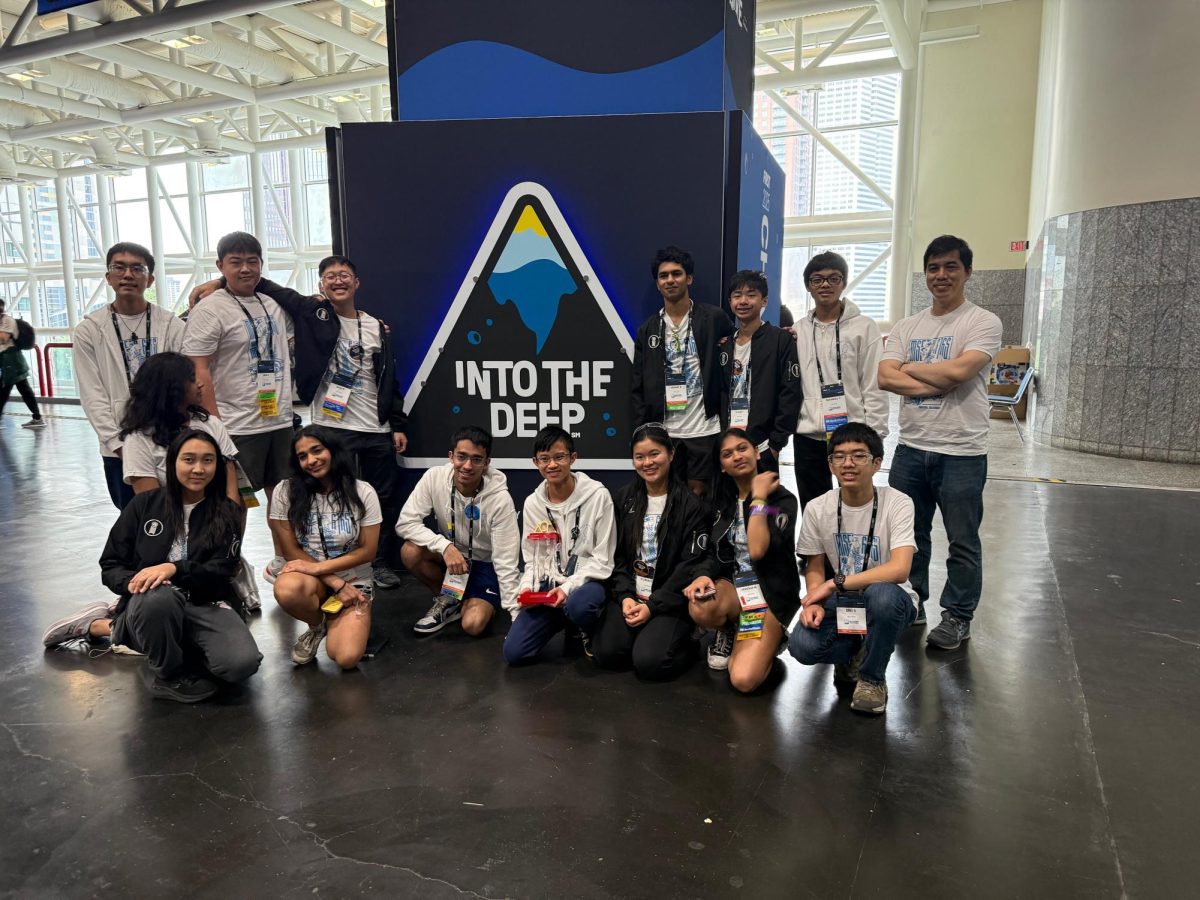
In April, the 6165 Cuttlefish team competed at the First Tech Challenge (FTC) World Championships for the fifth time in their history and performed better than ever before. That level of success was especially satisfying to their longtime mentor, Anh-Quan Nguyen.
In 2016, Nguyen began coaching in MSET after his oldest son joined MSET Jellyfish — that same season, the team qualified for the FIRST Regional Championships through a lottery system.
“That week, I had a Hawaiian vacation scheduled, and then Diane France (a head referee at FTC) called me saying we were going to get into regionals. I asked, ‘What is regionals?’” Nguyen said.
The team qualified through their detailed engineering notebook and the Think Award, which required thorough documentation and innovative designing, traits that Nguyen would reinforce as he continued coaching.
Despite the team placing last at that competition in 2016, for Nguyen, that level of competition was an eye-opening experience. He saw how much potential the program had to improve.
Said Nguyen: “I stared at my fellow coach, and he was just shaking his head. He said, ‘Oh they did so badly, they placed last!’ I told him: ‘Of course they were last place. Next year we’re gonna dominate.’”
Nguyen was proven right; the following season the team was the captain of the winning alliance at their first qualifier and the recipient of the Inspire Award, qualifying for regional championships once again. Similar to the Think Award, the Inspire Award was based on a formal presentation, engineering notebook and a well-designed robot.
Away from this volunteer position, Nguyen also is a doctor and holds two main jobs. He serves as a Medical Director for Cardiology Service Line at the Palo Alto Foundation Medical Group as well as an Associate Medical Director for the Bay Area Anticoagulation Clinic, also part of the Palo Alto Foundation Medical Group.
For his education, Nguyen majored in Molecular and Cell Biology with a neuroscience focus and Psychology at UC Berkeley for his undergraduate degrees. He then went to UC Irvine for four years of medical school, did three years of internal medicine residency at Mayo Clinic, did a three-year cardiology fellowship at the Texas Heart Institute at the Baylor College of Medicine and finished with a one-year Interventional Cardiology fellowship.
Nguyen struggles at times to manage both his regular day jobs and his robotics mentoring role, but does so by finding support in the systems he works in. In his directorships, he finds people he can collaborate with easier. As a cardiologist, Nguyen trains his staff, nurses and medical assistants so that they are highly competent. Similarly, in robotics, Nguyen relies on fellow mentors and the students he trains for support.
In his second year, Nguyen and a couple other mentors noticed that certain Cuttlefish and Jellyfish students would work extremely hard compared to their peers. At the time, it was also regular for FTC students to transfer to the First Robotics Challenge (FRC) program after one or two years — FRC was a larger team and had more success.
In response to these trends, Nguyen and the other mentors shifted their focus toward ensuring that members were equally committed, establishing rookie teams for those who couldn’t devote as much time to the activity.
As a result, by his third season, over half the Cuttlefish and Jellyfish team stayed on FTC, and starting that year, all veteran members were placed on Cuttlefish. That season, the Cuttlefish qualified for FTC World Championships for the first time in school history.
More than mentorship: Nguyen hopes to build lessons for life
In total, the MSET program has around 10 adult mentors, most of whom help FRC. However, while the Cuttlefish team gets help from some parents for organizational purposes, the team itself primarily relies on Nguyen as its sole mentor.
As an adult mentor, Nguyen said his goal is to help students build excellence in every aspect of robotics: technical skills such as software coding, hardware construction as well as soft skills such as community outreach and public speaking.
“I don’t care if we lose a match as long as we play our best game,” he said. “This year at regionals we didn’t win finals, but we played our best game for that moment. We didn’t make any errors — the other team just outplayed us — and that’s OK, it’s an honorable defeat.”
One key skill Nguyen always emphasizes involves teaching students the importance of making a good pitch. He claims a lot of success in such work over the years. He’s seen students who lacked the confidence to speak in front of a group go on to deliver commercial-style pitches with eloquence.
Nguyen also focuses on leadership training, meeting with student leaders to coach them on integral team-management skills, ranging from Plan-Do-Study-Act cycling or dealing with different personality types.
Nguyen currently has a daughter in the program, sophomore Ainsley Nguyen, who is also on Cuttlefish. Previously, his 20-year-old son, Cameron, and his 25-year-old son, Brandon, have also been part of MSET. While Ainsley is Nguyen’s last child to join the program, he doesn’t plan to quit mentoring anytime soon.
Through all his work, Nguyen’s favorite part of the process is seeing his seniors reach new heights in their last year.
“This year, seeing the seniors having a chance to go to the World Championships was amazing to me,” Nguyen said. “I love seeing my juniors and sophomores win as well, but I’ve grown up with the seniors and this was their last year.”
