





























Courtesy of IMDb
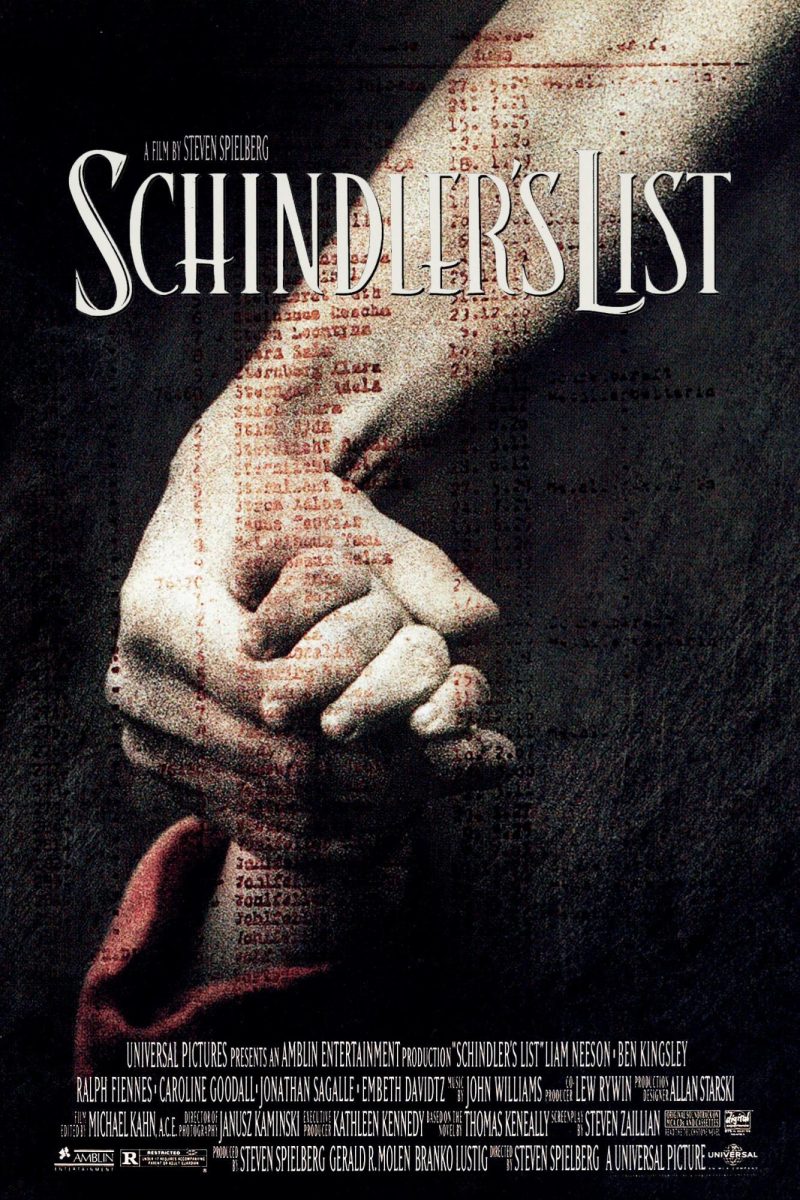
Movie poster for “Schindler’s List.”World history teacher Mike Davey’s class tends to be fast-paced. The class is almost consistently an entire unit ahead of other classes, and each class is jam-packed with information. But for three whole periods of world history, we watched a movie instead. And, while it was a different experience than scribbling down lecture notes, it was just as informing and impactful.
With an impressive 9/10 rating on IMDB and 98% positive reception on Rotten Tomatoes, “Schindler’s List,” a 1993 historical war drama, was directed and produced by record-breaking director and SHS alumnus Steven Spielberg, who has won three Academy Awards. It is also consistently ranked among Spielberg’s best works, competing with “Jaws,” “Jurassic Park,” “ET” and “Saving Private Ryan.”
But “Schindler’s List” is much more than just another action film. Focusing on the survival of persecuted Jews during World War II, this movie contains dark themes of anti-semitism, dehumanization and the corruption of power that depicts the reality of the Holocaust.
Based on a biographical novel by Thomas Keneally, the movie follows the true story of Oskar Schindler, a German businessman and member of the Nazi party, and the 1,200 Jews he saved with his fortune. While the movie is about just one story of survival during WW2, it presents a wider theme of resilience, redemption, dehumanization and love to the audience.
Artistically directed and filmed, the whole movie is intentionally set in black-and-white, with a few scenes in color that immediately catch the viewers’ attention and symbolize the innocence and vulnerability of the Jewish people during the Holocaust. The acting was outstanding — even for the minor characters — and this was a career-altering film for many actors and actresses such as Liam Neeson, who played Schindler, and Ralph Fiennes, who played Amon Goeth. Both gained Academy Award nominations for their performances.
Schindler is introduced as a flawed man. He proudly wears the Nazi emblem on his shirt, drinks, gambles and frequently cheats on his wife. Seeing WWII as a business opportunity, he seeks out the help of the Jewish accountant Itzhak Stern — played by Ben Kingsley — to set up an enamelware factory for the military. He hires Jewish people not because he feels empathy for them, but because they are cheaper than Polish workers. This sets the stage for Schindler’s eventual character development arc.
Spielberg then introduces Amon Goeth, a Nazi prison camp commandant, Schindler’s business partner and a representation of the worst evils of the Nazi party. Incredibly racist and borderline psychopathic, Goeth frequently shoots Jewish prisoners from his balcony as a leisure activity. Rather hypocritically, he falls in love with a Jewish girl named Helen Hirsh and makes her his maid, but his twisted ideals cause him to beat and abuse her, creating several scenes that feel like a gut punch.
Arguably the worst part about him is that most of his character — his random and uncaring shootings, abuse of his maid and thoughtless sadism— is historically accurate. To survivors of the Holocaust, his name is synonymous to death. Still, Spielberg gives depth to this character through interactions with Schindler and Helen, showing how war and dehumanization brings out the worst in people.
Meanwhile, Schindler realizes that Aryan lives are no more precious than Jewish lives as he interacts more with the Jewish people, especially Stern. What starts as a get-rich-quick scheme of hiring Jewish people becomes a humanitarian effort to save their lives, which the movie centers on.
Throughout the entire 3-hour movie, Schindler never openly admits to helping the Jews despite the kindness present in his actions, perhaps because he knows his real intentions would get him killed. Nevertheless, many in the Jewish community see Schindler’s factory as a haven, where even the SS guards can’t murder them on a whim.
By the end of the war, Schindler has brought 1,200 Jewish people to his factory, all of which he had summoned from camps with lists of names — hence the title. Now a failed businessman, he has spent nearly all the money he earned with the enamelware factory on transporting these Jews out of the camps and into his new bombshell factory in Czechoslovakia, where he makes sure not a single product would be usable by the German army due to its bad quality.
Within the story, there are several other minor characters who add to the personal experiences of the Holocaust: a young girl named Danka and her mother who desperately try to stay together, a Jewish couple that gets married in a concentration camp, a Jewish ghetto that gets completely eradicated and a little girl in red — the list goes on.
Like most movies, “Schindler’s List” isn’t completely historically accurate — several characters and the list of names was exaggerated for dramatic effect. Still, the essence of the story remains true. Not only does it recognize Schindler, who was mostly unknown before the movie, but it also honors the resilience and strength of the persecuted people who suffered during the Holocaust.
These themes are important for people of all ages, but are especially noteworthy for high school students learning about WWII at a time when widespread disinformation and even doubting of the Holocaust are common. This movie teaches empathy and history at once; fostering these ideas will help prevent other genocides from occurring in the future.
From a historical perspective, this movie is not merely entertainment — it’s a tribute to the millions of innocents who suffered and were killed, while doubling as an effective method of spreading awareness.
No doubt, this is a must-watch movie for anyone with three hours and fifteen minutes to spare.
The real Oskar Schindler died on Oct. 9, 1974 at the age of 66 in Hildesheim, Germany. The people he saved, known as Schindlerjuden, transported his remains to Jerusalem for burial in the Catholic cemetery. On his gravestone are the words: “The unforgettable rescuer of 1,200 persecuted Jews.”
Rating: 5/5 Falcons
